In God we trust, all others must bring data”- Edwards Dening
Before reviewing this eye opening book, I want to share a personal experience that shaped how I understand data and its limitations.
While working with the Government of Chhattisgarh, I was tasked with analysing data collected under the One Stop Centre scheme launched by the Government of India in 2015 to provide integrated support to women. The task was far from simple. At the time, there were around 30 districts, so I had to reach out individually to each district coordinator to collect raw data. After multiple follow- ups, the data finally arrived, fragmented, inconsistent, and often poorly recorded.
After days of cleaning, segregating, and analysing the data, I prepared a detailed report with insights, graphs, and recommendations.The Secretary of the Ministry of Women and Child Development appreciated the effort but insisted that I visit a few One Stop Centres myself to truly understand the reality on the ground.
That visit changed everything.
At one centre, I saw a torn register used to record cases. The person documenting them had limited understanding of the nature or severity of the issues. As a result, most cases were categorised as domestic violence, not because that reflected reality, but because it was the easiest label to use. For example, even a disagreement between a mother and a daughter was recorded under the same category. That is when I realised why my data analysis had been misleading. The numbers were accurate on paper but deeply flawed in context.
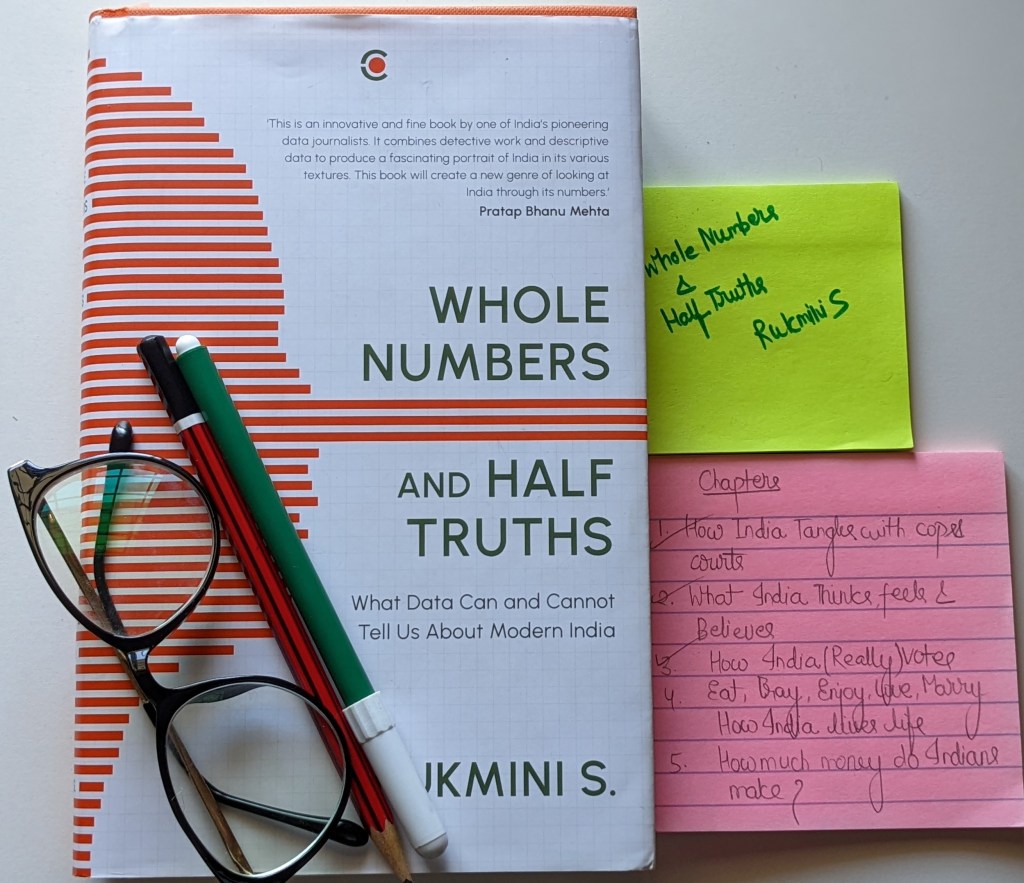
This is precisely what Rukmani S highlights in Whole Numbers and Half Truths. The book articulates what I witnessed firsthand: that data, when stripped of context, empathy, and social understanding, can flatten human lives into misleading conclusions.
Through rigorous research and storytelling, she explores how India really lives, votes, believes, earns, spends, and survives. She examines how the law works in practice, how society functions beneath the surface, and how data when stripped of context can distort reality rather than illuminate it.
The book powerfully challenges dominant narratives often circulated on WhatsApp forwards and casual public discourse. Its most important takeaway is this: data cannot be read in isolation. It must be understood within social, cultural, and political contexts, while also accounting for cognitive biases, both of those collecting the data and those interpreting it.
Rukmini S shows how stories derived from data often reflect the storyteller’s own privileges, frequently reinforcing upper-caste, cisgender, heteronormative perspectives while erasing lived realities at the margins.
Some key insights from the book include:
- Many reported cases involve consenting adults, often linked to inter-caste or inter-religious relationships.
- Indians remain socially conservative, even when they claim otherwise.
- Caste continues to deeply shape social relations and opportunities.
- Marriage within caste remains dominant.
- Women’s participation in the workforce remains low, even among the educated.
- Voting behaviour is complex, polarised yet deeply pragmatic.
- Youth-led change exists but largely at the margins; traditions still dominate everyday life.
- Education and employment outcomes are shaped by structural privilege and oppression.
- Class, caste, and religion intersect in deeply entrenched ways.
- Rural households spend more on cereals, while urban households spend more on eating out.
- Indian workers clock some of the longest working hours globally.
- Urban women most commonly work as domestic workers, while men dominate construction work.
- Son preference continues despite declining fertility rates.
- India is less urban than commonly assumed, and migration is slower and more localised than popular narratives suggest.
- Access to healthcare is deeply unequal, with poorer households often taking loans for medical treatment.
Together, these insights challenge the simplified narratives that dominate public discourse. More importantly, the book urges us to question not just what data tells us, but how it is collected, interpreted, and used. Ultimately, Whole Number and Half Truths is a call for humility, rigour, and honesty in how we engage with numbers. It reminds us that data can illuminate reality but only when paired with context, empathy, and critical thinking.


 Policy Wise