This is an unconventional book that tells us to change the way we work. It is filled with timeless wisdom. In spite of the book being written in 2010, whatever is written therein is still relevant and will continue to be useful even in the future. It is written in a straightforward style. This book can be finished in one day or even in three hours if nothing interrupts your reading.
Jason Fried and David Heinemeier Hansson, founders of 37 Signals, wrote this book. 37 Signals is a two-decade-old software company that is now known as Basecamp. The authors have shared practical insights in this book based on their own experiences of starting a company from scratch, operating on their own, hiring employees from all over the world, and handling crises as they arise.
In this book, you will find many inspirational lines that you can use in your life and work. These lines can be written on Post-it notes and stuck to your desk, so you can get a little inspiration every day. Here are a few of the best:
Be a starter
Scratch your own itch
No time is no excuse
You need less than you think
Start a business, not a startup
You need a commitment strategy, not an exit strategy
Be a curator
Interruption is the enemy of productivity
Meetings are toxic
Good enough is fine
Long lists don’t get done
Make tiny decisions
Focus on ‘You’ instead of ‘They’
Say ‘No’ by default
Welcome obscurity
Build an audience
Go behind the scenes
Show your flaws. Be vulnerable
Press releases are spam. Instead, call someone
Everything is marketing
Hire someone who can manage herself
Send people home at 5 PM
Sound like you
ASAP is poison
Please read this book and let me know what you think about it. If you have already read this book, please let me know your thoughts and experiences in the comments section.
If you liked reading this post, please buy me a coffee.
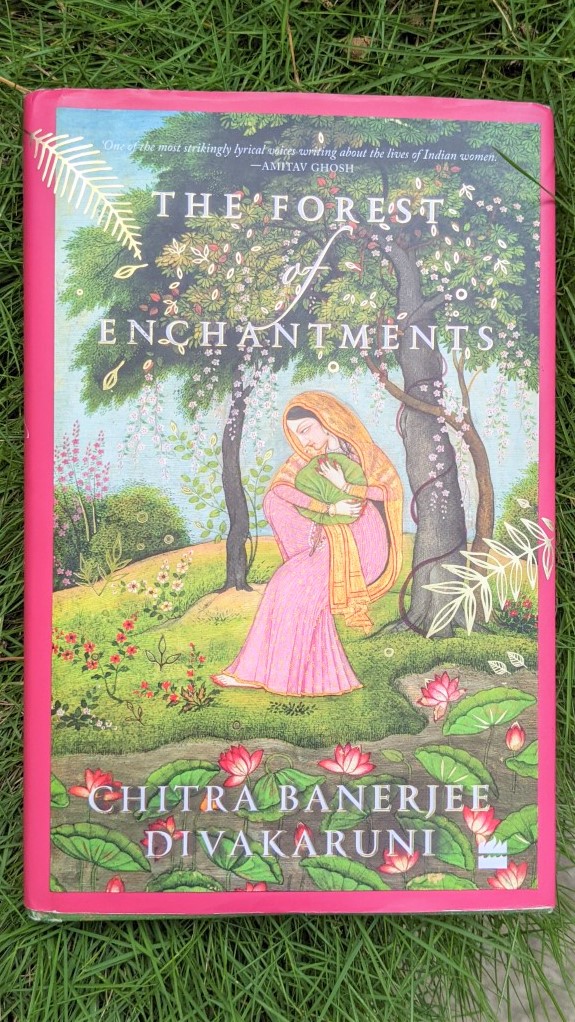
Stories have always been told from the perspective of the powerful. Most Indian mythologies glorify male characters. It is rare to find a female protagonist whose story of valor, sacrifice, or complexity of character has been told in mainstream work.
This very beautiful book, ‘The Forest of Enchantments’ tells the story of ‘Ramayana’ through its women who were an integral part of the story. Despite the book’s focus on Sita, it also tells the story of other women who suffered just as much, if not more, in this war between good and evil.
Sita’s story shows the vulnerability of being a woman and how she had to struggle to get respect and recognition for her capabilities. Essentially, the book deals with all human emotions, including love, passion, courage, jealousy, anger, and shame, while showing how these characters behave as normal human beings.
My favorite women from this story are Mandodari, Urmila, Kaushalya, Sarama, and of course SITA. However, we rarely know what their contributions were. Everyone knows what Lakshman did for his brother. Although he and Rama were exiled for 14 years, we do not know what his wife Urmila did for him. She had slept for 14 years so Lakshman would not have to sleep for his entire exile period.
Vibheeshan helped Rama conquer Lanka, but his wife Sarama sacrificed his son and protected Sita when she was being held as a captive in Lanka.
I loved this book for two reasons- first, it highlighted the stories of women I had never heard about, and second, it used beautiful and music-filled words that made me feel as if I were reading poetry. My mind created an image from the details in this book – I could see the forests, the palaces, the animals, and all the people that lived in this story.
Do read this book if you haven’t read it yet. If you have read this already, do let me know your thoughts about this in the comment section.
The pursuit of happiness by each person is best achieved when the State creates conditions of stability and vanishes into the background”
Excerpt from the book
It was a cold winter evening in Gurgaon. I was lying on my bed wrapped in a blanket, leisurely watching some YouTube videos. The video was interrupted by some Twitter notifications concerning Prime Minister’s address to the nation. I started watching Prime Minister’s All India televised address where he declared 1000 and 500 notes as demonetised. My first reaction was to check how much cash I had at home. Seeing only 1500 rupees cash at home, I felt relieved. Like other people on WhatsApp groups and Twitter, I also believed for a few days that this was a master stroke by the then government headed by Narendra Modi. This step is going to eliminate the black money available in the country. However, later on, like most other people, I had seen suffering, common people had to go through standing in the queue for long hours just to exchange their old currencies. My domestic help came the next day crying that she has no bank account here and she doesn’t know how she can replace her old notes. I also remember following the everyday newspaper headlines on this issue and how the government shifted the goalposts of this policy decision, saying that it will increase digitisation in the country.
Was demonetisation a good policy decision? Why did the BJP government take such a drastic decision without having a broad base consultation? Why there was no deliberation with the public before taking this decision? Did it make any impact on curbing black money in the country? What were the consequences of this decision? How it has impacted the common people in the country? This book will help you to make sense of these questions if not find the right answers.
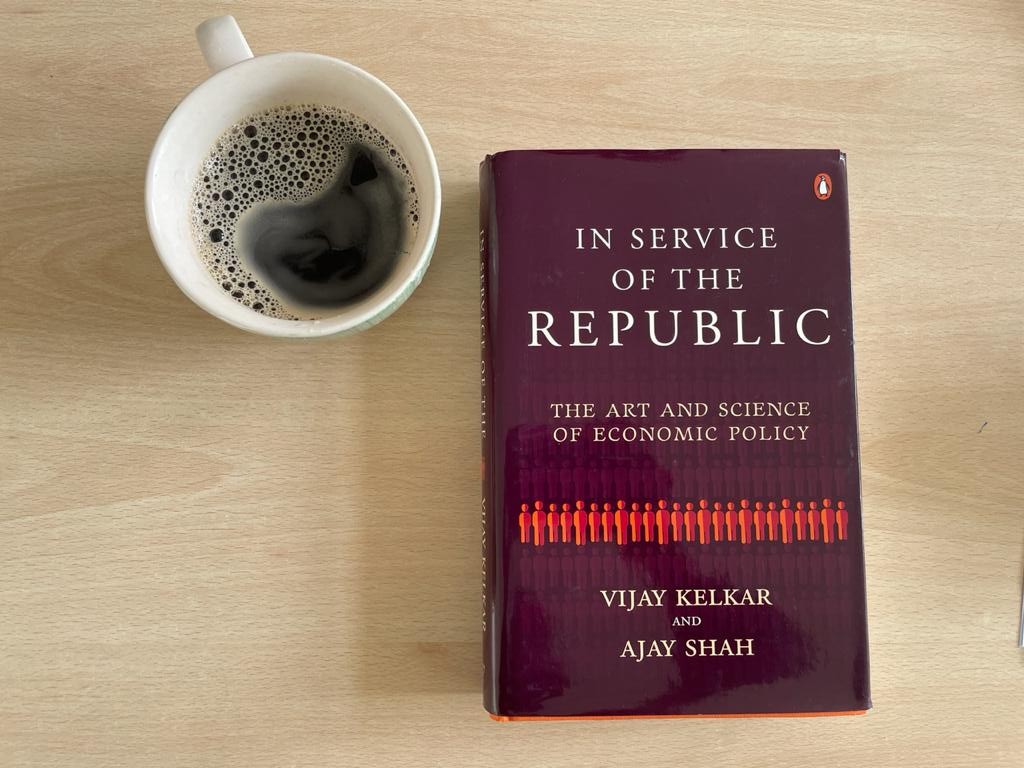
I purchased this book-In Service of the Republic: The Art and Science of Economic Policy last year after many episodes on The Seen and Unseen podcast recommending it a must-read for all those who are interested in policymaking. Vijay Kelkar and Ajay Shah, former bureaucrats are the authors of this book. This book not only makes one understand why demonetisation was a disastrous public policy decision but also shows the nuts and bolts of policymaking, execution, and implementation. Insights mentioned in the book make it a manual for all public policy practitioners. Although the book has 40 chapters, it’s short, so it’s easy to read. What goals should the State pursue? What is the government’s mission? Every line in this book made me want to write it down.
India i.e. Bharat: A Union of States
“A State as a human community that claims the monopoly of the legitimate use of physical force within a given territory” – Max Weber, The Vocation Lectures, 1919
Why State is needed? What is the main responsibility of the State? What are things State is supposed to do or not do? How State’s different actions have far reaching consequences not only for the present generations but also for the future generations. The authors list various conditions when the State’s actions are legitimate and justified. The state should not do anything except address market failure. Market failure happens when the free market fails to deliver efficient economic outcomes. Market failures happen in four ways:
Externalities occur when some of the costs or benefits of a transaction fall on someone other than the producer or the consumer. Pollution is an example of negative externalities. IT companies in Bangalore led to more parents providing computer education to their kids so that they can get jobs, which is an example of positive externalities.
Asymmetric Information refers to a situation where one party has more or better information. For instance, when a customer is buying medicines at a shop, she has no way of knowing if the medicines are adulterated.
Market Power is established when a few firms achieve a dominant position in a market.
Public goods are goods that are available to anyone. They have two characteristics: non-excludable and non-rivalrous. Roads and clean air are public goods.
India a low capacity State
“Indian State works through panic, package, and neglect“- Harsh Vardhan (Financial Economist)
Many authors Indian and Western have shown that the Indian State lacks capacity. It can organise a humungous Kumbh Mela where crores of devotees come to take a dip in the holy Ganga. It can also successfully conduct elections for such a huge electorate spread across and length and breadth of this country. However, the Indian state has continuously failed to deliver basic health, education, and sanitation services even after seven decades of independence. Why do Indian Institutions lack capacity? Because building a high capacity State takes time and consistent effort by policymakers, politicians, and bureaucrats.
Building a high capacity State takes time
“Where we do not have high intellectualism, we get raw power play”
Building the republic takes time. It will take many decades of hard work by the policy community for India to rise to the ranks of the advanced nations of the world. Policy reform is slow, hard work, and not amenable to quick wins on social media. There will be no sharp impact, no human interest angle. There will be small changes spread all across the economy, which can add up to substantial impacts.
Independent judiciary is an essential foundation of the market economy because it helps in the contract enforcement between the government and private firms. Poor contract enforcement leads to market failure. Different types of private solutions (contracts, torts, class action lawsuits, and private enforcement) can flourish when and only when the courts are swift and competent.
The need of the hour is to have an institutionalised application of mind. It is a way of ensuring that the right questions are asked, and alternatives evaluated before a decision is made. This helps avoid impressionistic and casual approaches to policy formulation and reduces the extent to which sectarian considerations dominate. In India, we have some irrational decisions because one section/caste group/pressure group is lobbying for it. Sound policy decisions require a lot of background research work, consistent probing, and also a feedback loop.
The Rhine river was not cleaned in a day. Rhine Action Plan was drafted in the year 1987 and it took many years of implementation and actions which led to the cleaning of the river. The hardest problems in state capacity are the criminal justice system, the judiciary, the tax system, and financial regulation. The best way to make progress is to take small steps and listen to the statistical evidence.
Policymaking is a process of trial and error
“When getting hold of a larger object, don’t discard the smaller object. Don’t use a sword when a needle will suffice”.
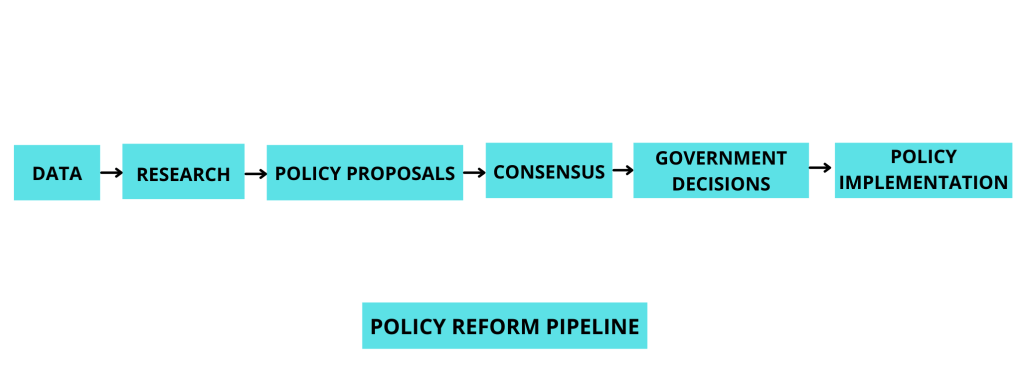
Public Policy is a process of hypothesis testing, of forming a theory about the world and experimenting with interventions that are thought to help. This testing should go through a policy pipeline where the first data is gathered. Research is conducted which led to policy proposals, creating consensus among the public and policymakers. Finally, the government takes the decisions and implement the policies.
Created on Canva
Why do public policies fail? There are various reasons behind it:
The information constraint: We don’t have enough data because the government itself does not collect the data with transparency and fairness. There are various other issues with data collection in the country. Policymakers just do not know what is going on. For instance-The data about people dying from COVID has so many discrepancies.
The knowledge constraint: We don’t understand the real problem because of a serious lack of social science research in India.
The resource constraint: The government spends more than we think and know. The marginal cost of public funds (MCPF) is much larger than Rs 1 in India.
The administrative constraint : Public administration is harder than human resource management in the private sector.
The voter rationality constraint: Voters have no incentive to know about issues of public policy.
Public Choice Theory: A Guide to Public Policy Making
……No matter how famous or well-reputed a person is, when she is hired as an official in the government agency, we are aware of the gap between her personal interest and the public interest. Public Choice Theory encourages us to engage in “politics without romance”. The objective is not to hire saints but to achieve a state which yields good outcomes when each actor is self-interested. Public Choice Theory predicts that public organizations will favor multiple objectives as this gives reduced accountability. Clarity of purpose is efficient for the principal and not the agent. A publicly stated and clear objective, on each policy initiative, improves the policy process. Public choice theory encourages us to think that all officials and all politicians are cut from the same cloth. We have to construct systems of checks and balances that will work through rational incentives of all parties and without assumptions that any one person is a saint. The puzzle of policy design is that of finding checks and balances.….
However, this theory also has its limitations. In reality, every individual in public life has a mixture of personal and altruistic elements. The State is not a benevolent actor, it is formed of self-centered persons. To create checks and balances, citizens, policymakers, and politicians can use these five pillars: data, media, intellectuals, legislature, and judiciary.
Strong Institutions are need of the hour
The policymakers should prioritise institution-building over just GDP growth. In the book named “Why Nations Fail”, the authors have given a ‘theory of institutions’ where they argue that institutions decide the destiny of the country. Institutions can be of two types: Political and Economic Institutions. The authors also add that poverty and prosperity of nations are the interplay of economic and political institutions. A complex modern economy only works when it is a self-organising system. It has to have the creative efforts of a larger number of individuals, all working in their own self-interest. There is no one measure of institutional quality but the authors have listed a few measures that can be used as a benchmark to understand the quality of Indian institutions:
Extent of perceived safety of women and functioning of the criminal justice system
Flight of millionaires
Flight of India-centric firms
Flight of India-centric trading
Flight of India-centric contract enforcement
Freedom of speech to comedians
Appreciation of ‘self-organising system’
The authors reiterate that State machinery should appreciate and facilitate the self-organising system. For instance- local problems should be solved by local people who are on the ground since they understand the problem better. The authors talk about Coasean Approach(Transaction Costs Perspective) to deal with market failures. The key concept of this perspective is that when property rights are clear, both sides are brought to the table to negotiate. However, this approach also requires the State to play a role in clearly defining property rights and judicial infrastructure that can help in enforcing contracts.
One of the best solutions mentioned in the book is an approach by political scientist Elinor Ostrom. She was the first woman to get a Nobel prize in economics. She discovered that many practical arrangements established by traditional communities over very long periods of time achieve good results. An example of this is declaring a moratorium on eating fish during the month of Shravan. Though this step seems religious, it leads to saving fish counts in the river.
Social engineering is inappropriate
Social systems are very complex and outcomes are generally greatly different from those that the planners may have desired. The values and imagination of the people should drive the changes in the world, rather than the values and objectives of a few central planners. Society can and should evolve gradually through the thoughts and actions of the people. The best framework of public policy is one in which the State impinges upon the lives of individuals as little as possible.
Policymakers need to be aware of the knowledge constraint, biases and implementation constraints. Most importantly they need to realise that every individual, official, and politician responds to incentives. We all remember how the sterilisation scheme launched during emergency miserably failed despite having a good intention of population control. Rather than State giving surprises, implementing stringent policy measures, policymakers should nudge the people through signaling or incentives towards social change. As the authors of the book added, “we should pursue revolutionary change for government structures but evolutionary change for the people”. The best thing I got from this book is that I should never see even policymakers as someone who knows everything. They are also working in unknown territories. Better policy making requires a lot of effort and commitment from all stakeholders including civil society organisations, NGOs, politicians, and the common people.
If you liked reading this post or gained something from it, please buy me a coffee:
Trigger Warning: This post refers to acts of violence.
“An Indian woman’s first challenge is surving her own home” -Sonia Faleiro
One more year has passed. New beginnings on a new year. However, things feel new on the surface but not in reality or we pretend that things are new just because a new year is around the corner. Nothing has changed for a girl/woman in India. Don’t know if it will change in the near future. Misogyny, patriarchy, and gender discrimination are everyday phenomena in our country. We all face it. Rape is trivialised. Recently, a legislator in the State Assembly of Karnataka made an insensitive remark about rape, and later he was ready to apologise if his comments hurt the sentiments of women.
We have a central government scheme named Beti Bachao, Beti Padhao to save the girl child. Do we need to save our daughter? Or do our daughters need to save themselves from this whole system? 80% of the money allocated to this scheme was spent on advertisement as per a parliamentary standing committee report. What more we can expect when girls’ parents give them bizarre names like Missed Call, Antima, and Phaltu to express their anger and disappointment because they never wanted to have these girls. I don’t even want to imagine the kind of shame and trauma these girls might be going through because they were made to feel that they were unwanted by their own parents. Being a woman, I have personally experienced this kind of discrimination. There was a time when I used to feel that I am going to fight for my rights. I will complain against these practices. However, different incidents and news reports dealing with discrimination and violence against women have broken my spirit. The most frustrating thing is that we, women, are manipulated into believing that we deserve this discrimination and violence.
A little overview of the Book and the Author:
The book, “The Good Girls” by Sonia Faleiro will make you uncomfortable. It will make you angry and ashamed of our country and society. This book is about the Budaun case where two girls were found hanging from a tree on 26th May 2014, just a day before when the NDA government’s first term started with the promise of “acche din”. The book uncovers the events and circumstances leading to Padma Lalli’s death against the backdrop of the political and socio-cultural life of the state of Uttar Pradesh, notorious for violence against women. All those little details and descriptions about the mundane activities of the households and the exploitation of women shown in the book were quite relatable to me. The author’s deep research about the patriarchal settings and how women are never allowed to tell their stories makes this book an important read.
The author is a journalist who lives in London. She returned back to India and did extensive research for six years to write this book. She visited the Katra village and conducted hundreds of interviews. This case created so much furor that it was ultimately transferred to CBI. In this book, the author also discusses the caste complexities, corruption in the police system, the deep patriarchal structure, and discrimination against women. The book reads like a suspense thriller and I never felt like putting it down. Almost all chapters consist of one or two pages which makes it very easy to read. The chapters’ titles are thoughtful. It intrigues you to know more about the incidents. Sonia has woven this unfortunate incident in the form of a story that not only gives you context but also provides a political, social, and cultural perspective about the lives of the people involved.
Story of Padma and Lalli:
Padma Shakya and Lalli Shakya (names changed since the case is sub-judice) are two ‘good girls’ living in the Katra Sadatganj village of Badaun district. Padma and Lalli were cousin sisters. Padma was sixteen years old and Lalli was fourteen years old. They were always together like two grains of rice. They did everything together. They both had an ordinary life but they were the new age girls. Padma was curious and wanted to explore things. Lalli wanted to study further and do something in life. However, these good girls were never good enough for the people around them because they never wanted to be bound by the rules of society.
Control, control, and more control:
In India, girls are not supposed to have choices. They are bound to do what they are told to do. They are not allowed to go outside. They can use mobile phones but they can’t own them. Even to use it, they need to take permission. Many khap panchayats, villages, and schools in India have banned mobile phones for women. If they go out, they will have to return before it is too dark. They are the honor of the family and they need to be saved. And if they don’t follow these dictates or unsaid rules, they are killed. The most ironic thing is that women are controlled not only by society but also by the State in the name of their safety and empowerment. The recent move of increasing the age of women for marriage can be seen in the same light. A girl who is 18 years old, has the right to vote and choose her representatives but she does not have the agency to choose her partner. This is a clear case of violating women’s choices who want to get married before the age of 21.There is evidence to prove that a large share of reported sexual assaults across India is consensual relationships that are criminalised by parents.
We can see the same kind of control in the Shakya family. Padma’s father bought her a phone which allowed him to record her conversations. He forced Padma to leave her studies so that she can get married to save her family’s honor. When these two girls insisted on going to the village fair, their mother (Siya Devi) scolded and said ‘Ladkiyan bahar Nahin ghoomti’ (Girls don’t wander about outside the house).
Sex, Sexuality, and Shame:
Sex is still a taboo in India. It is associated with something bad. No sex education is provided in our country. Especially pre-marital sex is something frowned upon in our society. I just don’t understand the logic. After marriage, you can have as many kids as you want, but you can’t explore your sexuality before marriage. Height of hypocrisy in our society. Padma Lalli and Pappu Yadav had a sexual relationship that was not acceptable to their respective families. Padma and Pappu were caught in an awkward moment the day the girls got disappeared in the fields. The next morning Padma Lalli were found hanging from the tree in the mango orchard.
Though their family members alleged that they were gang-raped and murdered by Pappu along with his uncle and a Yadav (caste is important here because initially this case was seen as a caste rivalry between Yadav and Shakya community) policeman, CBI inquiry did not find any evidence of it. CBI inquiry concluded that girls took their own lives. However, it is still not clear what has happened on that unfateful night when these two teenage girls disappeared. No one knows what was there in the phone recordings. Nazru, the cousin of Shakya brothers, who was spying on Padma Lalli on the day of their disappearance, still feels that he had seen those men who took these girls. Reading this book will help anyone uncover the shocking turn of events and why the death of these girls is called ‘ordinary killings’.
Saving the honor was more important for their family even when those girls were dead. Sohan Lal, Padma’s father destroyed the phone so that no one gets to know about the relations between Padma Lalli and Pappu. What kind of society we are living in? Why our own parents are like that? Why they can’t think about their family first than society? That’s why Sonia in one of her interviews added that we all are responsible for their death and not one person or institution. The whole system is broken.
Let me tell you the story of my grandmother! I spent my childhood with her. I have seen her saving one rupee each day which led to huge savings later in her life. She did unbelievable things. She has a lot of patience. She believes in moving mountains even if she is old and sick. She never loses hope. She believes in the idea of compounding. Certainly, she does not understand the economics behind compounding. I have seen her converting hundreds into lakhs bit by bit. You must be thinking why I am telling you this? Recently, I saw a post about a book called, “The Psychology of Money” on Linkedin. This title made me curious and I decided to read this book. While I was reading this book, I realised that these pearls of wisdom on wealth and happiness were always there in front of my eyes. It usually goes unnoticed. The author of this book, Morgan Housel tells you those simple and obvious things about building wealth as Sherlock Holmes once said, ‘The world is full of obvious things which nobody by any chance ever observes.‘ It’s possible that we see these snippets in our daily life, but we never understood their significance of them.
Luck and risk
The book is divided into 20 chapters that take the reader from one timeless lesson to another about building wealth. As per the author, past experiences impact one’s behavior towards money. He believes that financial outcomes are driven by luck, independent of intelligence and effort. Luck and risk both play an important role in someone’s life. Outcomes are not only guided by individuals’ efforts but also by actions outside of our control. One of the best things to be said by the author is this: “Not all success is due to hard work and not all poverty is due to laziness” Therefore, he suggests keeping this thing in mind before judging people. Housel suggests having the virtue of contentment and not to risk what you have. According to him, there are many things that you should never risk. For instance- reputation and freedom, family and friends and happiness are some invaluable things that no one should ever risk in their life.
Things are uncertain and many times not dependent on historical factors. You should always be ready to face surprises in the financial market because no one clearly knows what might happen next. You must always give space to the room for error and be always ready to deal with unknowns. You should be ready to take risks but don’t take a risk that can wipe you from the world. Pessimism is so seductive and believable because setbacks happen too quickly to ignore. In comparison, progress happens too slowly to notice. Improvement is driven by compounding that always takes time. On similar lines, you should be ready to face losses in the financial market. Housel adds that true financial optimism is to expect things to be bad and be surprised when they are not. Nothing is free in life. Market returns are also never free. You should always be ready to lose some money and be ready to face the consequences. It’s like give and take. If the market gives you some returns, it also takes some back.
Compounding is the key
The most important concept discussed in this book is “compounding”. Time is the most powerful force in investing. The duration of investment matters. It takes time to accumulate funds. It makes little things to grow big and big mistakes fade away. However, our minds are not built to comprehend the enormous power of compounding. As I told earlier, I have seen compounding working in my own life. Once my grandmother bought something worth ten lakh rupees when she was earning only 10 thousand rupees per month. It looked totally absurd to me and I tried to stop her from buying something so expensive when her income is so less. But she told she will slowly make this payment. Still, I couldn’t believe it. I didn’t believe till the date she was able to complete the whole payment. So compounding works in a way that our mind is not ready to sense it.
Survival Mentality
“Staying wealthy is more important than getting wealthy”, says the author. Keeping your money safe and using it rationally is more important than getting more money. Nothing should be taken for granted. Investing requires taking risks, being optimistic, and putting yourself out there but keeping money requires humility, fear, and most importantly frugality. The ability to survive plays an important role in becoming wealthy and in creating happiness. The author adds that sticking around for a long time should be the cornerstone of anyone’s strategy in life. Growth takes time. Be it about money or in career. And growth requires surviving all the unpredictable ups and downs that everyone inevitably experiences over time. Applying a survival mindset means appreciating three things in life:
You need to have enough savings to survive any disruption, pandemic and chaos in your life.
Planning is important but the most important is to plan on the plan not going according to the plan.
You need to have sensible optimism.
Being in control of your life
The best wisdom shared in this book is about how money can give you the freedom to control your time. As the author adds that the highest form of wealth is the ability to wake up every morning and say, “I can do whatever I want today” The ability to do what you want, when you want, with who you want, for as long as you want is priceless. It is the highest dividend money pays. Being in control of your life makes you happy.
Savings are linked not to your income but your humility
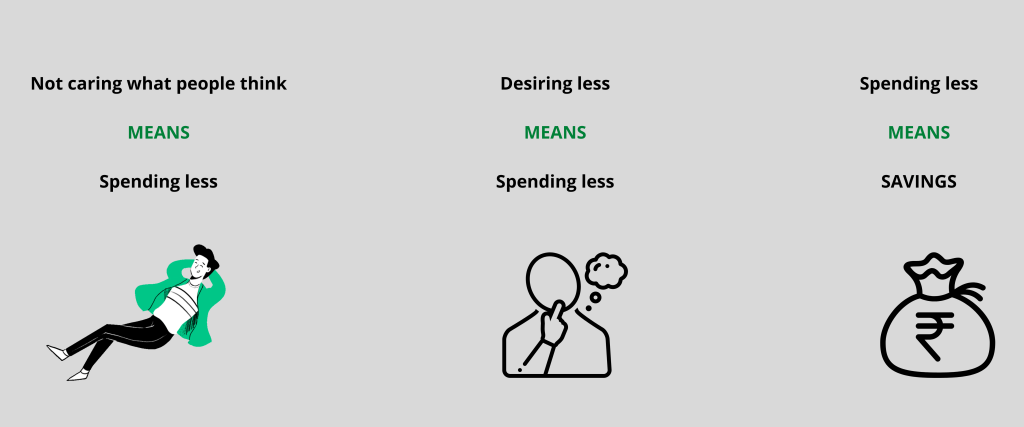
Creating wealth has no direct relationship with the income you earn or the investment returns you get. It depends on the saving rate. Saving the money you have and exercising frugality are the ways to build wealth. I have seen this habit not only in my grandmother but also in other family members. They don’t throw old clothes, boxes, and many household stuff and re-use them many times. They don’t go out and spend money to experience things as the new generations want to do. They have their own justification. However, saving money is the only way to build wealth. Spending money is also linked with your ego. If you desire less, you can save more. Housel has something interesting to say about increasing your savings. If you want to increase your savings, raise your humility than your income.
Saving money is the gap between your ego and your income & your income and wealth is what you don’t see.
Acquiring material things is for self-satisfaction. No one gets impressed because of someone else’s possessions. In fact, people are impressed when someone possesses the qualities of humility, kindness, and empathy. Do not take any financial decisions because you are influenced by someone. Do not buy things because you just wanted to show off to someone. It is a total waste because people are influenced because of your good behavior and not because of your money, house, and the kind of stuff you own. In fact, it literally means that your real wealth is what that no one sees it. The author believes that ‘the only way to be wealthy is to not spend the money that you do have. It’s not just the only way to accumulate wealth, it’s the very definition of wealth.
The creation of wealth is linked to the psychology and behavior of the person. Saving money is like developing a good habit as James Clear shows in his book Atomic Habits. You don’t need a specific reason to save. Savings without a specific goal give you leverage to deal with unpredictable situations. It gives you flexibility and control of your time. The author also adds that you need to focus on being reasonable than rational because ultimately you are a human being who has emotions and feelings. You need to cut down on your expense but it does not mean that you stop living.
People change so do their goals in life
People’s desires and goals change so it is difficult to make long-term plans. The surprising thing is that people themselves don’t realise that how much they have changed in the past and how much they are going to change in the future. The author suggests keeping two things in mind whenever you are making a long-term decision. Firstly, you should avoid extreme ends of financial planning because people adapt to circumstances and the thrill of chasing dollars or living a simple life diminishes after a point. Secondly, you need to accept that things change and be ready to move on. The most beautiful thing author has to say is that you must have humility when things are going right and forgiveness & compassion when they go wrong. Because we never know what will happen and always be grateful for things that we have.
The crux of building wealth is to be humble, practice frugality and make saving your daily habit. Be a Ronald Read and not Richard Fuscone!
“If you can get 1% better each day for one year, you will end up 37 times better by the time you are done”
First, let me tell you the story of this tiny plant. Last year during the lockdown, I was spending good time gardening, writing, and clicking pictures. I reused an old plastic bottle and filled it with some soil and planted a small stem of my favorite plant-pothos. I fastened it in my balcony grill. Every alternate day I was watering it. But after some days, I saw it drying. I got disappointed and stopped thinking about it. I also reduced the frequency of giving water. Days and months passed. One day on a weekend, I saw a tiny green stem inside the old plastic bottle. I couldn’t believe it. It felt like some extra grass grew. I went closer to the bottle and there was a sweet smile on my face. I finally knew that my plant survived. It survived: because of everyday’s care & nurture that got accumulated for days. On similar lines, your good habits are like these tiny changes you make every day that leads to a bigger change later in your lives. (Scroll it down to see the beautiful plant as of today)
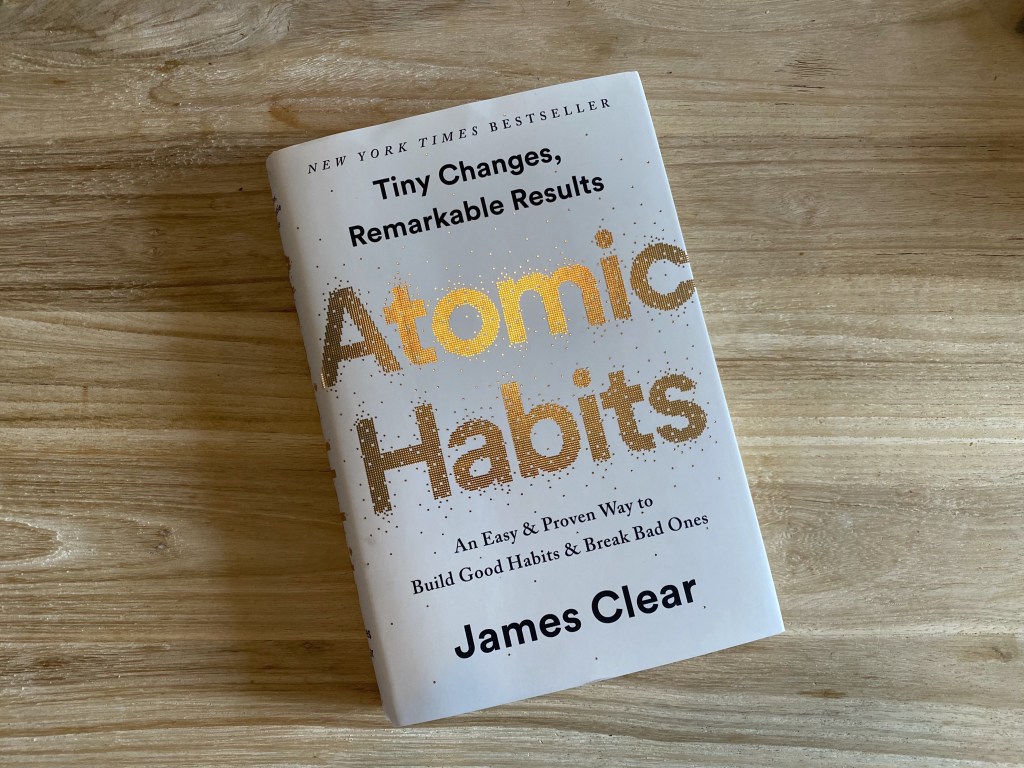
Reading this book makes you believe that small habits can make a big difference. And what is a habit? A habit is a behaviour that has been repeated enough times to become automatic. James Clear believes in incremental change. He feels that success is the product of daily habits-not-once-in-a-lifetime transformations. The interesting thing about this book is that it not only tells you how to create good habits but also how to break bad habits. He also warns the readers to be careful about the future trajectory of their lives as it will be dependent on their daily habits.
To me, this book feels like the combination of popular books Sapiens (A Brief History of Humankind) and Nudge(Improving Decision about Health, Wealth and Happiness)Like Sapiens, this book tells us that we have the brains of our ancestors but temptations they never had to face. We still crave calorie-dense foods because our brain’s reward centers have not changed for approximately 50 thousand years. Like Nudge, James Clear argues that the environment matters more than motivation. As Richard H Thaler talks about the concept of “choice architecture” that shapes people’s behavior, James Clear believes that every habit is context-dependent. People often choose products not because of what they are, but because of where they are. Accordingly, we need to design our environment such that we pursue our good habits. For instance- if you want to hydrate yourself, you must keep the water bottlers near you. We have to create space for every habit. A stable environment where everything has a place and a purpose is an environment where habits can easily form.
Change can take years -before it happens all at once
Our daily habits(positive/negative) compound for us and lead to a bigger change. And the thing is that whenever we have breakthrough moments, we don’t realise the reason behind them. The author has talked about the concept of “plateau of latent potential”. This is that moment where we get breakthrough results, but the thing is that we human beings generally don’t have patience. We can’t wait. I can share from my own personal experience. When I started preparing for civil services, things seem insurmountable and I also felt for some time that I don’t know if I can do this. But I got results. I couldn’t even clear prelims in my first attempt. But in my subsequent attempts, I cleared prelims and mains both. And it does not mean that I didn’t work hard in my first year. My result was a cumulative effect of all years and not only of the current year when I cleared the examination.
The author challenges the norm of setting goals if anyone wants to succeed. He adds: “If you want better results, then forget about setting goals. Focus on your system instead.”
There are three layers of behavior change:
Outcome-based habits: What you get
Process-based habits: What you do
Identity-based habits: What you believe
The ultimate form of intrinsic motivation is when a habit becomes part of your identity. The more pride you have in a particular aspect of your identity, the more motivated you will be to maintain the habits associated with it. True behavior change is identity change. It means that to make your habit permanent, you must make your habit part of your life and identity.
One of the best things Clear has to say is that you need to unlearn and continuously edit your belief systems to upgrade your identity. And this cannot happen overnight. For instance- doing exercise is a good habit but to build a healthy body, you have to get out of your bed every single day at the same time. Go for a walk. Repeat this every single day despite all odds.
As per Clear, there are four simple steps to build a better habit: Cue; Craving; Response & Reward The cue gives you an indication about reward, craving makes you feel like getting that reward, the response is the actual habit you perform and rewards are the end goal of every habit. This whole process is also called a feedback loop.
The Habit formation Feedback Loop
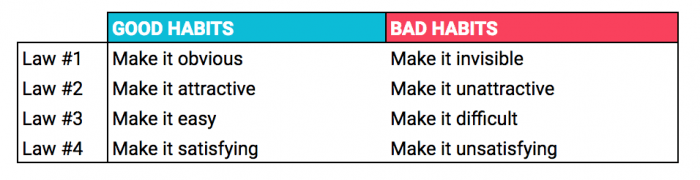
Developing good habits or changing habits first and foremost requires you to understand what you are actually doing. The author tells us to create a list of our daily habits so that we can observe our thoughts and actions. We need to ask this question after making our daily list, does this habit help me become the type of person I wish to become? Below are the laws that we need to apply to cultivate good habits and eradicate bad habits.
The Laws of Habit Formation
Even our family, friends, and people we follow play an important role in shaping our behaviours. We pick up the habits from the people around us. As the author adds that ‘ we don’t choose our earliest habits, we imitate them’. We imitate the people we admire. The best strategy to develop a good habit is to surround yourself with the people who have the habits you want to have yourself. Sticking with good habits requires you to create short-term rewards. As our brains are still tempted towards instant gratification, we need to create a habit tracker. The author adds that a habit tracker makes you believe that you are working towards becoming the type of person you wish to become.
In the end, the author talks about ‘the Goldilocks Rule’ that will help you to stay motivated in life and work. As per this rule, humans experience peak motivation when working on tasks that are right on the edge of their current abilities. Not too hard, Not too easy, Just Right. Reaching the goldilocks zone makes you achieve the state of flow. Flow is something one achieves when they have immersed themselves in what they are doing. But doing the same thing or following the same habit can also bring some boredom. The biggest challenge for self-improvement is dealing with this boredom. “The only way to become excellent is to be endlessly fascinated by doing the same thing over & over. You have to fall in love with boredom”, adds the author. Mastery requires more practice than planning. Though habits are important, they are not enough. You need to have a combination of automatic habits and deliberate practice. And most importantly, you need to review and reflect on these habits to continuously fine-tune them as one thinker has rightly said” a genius is not born, but is educated and trained”.
“Jahan Koyi apna Dafn na hua ho woh jagah apni nhi hua karti” [A person does not belong to a place until someone beloved is buried there]
Gabriel Garcia Marquez- One Hundred Years of Solitude
Reading the book, “Bread, Butter, and Cement” by Annie Zaidi, felt like a trip down memory lane. It made me nostalgic. It made me think of my roots, my identity, and my belongingness. The book is beautifully written and expressed. It feels like a slow cold breeze passing below your feet while you read this book but also makes you worry about the things happening in our country as to how our heritage and culture are being devoid of diversity.
Like Zaidi, I always wanted to own a place that I can call mine. Do I belong to a place or Do I want a place of my own? The first one is of course where my dada, dadi, and my ma lived their whole life. That place belongs to you where your ancestors have lived. If you see this in a larger context, it’s so difficult to imagine the lives of the people who were uprooted from their homeland because of partition, communal strife, or poverty and have had to move to a different place. The second one is that place that I am going to build/buy that is my own.
The title of the book intrigued me because what story could link three unconnected words: bread, butter, and cactus. It comes from the author’s childhood when she was living in the J K Puram colony. It was a colony for workers of the cement factory of the same name. Her mother was working as a principal in the school run for kids living in the colony. They moved to this unknown place so that her mother could provide ‘bread’ to her children. The author also describes the circumstances and situation prevailing in that colony and how the author wanted to escape the everyday ‘sameness’ of the place. The only life around was some cactus. There was nothing nearby and it almost felt like she was living on some island.
The book is neatly divided into nine chapters with unique and thoughtful names. Every chapter name has some hidden meaning. This book stands out because as it flows, the author shares her personal story while reflecting and interlinking the country’s socio-political events. For instance, I absolutely loved the chapter named ‘Gur, Imarati and Goons’ telling the story of Azamgarh in particular and eastern UP in general. ‘Listening to mother’ and ‘Place like Home’ are the two other beautiful chapters giving a beautiful perspective on how language is so important to feel the sense of belongingness and how creating your own home or having a home makes a lot of difference in your life. One of the lines from this chapter is fascinating: ‘Home is where suffering is shared out, like a bread, and or a three-seat bench shared by four’. The chapter on language is thoughtful and full of insights. It shows how much language diversity we have in our country and despite that, there is an imposition of one language on everyone. Hindi itself has around 49 variants.
Just finding out that the author’s hometown was Azamgarh which is also my hometown created a strong urge for me to read this book. Being a woman who belongs to the same district and also migrated to a different place and trying to create my own identity made me relate to the author’s feelings in this book. Just like the author of this book, ‘belonging had always been a fraught question for me’ because I also never lived at one place for long. Especially after my marriage, I moved to South India totally devoid of North Indian roots, culture, food, and the people. I am not sure where I belong.
I remember my first UPSC interview when they asked me about my hometown and I was trying to defend the reputation of my district as it has been stereotyped and demonised as a place linked to terrorism. I can say that even I was suffering from that bias otherwise there would be no need to defend. The author is also anguished about why a place of poetry, textile, and imarati has been stereotyped just because a section of minorities live there. It is sad. Even I agree with the author that this stereotyping isolates the minority community and also prevents the Hindu majority from taking pride in their regional identity. A couplet comes to mind after reading this:
“Sabhi ka khoon hai shaamil yahaan ki mitti Mein,Kisi ke baap ka Hindustan thodi hai” [Everybody’s blood is mixed into the earth here, Hindustan does not belong to anybody’s father]
Throughout the book, Zaidi shows concerns towards the marginalisation of minority communities with a special focus on Muslim communities. Being a Muslim and a woman, she has had to face a lot of questions and rejection. The socio-political climate of the country made her conscious of her identity. She was worried about what people will think or how they will behave if she wore a hijab/burqa.
This is the sad reality of this country. The recent findings of a three-year study on discrimination in housing, most cosmopolitan cities and neighborhoods continue to keep Muslims and Dalit out of their homes. Stereotyping and discrimination against Muslims and Dalits are rampant in our country. One of my close Muslim friends (I don’t want to disclose his identity), who is a writer and public policy expert tells me, ” I no more think India is my country and I want to move out from here as soon as I can”. Hearing this, I thought; where we have reached and what we have become as a nation.
“The ache for home lives in all of us.The safe place where we can go as we are and not be questioned”
Maya Angelou
The theme of this book is about home, identity, belonging, and most importantly about mitti (soil) of one’s birthplace. How absolutely nothing can replace the feeling of your roots. How this mitti or zameen as we call it, has ‘dual connotations’ that mean land and also a certain psychological feeling. It made me feel proud to know that the author traces her roots to eastern Uttar Pradesh. Generally, people from Uttar Pradesh who have relocated would rather not reveal their identity out of fear of being stereotyped.
Note: I created a draft of this blog last month but could not publish it because almost everyone in my family was sick. Finally, when I started feeling a bit better and things got stable at home, I completed this blog today.
If this post resonated with you, please buy me a coffee by clicking the link below:
“The Internet is the first thing that humanity has built that humanity doesn’t understand, the largest experiment in anarchy that we have ever had”
Eric Schmidt, Former Google-CEO & Co-founder of Schmidt Futures
#Baba Ka Dhaba, #Justice for Sushant Singh Rajput #Justice for Rhea #Justice for George Floyd #Black Lives Matter #Dalit Lives Matter #Metoo are some of the recent most popular hashtags on social media leading to huge outpouring of sentiments from the public creating an immense impact in real lives sometimes positively and sometimes negatively. The power of smartphones and the internet which made these hashtags popular is the theme of this book.
The book “India Connected” by Ravi Agarwal celebrates the power of the internet and smartphone that is leading to unthinkable and unpredictable changes in people’s lives. The book is quite relevant at this time when India seems at the cusp of change. Especially during the Covid period when a smartphone with the internet looks like the driving force behind everything. The smartphone is transforming Indian democracy in an unprecedented manner. As Ravi adds, “the influence of smartphones on the world’s largest democracy is pervasive and irreversible, disruptive, creative, unsettling and compelling.”
The author travelled to different cities in India and met with innovators, founders, teachers, common people, students, government officials, and villagers who are an important part of this digital revolution. The book seems like a conversation between the author and these people. The author divided the book into three parts, and each part consists of two or three chapters. The first part is about ‘opportunity’, the second part is about ‘society’ and the third part is about ‘the State vis a vis, its interplay with the digital revolution.
The book provided a balanced perspective on the smartphone revolution in the country. How the smartphone with the internet is bringing about substantive changes in the lives of people, providing opportunities for education and employment and also empowering the women in villages. How a smartphone is changing people’s thinking, and their dating patterns. How the young generation is getting addicted to their smartphones leading to anxiety, depression, and other mental health issues. How smartphone has also made pornography easily available. How youth of the country is using it as an outlet for venting out their frustration through trolling, rumor, and prejudice. Lastly, the author writes about the role of the State with respect to the internet and social media unfolding in the country.
For the author, the internet-enabled smartphone will mean the same for India as the automobile for America. ‘The smartphone is the embodiment of the new Indian dream.‘ A Smartphone is changing Indian people’s lives in various ways in which they live, learn, love, work, and play. The stories narrated in the book make it an interesting read. It makes you think about the enormous impact of smartphones on Indian society.
However, the author also talks about the challenges of the smartphone revolution in the country. Fake news, trolling, hate crimes, cyberbullying, mass piracy, etc. are creating huge challenges for society. It also impacts society negatively leading to crimes and polarization. Smartphone addiction is making teenagers depressed and anxious. Teenagers are suffering from ‘nomophobia’. As the author mentioned in the book, smartphone addiction can neurologically damage a young person’s brain in the same way as cocaine addiction. It seems smartphones are destroying the younger generation, but there are millions who will not have access to these ‘magic devices’ because they don’t have resources and they are illiterate.
The recent Netflix documentary, ‘The Social Dilemma’ revealed that the social media giants are manipulating our minds. We are engaging with these platforms as they want us to do. The recent social media circus around the tragic death of a Bollywood actor and the subsequent media frenzy leading to the arrest of his girlfriend reflects the negativity these social media sites bring to the people. The author has shown how the consumption of pornography has increased exponentially in our society and how some people believe that it is leading to an increase in rape cases.
The last chapters of the book show how the State is acting as a big brother and shutting down the internet. When the internet started giving an outlet to Kashmiri people to show their outrage, State closed down the internet in the name of stopping unrest and terrorism. The book also talks about the fiasco of free basics and internet.org and how civil-society activism led TRAI to rule against it in 2016. Digital money has become an important part of the Indian economy through some homegrown startups and obviously, the government of India’s ill-conceived moves of demonetization gave it a push.
I enjoyed reading the second and third parts of the book. It’s insightful and also scary to know how internet-enabled smartphone is creating innumerable problems in society but also if used properly lead to positive changes in people’s lives. As the author tells “India Connected is a story about change and it is a story that has just begun and the next chapters of the story will depend on how these technologies are harnessed and regulated”, there is a need to create more awareness and sensitization among the youth about the problems emerging due to these technologies and also create mechanisms and regulations to deal with the same. The recent story of #BabakaDhaba is a great example where a smartphone & social media brought so much positivity and hope into someone’s life.
If you liked reading this post, click the link below to buy me a coffee.
“Death is inevitable; Each moment is precious; Nothing matters in the End”
Recently, in a light conversation, I said, “We all are going to die” in the context of this dreaded pandemic. I could see the expression of people disliking that comment because no one wants to talk about death in our society. Death is seen as inauspicious. We all want to live in a fantasy and don’t want to think that we all have limited time. This thinking has repercussions not only on our health but also on our future. As the author says, “how we seek to spend our time may depend on how much time we perceive you will live forever.”
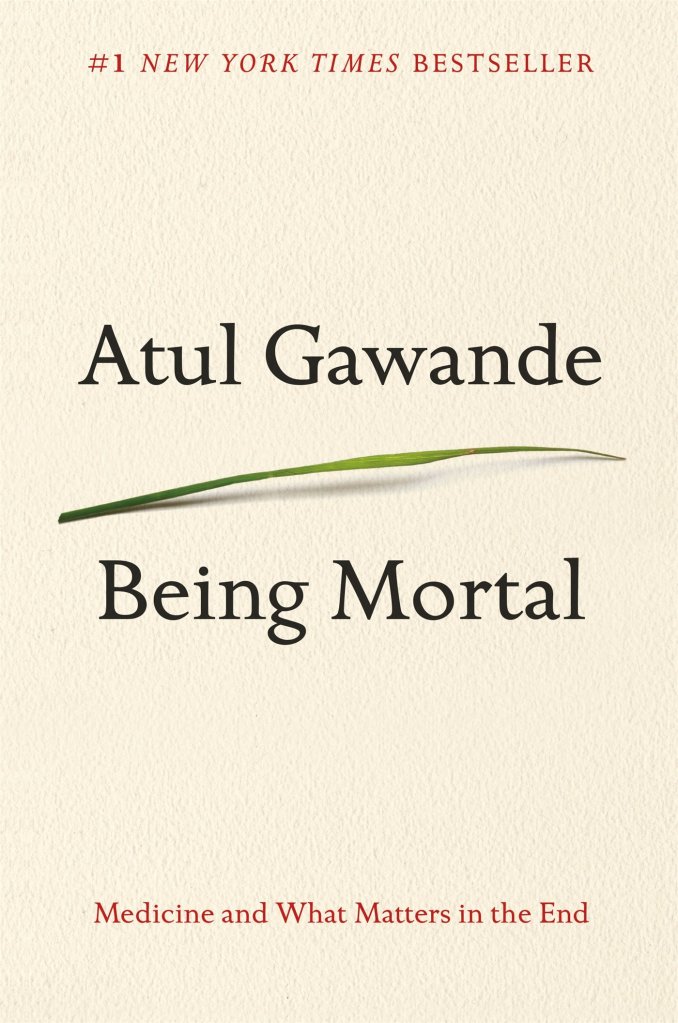
This book is actually about the experience of death and how the medical system has failed to understand what it means to deal with a finite life and make the final years a joyful experience. Do we forget the inevitability of death and the fleeting nature of life? When we become old, we don’t want to talk about death, we talk about living.
The beauty of this book is that it has been written by a surgeon who is also a professor at Harvard Medical School. This book has his personal accounts of dealing with terminal patients and also the death of his own father. The author has shown how the medical system has failed to educate medical professionals about aging, frailty, or dying. Gawande speaks about the failure of the medical system in informing or educating a patient about his condition? There is a need to understand the unfolding of the whole process and its impacts on people around them.
Death had no meaning to me until someone close died in my family. Society teaches people “not so important things” such as making a lot of money, buying a big house, memorizing every formula to pass every exam, and studying for the GRE. However, no one teaches us how to live our lives. What does death mean? Especially as we grow older, we have no idea what we are fighting for. What are our priorities? What are the trade-offs? We don’t talk about our worries or hopes for the future. How much are we willing to sacrifice? What are we willing to give up?
How care of the elderly has changed from ‘multi-generational systems support’ provided by the family to institutionalized nursing homes. Nursing homes today act as prisons. The elderly don’t feel comfortable in them. They feel chained and restricted. The elderly living here always yearned for privacy at home.
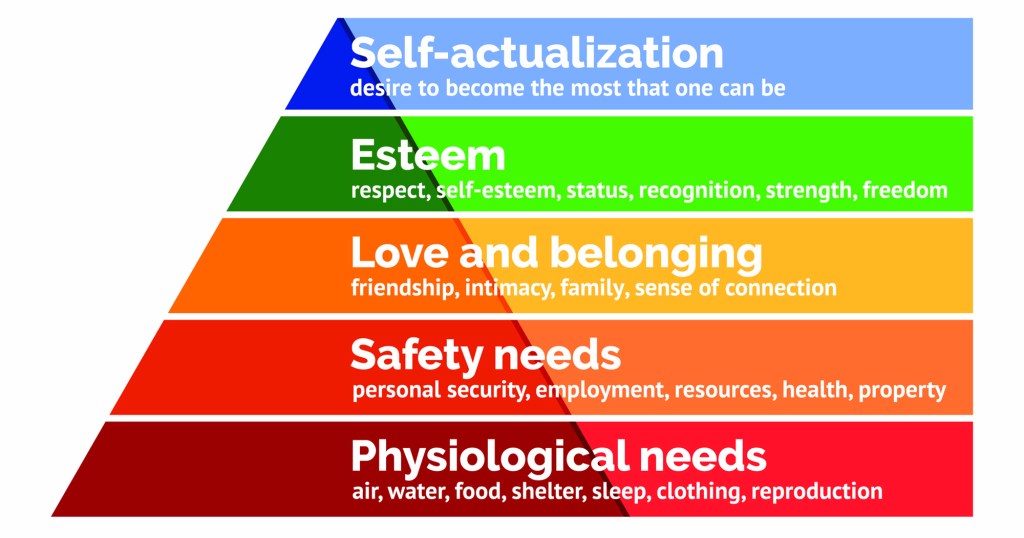
We are so engrossed in living this life that we forget to ask the question: what’s the purpose of our lives? Did we ever ask this question to ourselves? What makes life worth living when we will become old and unable to care for ourselves? To answer this question, the author discusses psychologist Abraham Maslow‘s influential paper, “A Theory of Human Motivation” which is depicted in the form of a pyramid and talks about the hierarchy of needs of people. According to Maslow, ‘safety’ and ‘survival’ remain the primary and fundamental goals of our life even in our old age.
Maslow’s hierarchy of needs
People in old age focus on being rather than doing and they live in ‘the present than the future. Old age generally functions at the peak of this pyramid and focuses on ‘self-actualization.’ “Living is a kind of skill. The calm and wisdom of old are achieved over time,” says the author. As per various experiments (discussed in this book by the author) conducted during some crises like the 9/11 attacks, the SARS epidemic 2003, etc., old and young both valued the bliss of life and focused on being rather than doing. This might be true for the current pandemic also. People these days from all generations are slowly realizing the meaning of life.
This book also shows the results of experiments of assisted living done on various old people where they were given small freedoms in terms of taking care of plants, spending time with a cat, a dog or a bird, etc., helped them to live a longer life. The most important finding of the experiment was “having a reason to live” which reduced the death rate. Harvard Philosopher Josiah Royce in his book, “The Philosophy of Loyalty,” informs us that people seek a cause beyond themselves. That cause could be anything: it can be small or very big. ‘We all require devotion to something more than ourselves for our lives to be endurable.’
The only way death is not meaningless is to see yourself as part of something greater: a family, a community, a society. If you don’t, mortality is only a horror. But if you do, it is not.
Josiah Royce(The Philosophy of Loyalty)
The biggest problem in the medical sector is that they never focus on the well-being of the people, rather they focus on physical health. They are hell bent on repairing the body parts and not the nurturing of the human soul. Not only the medical field but society as a whole needs to understand this, as people grow old and become aware of their fleeting life, they are more interested in writing the story of their lives and believe in living in the moment.
Amid this pandemic, there is a need to remember our old traditions of the ‘art of dying and accept death and decline as normal and eternal truth. We must accept our lives of old age that will come along with sickness, frailty, and isolation. Ultimately, we will need the support and care of others. We would rather spend the last days of our lives with our family members than in ICU. In a nutshell, Gawande has made several important points about life and death, especially how medical science can correct the wrongs committed till today in failing to accept the inevitable. Acceptance will lead to find solutions that can make old people’s lives better and joyful in their last days.
If you liked reading this post, click the link below to buy me a coffee.
“An imbalance between rich and poor is the oldest and most fatal ailment of all republics”.
Plutarch
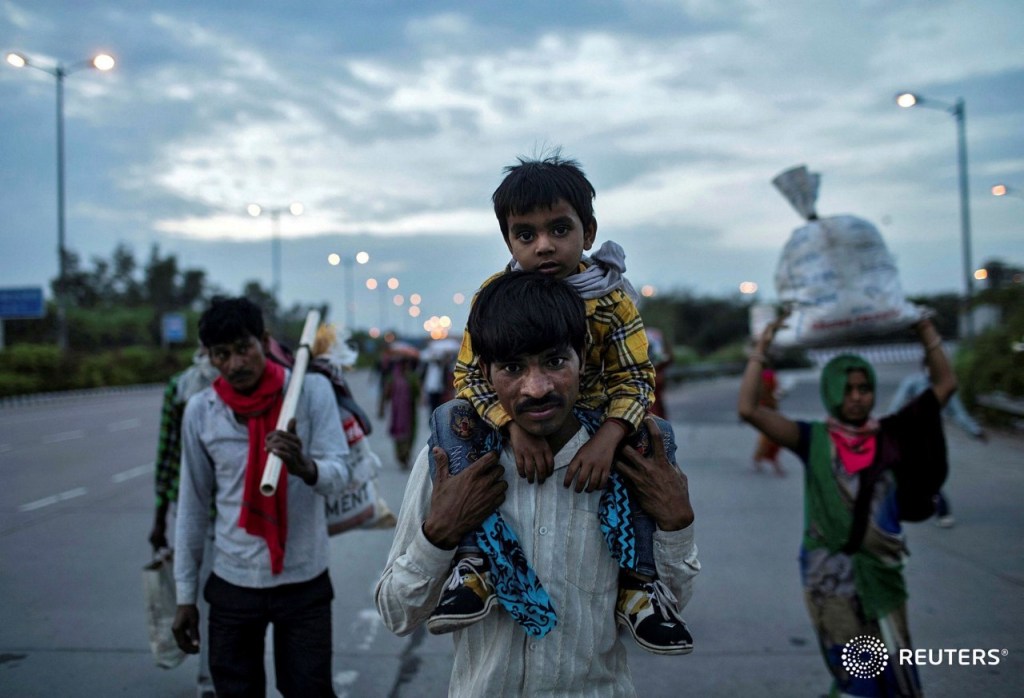
Migrants returning to their home walking hundreds of km due to lock down declared by the government due to corona virus crisis.
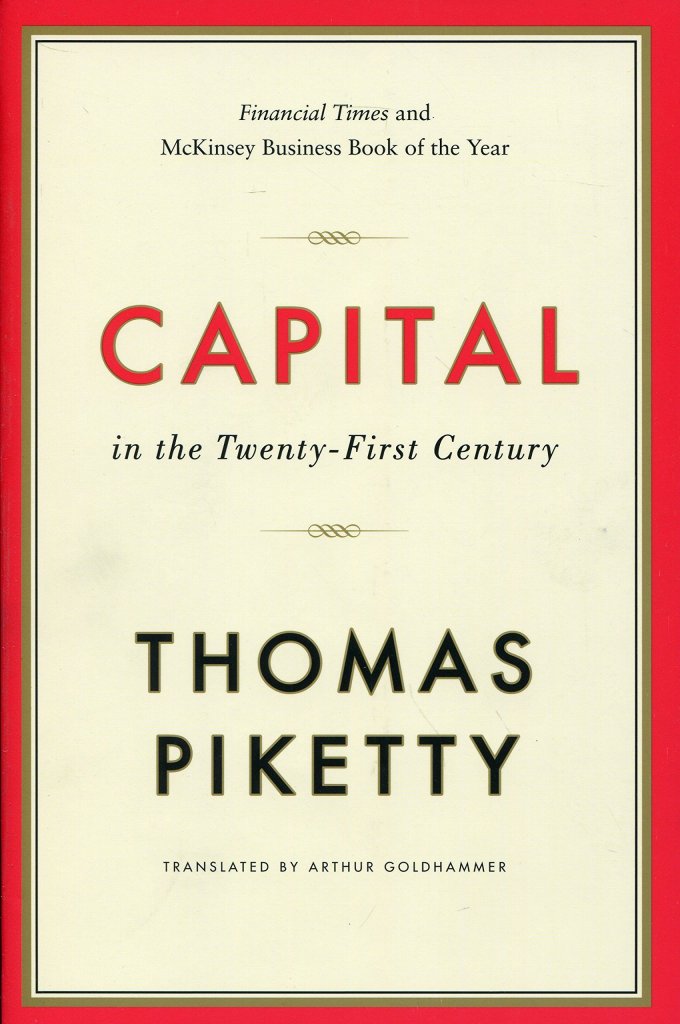
The present migrant crisis in India is a stark reminder of the economic inequities existing in our society. When rich and middle-class people are spending their time in the comfort of their homes doing various activities, poor and marginalized migrants are walking for a hundred thousand kilometres to reach their homes. Some also died on the way because of hunger and exhaustion. In this context, I thought to write a short review of the book, “The Capital” by Thomas Piketty. How income inequalities are going to hurt us in the longer-term unless some concrete steps are not taken by the State and its people.
I never read the whole book but managed to give a paper presentation on it in my final year of public policy course. Whatever critics say, this book has brought the issue of income inequality at the forefront. Income inequality is not only an issue based on some statistics but also it’s a moral issue that will always pinch the conscience of the people. This book became popular since it got published. Piketty also hailed as “the Modern Marx” by “The Economist” magazine. He is a French economist who also taught at MIT for two years. His major work is a compilation of historical data about economic inequality. He is critical of economics discipline.
“To put it bluntly, the discipline of economics has yet to get over its childish passion for mathematics and for purely theoretical and often highly ideological speculation at the expense of historical research and collaboration with the other social sciences.”
Thomas Piketty-The Capital in 21st Century
The core concern of the book is to put the issue of inequality in its broader historical context. The author’s main argument is that in an economy where the rate of return on capital outstrips the rate of growth, inherited wealth will always grow faster than earned wealth. He also adds that the concentration of wealth at one level is incompatible to democracy and social justice.
The history of the distribution of wealth has always been deeply political, and it cannot be reduced to purely economic mechanisms.
Thomas Piketty-The Capital in 21st Century
He rejects the Simon Kuznets hypothesis which says that though societies become more unequal in the first stages of industrialization, inequality reduces as they achieve maturity. However, Piketty does not think like that. According to him, demography, low taxation and weak labor organizations will fundamentally lead to greater inequality.
The author feels that unless we do something, ‘free-market economy’ will become a ‘patrimonial system’ with an entrenched hereditary upper class and the rest of the population. He is highly critical of higher compensation paid to senior executives of MNCs that is responsible for extreme inequality in the wake of 2008 financial crisis. To save the world from this ‘doomsday scenario’, the author proposes various measures namely a global tax on inherited wealth, changes in income taxes, use of inflation to redistribute wealth downwards and also enforced transparency of banks.
His paper -,“Indian income inequality, 1922-2014: From British Raj to Billionaire Raj”? co-authored with Lucas Chancel argues that income inequality was highest in India in 2014 since the creation of Indian Income -tax in 1922. They concluded that the top 1 percent earners in 2014 earned 22% of India’s national income. Though there are various counter- arguments to it. Jagdish Bhagwati & Arvind Pangariya refuted this argument in their book, ‘Why growth matters’. Swaminath Aiyar also disapproved of his idea of stark inequality in India in one of his articles on the grounds of statistics and his failure to distinguish between different kinds of inequality.
Thomas Piketty’s hypothesis criticized by many economists. According to them, his approach to economics is anti-mathematical. As per the paper, “Income Inequality, Catastrophe Predictions, Thomas Piketty“, How income and economic unit are defined can create significant differences in the data produced and in the interpretation of the data? For instance, Stephen Rose and Thomas Piketty reached different conclusions about the status of the middle class based on the definition of income and economic unit. Generally, there is no correlation between increasing income inequality and general welfare. His use of tax records to approximate income is convenient and allows easy comparison across different countries and at different times and he also not considered the social security payments as part of his data.
Though income inequality is a complicated issue, Piketty’s biggest contribution is to elevate the income inequality issue to the forefront of both public and scholarly attention. Whatever is the reason behind stark inequality existing in society, the issue of inequality will always be debated as a moral issue.
Be formless, shapeless like water. When you put water into a cup, it becomes the cup. You put water into a bottle it becomes the bottle. You put it in a teapot it becomes the teapot. Now the water can flow or it can crash. Be water, my friend-
BRUCE LEE, The Lost Interview, 1971
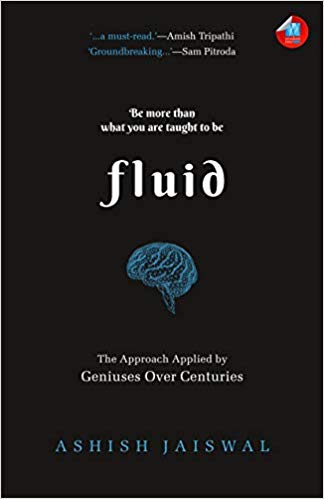
This is the season of results. I am not talking about election results but the results of high school and intermediate students in the country. On one side marks of the students are skyrocketing touching 90 to 99 percent and on the other side, around 22 students of Telangana Board of Intermediate Education (TBIE) has committed suicide because they were failed or did not get expected marks due to some goof-ups in giving marks by the board. Recently, one Delhi woman’s Facebook post became viral as she was feeling proud when her son scored 60% marks in high school examination of CBSE board. Not only this, as per the recent ASER report 2018, 75% of the Std III students of the government schools across the country can not read and perform basic calculations. It shows the grim picture of the Indian education system. In fact, this is the key idea of this book written by Ashish Jaiswal, a scholar from the University of Oxford. He is a humble and down to earth human being.
The title of the book is so intriguing that I had not thought in my wildest dream that the author is going to discuss the education system of India. How the Indian education system is creating rote learners, unemployable and unskilled graduates? There is one more peculiarity how the so-called best education system provided by IIT-IIM and foreign degrees creating money minting machines. These people have no concern and responsibility for the “Lok Kalyan” means public welfare the term used by the author to answer the question- ‘what should be the ultimate purpose of our life’? The sad example of this rat race is suicide of Sarveshresthra Gupta, graduate from one of the Ivy League colleges. He ended his life due to stress and work pressure.
Why India despite being the oldest civilization in the world is still behind its counterparts at various fronts? Why no Indian university has achieved the feat of the best rankings in the world ? Why there is a massive “brain drain” from India to western countries? Why we are still talking about poverty elimination in our country even after seven decades of Independence? Why our education system are not able to produce more number of people like Amartya Sen, Rabindranath Tagore & E Sreedharan and producing mediocre engineers, doctors and social scientists. Why do we Indians still feel inferior to western people in culture, language and heritage of our country? There might be a number of reasons behind these questions. But I am confident that the way Indian education system evolved over the years is one of the most important reasons which drags India behind. Why this is so?
This book tries to answers these questions. Being fluid means be more than what you are taught to be. As per the author, you become fluid specialist when you explore the universe in integrative form, learn from your surroundings and take the inter-disciplinary approach to create knowledge and wisdom. Anti-fluidity in terms of compartmentalization of the streams in different subjects taught in the school has made us unimaginative. We are told to choose our specialization after our high school exam when we are hardly aware of the world around us. Everyone hear this conversation. Choose science and mathematics and your life will be set. Go for engineering or medical or commerce, you will earn good money. Go abroad and earn in US dollars. Nobody tells us, “follow your passion and do something for the greater good”. Not only this, when you want to explore the world or you want to take a gap in your studies, this decision is looked down upon by the society in general and family in particular. The author mentioned about Rene Descartes, father of modern Western philosophy who once left his education for the sake of travel. He is the one who wrote- ‘I think, therefore I am’.
In fact, the author has shown how the whole theory of right-brain and left-brain is complete non-sense. The author quoted Neil deGrasse Tyson, american astrophysicist who completely rejected this theory saying that these fake divisions between science and art is taking our civilization away from true learning. Charles Percy Snow, British scientist and novelist in his book, ” The Two Cultures and the Scientific Revolution” highlighted the huge gap between those studying sciences and arts and concluded that lack of exposure to other academic circles led to hostile and distorted image of each other.The sheer categorization of subjects into STEM and non-STEM shows the stereotype mindset towards social sciences subjects.
This book tells us to be fluid in our approach towards the process of learning. Spontaneous learning is the most beautiful thing. It not only makes you a better person but also gives you various perspectives to understand the world. The author of the book mentioned many learned people like Charles Darwin, Aristotle, Leonardo Da Vinci, Goethe, Amartya Sen, C V Raman, Peter Geddes, Frank Lloyd Wright, Edwin Land, Steve Jobs, etc who did not follow a set path and explored the universe.They exposed themselves to diverse fields of education. The fluid approach which was depicted in the form of charkha(wheel) by the author appreciates the ‘integrative nature of the universe’. In the era of digital technology and artificial intelligence, when there will be more monotony and job losses, the people who are fluid in their approach will have more chances to survive because of their exploratory nature and never-ending desire to challenge the defined boundaries.
One of the most important findings of Jaiswal is that India should get credit for Da Vinci’s Vitruvian man. The undiscovered Hans Purush from Vishnudharmottaram Puranam mentioned by Rishi Markendeya was one of the perfect men discussed in the Purana. In fact, the author wants to stress the point that human knowledge is circulatory. The world has been benefited not by one single country or race but by the combined intelligence of all spread over the thousands of years. For instance- architectures around the world are the best example of combined intelligence and cultures of humanity. The best example mentioned by the author is our India Gate which not only incorporated western architectural influences but also the elements of Indian architecture in terms of the dome on the top and canopy structure in front. Indians should not feel inferior of their history, culture, language, etc because we have a lot more to offer to the world not only with respect to new knowledge but also we gave the idea of spiritualism and simplicity to the world.
This book is a culmination of out-of-the-box thinking. The author tried to challenge the stereotypes and boundaries built by society. He wants readers to be a learner who explores the universe, gets inspired by the surroundings and creates a melting pot of intelligence to work for the public welfare. Most importantly, as a public policy student, I always look for solutions keeping in mind that world is full of complex problems. I agree with the author that there are many issues plaguing the Indian education system but what are the solutions. How can we inspire everyone to be fluid in their approach?
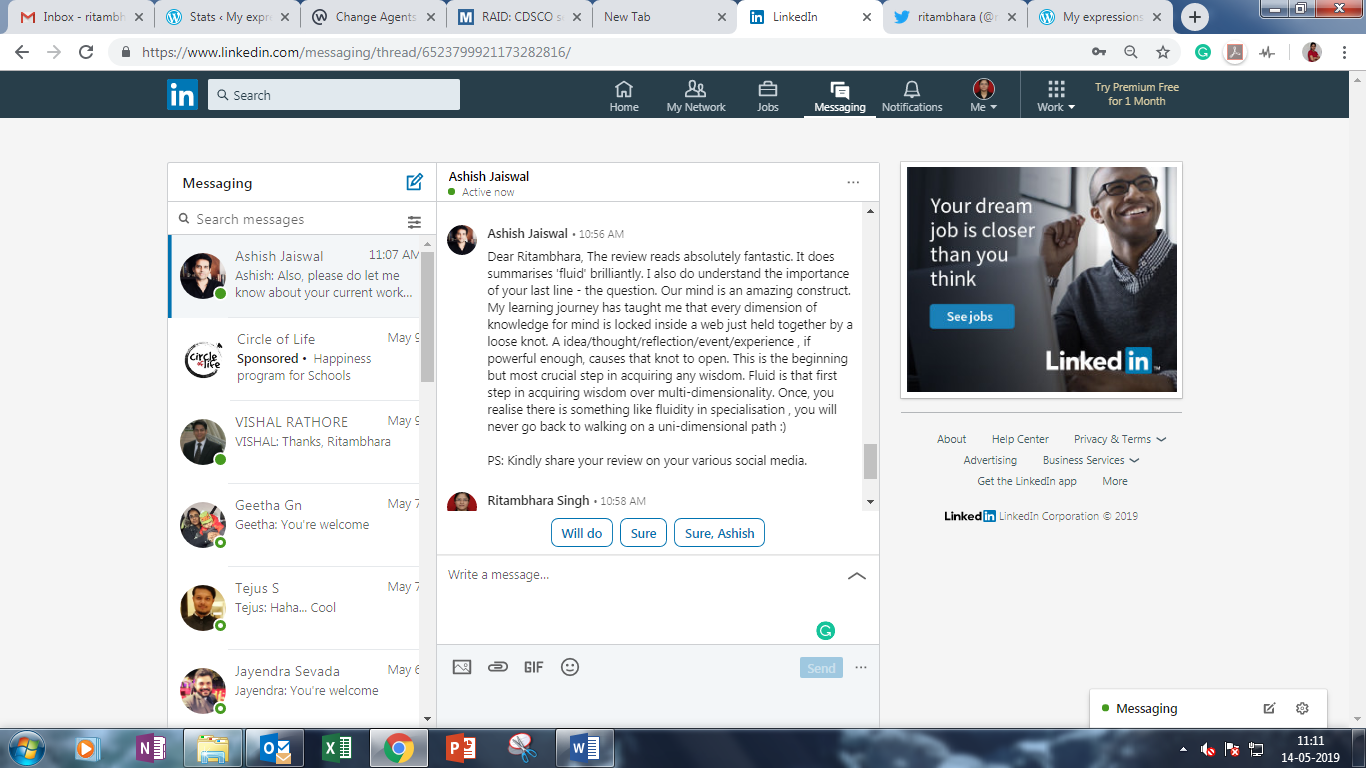
Please find the author’s Comment on this review:
Dear Ritambhara, The review reads absolutely fantastic. It does summarises ‘fluid’ brilliantly. I also do understand the importance of your last line – the question. Our mind is an amazing construct. My learning journey has taught me that every dimension of knowledge for mind is locked inside a web just held together by a loose knot. A idea/thought/reflection/event/experience , if powerful enough, causes that knot to open. This is the beginning but most crucial step in acquiring any wisdom. Fluid is that first step in acquiring wisdom over multi-dimensionality. Once, you realise there is something like fluidity in specialisation , you will never go back to walking on a uni-dimensional path 🙂
“Public Policy is whatever government choose to do or not do”
Thomas R. Dye (Political Scientist)
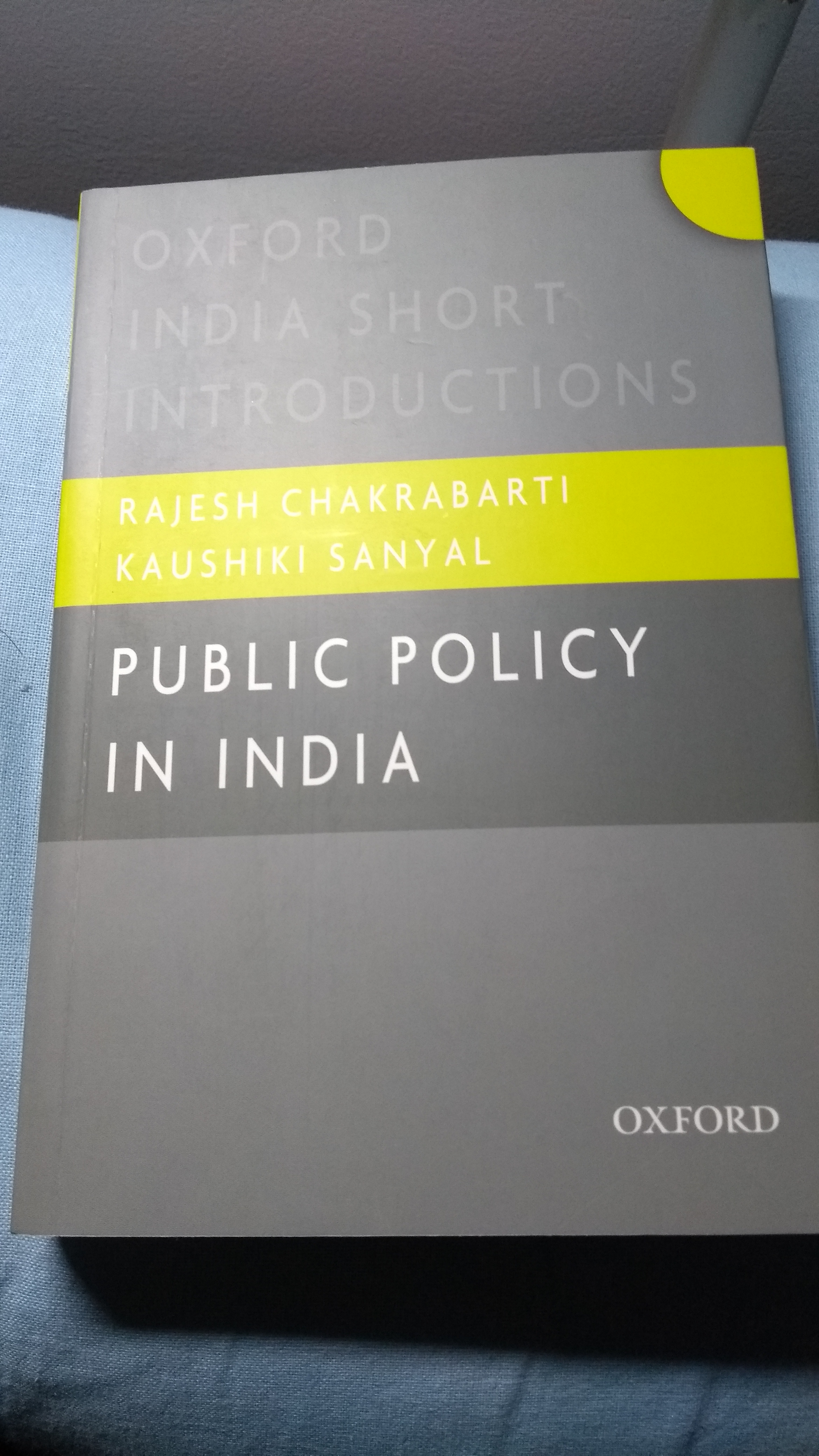
I got this interesting opportunity to listen to the lectures of Dr. Rakesh Chakravarti and Kaushiki Sanyal (Authors of this book) during the Policy Boot Camp 2017 where this book was part of our reading materials. This book is quite short and interesting as it talks about the origin and processes of policy making in a few pages. Every public policy enthusiast read this book before venturing into the complex field of public policy.
In these few pages, this book answered all intrigued questions related to public policy. For instance: What is public policy? What is the origin of public policy? How can we contribute to policy making? What are the institutions which provide degrees in this area? What are the stages of policymaking exercises? When did public policy as a discipline become popular in India? It touches almost most of the aspects of the policy making and encourages us to read more about the issues in the domain of public policy. And this book is quite significant for Indian policy students as it has been written in the context of current issues dominating in the social space of the country. It talks about the nirbhya rape case as well as public transport revolution created by Delhi metro.
The authors have tried to trace the history of public policymaking starting from HaroldLasswell‘s basic definition of public policy as ‘whogetswhat,when and how‘asthestartingpointforthisexistence.They also discussed in detail the transformation of Bihar in the leadership of Nitish Kumar emphasizing that a great leadership can bring about substantial changes in a short span of time.
They talked about the challenges of policy implementation and evaluation. The ideas of RandomisedControlTrial(RCT) and the differenceindifference principle as methods for effective implementation of public policies were explored in the book.
They tried to tell the policymakers of the country not to be dogmatic so that they can adopt various perspectives from around the world in the policymaking process. In the last pages of the book, the authors provided various innovative solutions to overcome various challenges to policy making, implementation, and evaluation. They tell you, how to broad-base policy-making, how to increase legislative capability, and how to evaluate policies in a better manner so that we can develop better policies.
I would recommend this book to all current and future policy makers so that they can understand the nitty-gritty of policy making in just a few pages.
In this case study, there was a group where we have to play different roles like someone was playing a representative of the private sector, another three people were playing the role of local government and another was a representative of the government. So, it was a great learning experience and realization towards the complexity of public policy making, implementation, and its challenges:
The first time in my life, I realized how difficult it is to bring about consensus on any one particular issue. It is very difficult to satisfy the aspirations of each person in the group.
I was acting as a representative of the government and I had to mediate between private sector representatives and local government representatives.
When the discussions were going on, suddenly one of the local representatives went outside the room saying that he didn’t agree with the proposals. This showed the kind of emotions someone goes through when it comes to your self-interest.
At last, we somehow reached a deal but I think that I, as a government representative, gave more concessions than it was required.
I don’t know if I acted in a good sense or not? Even so, it was quite insightful and an eye-opening exercise that provided an interesting experience of nuances of policymaking. Convincing and negotiating with others when their self-interest is involved is a very difficult issue. We keep on criticizing our leaders, bureaucrats, policymakers, teachers, etc., but we never put ourselves into their shoes to understand their constraints and challenges.











 Policy Wise