The idea of ‘sustainable development’ came into the limelight in the 1980s after some extreme events like ‘acid rains’ and the human disasters of the Bhopal Gas Tragedy[i] (1984), Chernobyl Nuclear Disaster [ii](1986), etc. Brundtland Commission Report titled “Our Common Future” has given the idea of sustainable development. As per the report, “Sustainable Development is the development that meets the needs of the present without compromising the ability of future generations to meet their own needs”.
The UN Sustainable Development Goals (SDGs) adopted by the international community in September 2015 under the UN Sustainable Development Summit, comprehensively cover social, economic, and environmental dimensions and build on the Millennium Development Goals (MDGs). There are 17 SDGs which have 169 targets to be achieved by 2030.
17 Sustainable Development Goals (SDGs) are given below :
No Poverty-End poverty in all its forms everywhere.
Zero Hunger-End hunger, achieve food security and improved nutrition, and promote sustainable agriculture.
Good Health and Well-Being for People– Ensure healthy lives and promote well-being for all ages.
Quality Education– Ensure inclusive and equitable quality education and promote lifelong learning opportunities for all.
Gender Equality– Achieve gender equality and empower all women and girls.
Clean Water and Sanitation– Ensure availability and sustainable management of water and sanitation for all.
Affordable and Clean Energy: Ensure access to affordable, reliable, sustainable, and modern energy for all.
Decent Work and Economic Growth: Promote sustained, inclusive, and sustainable economic growth, full and productive employment, and decent work for all.
Industry, Innovation, and Infrastructure: Build a resilient infrastructure, promote inclusive and sustainable industrialization, and foster innovation.
Reducing Inequalities: Reduce income inequality within and among countries.
Sustainable Cities and Communities: Make cities and human settlements inclusive, safe, resilient, and sustainable.
Responsible Consumption and Production: Ensure sustainable consumption and production patterns.
Climate Action: Take urgent action to combat climate change and its impacts by regulating emissions and promoting developments in renewable energy.
Life Below Water: Conserve and sustainably use the oceans, seas, and marine resources for sustainable development.
Life on Land: Protect, restore, and promote sustainable use of terrestrial ecosystems, sustainably manage forests, combat desertification, and halt and reverse land degradation and halt biodiversity loss.
Peace, Justice, and Strong Institutions: Promote peaceful and inclusive societies for sustainable development, provide access to justice for all, and build effective, accountable, and inclusive institutions at all levels.
Partnerships for the Goals: Strengthen the means of implementation and revitalize global partnerships for sustainable development.
These goals are very comprehensive and universal in nature. They are a big improvement over the MDGs because SDGs were developed after a long multi-stakeholder consultation process. However, the SDGs are also criticized due to various challenges in achieving them as well as their lack of focus on social issues:
The goals are wishful and unattainable. For instance- the eradication of poverty by 2030 will be almost impossible in the wake of low economic growth and various other issues in the conflict-ridden world. The biggest criticism came from The Economist calling SDGs ‘worse than useless’.
There is also criticism regarding the definition of “sustainable” itself. There is no precise definition of sustainable development. Even UNDP has not taken any effort to define the idea of sustainable development.
Achieving the goal of sustainability, not only in developing countries but also in the developed world will need a lot of funding. The absence of planning regarding the financing of SDGs is the biggest drawback of these goals.
There is also a lack of support for developing and poorer countries on the part of developed countries for financing and technology transfer to achieve the goal of sustainable development. For instance-
There is also a lack of political will to deal with the issue of environmental degradation and climate change in various countries of the world. For instance- Under the leadership of Mr. Trump, the USA has withdrawn from the Paris Climate Agreement.
Natural occurrences and disasters such as earthquakes, tsunamis, etc can pose a threat to sustainability.
The government’s conflict between immediate profit and investment in sustainable technologies can also derail the implementation process of SDGs.
There is no proper monitoring and ownership mechanism to measure the implementation of SDGs in various countries of the world.
Many experts also criticized the SDGs for not putting enough emphasis on social issues whilst the goals regarding the environment and economic security are extensively secured.
Challenges for India to achieve Sustainable Development Goals (SDGs):
India[iii] accounts for the largest number of people living below the international poverty line with 30% (800 million) of its population living under $1.90 a day. Pulling this massive population out of poverty will be a nearly impossible task for India without international support.
A new study[iv] estimates that implementing SDGs in India by 2030 will cost around US $14 .4 billion.
It will be a big challenge for NITI Aayog to monitor and provide innovative solutions to achieve the massive targets of SDGs.
India’s huge geographical as well as cultural diversity can also be a challenge to achieve the goals of sustainability because the needs and requirements of various regions are varied and they will need context-specific
India’s federal structure and differences among the States regarding the development indicators can also create challenges but if channelize properly in terms of “competitive federalism” can also turn into an important tool to achieve the goals of sustainable development.
In the context of India with a huge population and social challenges like massive poverty, hunger, malnutrition, acute gender discrimination, and low per capita income, these goals are nearly impossible to achieve. However, India[v] can play an important role in achieving sustainable development goals. In fact, these goals can be treated as ‘ideal goals’ which can act as a guideline for the national and international governments to measure their success in achieving inclusive and sustainable development.
It is ironic to see that “Government’s work is God’s work” is written on the Vidhan Soudha, the seat of the State Government of Karnataka but the 24% of newly elected MLAs of the Karnataka Legislative Assembly face serious criminal charges. Even India’s temple of democracy i.e. parliament is filled with lawmakers who have criminal backgrounds and more disturbing thing is that the percent of legislators facing criminal charges have increased in the subsequent General Elections. For instance, 34% of MPs elected in 2014 faced criminal cases as compared to 24% of MPs elected in 2004.
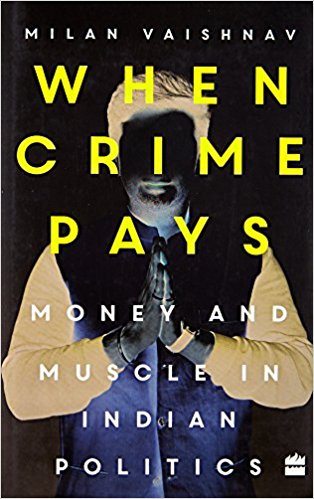
On the face of increasing criminalization of politics, Milan Vaishnav, senior associate at the Carnegie Endowment for International Peace in Washington, DC, book “When Crime Pays: Money and Muscle in Indian Politics” is an eye-opener in terms of understanding the puzzling co-existence of criminality in politics along with the democratic accountability. The author has tried to address the questions of their co-existence since the beginning when they acted as “anti-social elements” to mobilize the voters for their masters(politicians) to becoming the lawmakers themselves.The author has beautifully applied the concept of a market in terms of ‘supply’ and ‘demand’ to understand the “electoral marketplace” where voters play a ‘role of buyers’ and political parties play a ‘role of sellers’. And the most interesting thing is that all these players are guided by their self-interest. Voters want the governance vacuum to be filled, political parties want self-financed candidates and criminal candidates want self-preservation and self-protection.
The origin of this whole criminality in Indian politics which has deep historical linkages in the post-independence era when these anti-social elements acted as a facilitator to the politicians. However, these elements entered into the political fray due to the breakdown of the Congress party’s patronage networks, vacuum created in the governance process due to the emergency declared by Indira Gandhi in 1975, increasing social demands in terms of ‘identity politics’, the huge ‘crisis of governability’ when Indian state fails to deliver basic services to the citizens. However, the author has provided an important insight into the book,
“Electoral support for the politicians with criminal records is not necessarily symptomatic of a breakdown in democratic accountability. Instead, malfeasant politicians and popular accountability can in fact be compatible to each other”.
-Excerpt from the book
In fact, this whole idea refuted the concept of “ignorant voter scenario hypothesis”. In fact, the voters are not ignorant or uninformed, they are simply looking for candidates who can best fill a perceived vacuum of representation and protect the status of the community. The author through his various field surveys, as well as interviews of the candidates, provided interesting details of the criminalization of politics in India and what are the causes as well as how it is sustained in the strong society like India.
The supply of criminal politicians and money power is intertwined to each other as money plays an important role in the election expenditure. This also has historical underpinnings when the corporate donation was banned by the then Prime Minister Indira Gandhi to appear harsh on ‘crony capitalism’ which in turn created the pathway for black money and hard cash to enter into the election financial regime. Not only this, India’s grand corruption in terms of ‘regulatory rents’, ‘extractive rents’ and ‘political rents’ created a linkage and interaction among them created more ground for criminal politicians to emerge. The author has quoted the example of ‘Reddy Brothers‘ in Karnataka, Madhu Koda of Jharkhand, YSR & Jagan Reddy from Andhra Pradesh showing that how they have extracted rents from natural resources taking advantage of severe gaps in India’s governance system. This whole corruption and hard cash create a lot of money power which helps in winning the elections. In fact, as per the analysis provided by the author, candidate’s wealth and electoral success are highly linked, richer is the candidate, more chances of winning. It answers the questions of why political parties select the candidates from the criminal backgrounds.
There is also calculated reasoning on the political parties to select ‘self-financing candidates’ who do not drain the party coffers but can provide rents to the party in the wake of costly elections, increasing competition etc. Criminal Politicians are like “Robinhood- one who robs the rich and gives to the poor” who act as a credible representative in a multi-ethnic society like India. The idea of Robinhood has been a recurring theme of Bollywood movies sometimes inspired by the real characters of Indian politics. That is why the author has named one of his chapters- doing good by doing bad to address the demand side of criminality. In fact, this shows that these bad politicians use various tools like ‘redistribution’, ‘coercion’, ‘social insurance’ and ‘dispute resolution’ to signal their credibility to protect the interest of their community. This whole politics of dignity rhetoric creates an extensive ground for “defensive criminality” to flourish.
The failure of the state to maintain rule of law, deeper social cleavages and ethnic differences create demand for criminal politicians to protect the interests of their community. The author has also provided an interesting insight in terms of the role of ethnicity in creating push of criminality as it was found that less number of criminal candidates contest from reserved constituencies as compared to general constituencies. The less criminality in reserved constituencies is due to the need of appealing to all section of voters for winning the election.
Ultimately, the conclusion of the author in the book is that the real factor of the emergence of criminality in politics is ‘institutional erosion’ of the Indian state. In fact, the capacity of the Indian state was questioned many times by various authors. Gunnar Myrdal in his book “Asian Drama” called India as a “soft state” because of its failure to implement basic economic and social policies efficiently and effectively. There is also a paradox of “weak strong state” as called by Lloyd and Susanne Rudolph where the Indian State is able to send Mars Mission in its maiden attempt but it is not able to fulfill the basic necessities of its citizens.
In fact, most of the book related to Indian politics reach this conclusion that we have achieved so much but our ‘institutions’ need radical reform to strengthen the capacity of the state. That is why the author also says, “Downsizing the state” or “enlarging the state” are imperfect catchphrases; what is needed, in a nutshell, is for the Indian state to be “right-sized”. It means that we need a radical restructuring of the institutions like the police, courts, political parties, the election system in terms of funding etc to make it more strongly to perform the role of a strong state who is not mocked when it can do more difficult things but not able to provide basic necessities of the people.
The author in 311 pages has provided a comprehensive study of the nexus between crime and politics which also has implications for other countries of the world. As the author also wrote about the other countries like Brazil, Mexico and many African countries where similar scenario exists. This book was quoted by the recent Supreme Court Judgement on the criminalization of politics where the Supreme Court has ordered the Parliament to legislate to bar the criminals entering the mainstream politics. It is also the winner of Kamaladevi Chattopadhyaya NIF Book Prize for Best Non-Fiction Book of 2017.
However, as per my understanding, the book has fallen short in providing concrete solutions to deal with the problem of criminalization of politics. It has provided broad solutions which are already there in the public domain regarding the strengthening the institutions, reforming the whole governance process which is, in fact, an ongoing process. The criminalization of politics is a deep malaise also agreed by author reflects the overall attitude of society in terms of voting behavior guided by narrow interests of self-preservation, development and quick success. We obviously need the restructuring of the institutions along with that there is a need to inculcate good values, ethics, and morality in the society since childhood to make India a better nation because of it’s the people who constitute nation and state.
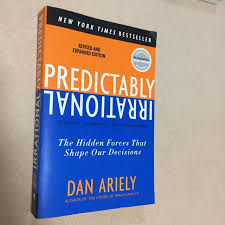
Nobel laureate Herbert Simon gave the concept of“bounded rationality” which tells us that the human mind can not cope with the complexity of the world due to the limitations in their mental capacity. To make sense of this complexity, we create a simplified mental model of reality and work with this model. Obviously, the model created by us is full of biases, stereotypes and irrational views. On similar lines, the author of this book-Dan Ariely tries to understand the rationale behind irrational decisions taken by human beings who are termed as the most intelligent species of their time. A personal tragedy motivated him to write this book.
The quote “Man is not truly one, but truly two” by Dr. Jekyll tells the crux of human behaviours. We always wonder after seeing various newspaper reports related to irrational crimes like teenage pregnancy, rape of children, extreme violence etc committed by sane individuals. Generally, it happens in a fit of arousal which can vary from hunger, anger, excitement, jealousy and importantly sexual arousal. This happens because human beings are not only irrational but systematically and predictably irrational. MIT Behavioral economist Dan Ariely proved in his book through various experiments which makes you understand irrationality in human behavior so that we can design our choices for the better decision-making process.
Dan Ariely in this book has tried to substantiate through various experiments that despite all achievements and wonders achieved by human beings, we behave irrationally in our daily life because of wiring in our brains. We behave irrationally because its easy for our brain to make things clear in a complex world. He talks about relativity and tells that we don’t have ‘internal value meter’ that can evaluate the worth of any product or other emotional things also. We always compare things to understand its worth. In fact, relativity helps in the decision-making process but it also makes life miserable because of never-ending quest of getting physical and other emotional things in life better than others.
These ideas are very much visible in our daily life. We all experience the phenomenon of comparing with our neighbors, friends, colleagues etc. In fact, we also get suggestions from others that don’t compare yourself with others. However, we can’t stop doing this because we don’t have any other way to measure things. Not only this, we make very crucial decisions in our life like buying things, subscribing magazines, choosing the life-partner etc with the help of relativity.
The zero-price effect creates an emotional pull for all human beings to participate in the processes which offer things for free. We automatically accept the free beer or Pepsi or energy drink not because we liked it or we needed it but because it’s free. At times, the zero price can affect our decision-making process in a negative manner also as seen in terms of wastage of common resources owned by humanity.
One of the interesting findings in the book is that “we live simultaneously in two different worlds -one where social norms prevail and other where market norms make the rules”. In fact, social norms and market norms exist together in the society but whenever they collide, it creates a lot of problems. We can not measure the value of emotions and other social norms in monetary terms. When the social norms are converted into market norms, it is very difficult to go back. Here the author gave the example of a study conducted in a school in Israel where parents were penalized if they came late to pick up their children. The result was disastrous after this, as parents now didn’t feel guilty about coming late to pick up their kids, as social norms were converted into market norms.
The author also talks about the rampant consumerism, procrastination, problem of self-control, the high price of ownership not only in terms of physical products but also in terms of ideas, point of views. When we agree to one point of view, we just don’t want to change it because of the fallacy of high valuation of whatever we have. And he also proves that due to our stereotypes and expectations, we get in what we expect. The value of price is very important in our life. We lavishly enjoyed the food in a high-end restaurant even if the food is bland because we have paid more for it. That’s why the author mentions that our headache disappears when we take a 50 cent aspirin but it persists when we take an aspirin worth of a penny.
At the end of this book, the author spoke about the character of human beings and why we are dishonest? In fact, as per the author, we are honest till the moment it suits our requirements. When there is an opportunity, many honest people will cheat. It happens because small transgressions do not wake up our conscience and super-ego as propounded by Sigmund Freud. We cheat on small things because of the absence of internal honesty monitor.
In the era of digital banking, the author provides a radical perspective that people are more prone to cheat when they are not dealing with cash. He makes the argument that when we cheat under electronic transactions, we don’t feel it in our hands and therefore we don’t even realize that we are doing something wrong. In fact, it is so true that when we spend money through credit cards, we don’t feel the pinch but when we buy things through cash, we feel about spending money. In fact, this can be the reason behind various electronic frauds happening in various parts of the world. Daniel also revealed one interesting thing about honesty. That is when someone reminds us about moral values and principles, we follow it immediately.
The author also talks about our behavior to influence others and sacrifice ‘ personal utility’ to gain ‘reputational utility’. It happens because we want to show others that we are ‘unique’ and different.
However, the realization that we are predictably irrational also creates opportunities to frame our choices and influence the decision-making process of individuals to make better decisions in life. The zero-price effect can be used to frame good policies in terms of making it free to travel in public transport, using electric vehicles etc. Social norms are cheap and have a strong emotional backing which can be used to influence people to pay taxes, to take care of the elderly etc. In fact, we need to be reminded of moral codes every now and then so that our super-ego does not sleep and makes us aware whenever we try to commit any dishonesty.
In this book, the author provided stimulating and thought-provoking details of human behavior and how human beings are systematically irrational because we repeat our behaviors again and again. This book along with “Nudge: Improving Decisions About Health, Wealth and Happiness”authored by Richard H. Thaler & Cass R. Sunstein and“The Art of Thinking Clearly”written by Rolf Dobelli provides a holistic understanding of human behaviour, its irrationality and how to capitalise on this irrationality by using incentives, nudges, social norms, default options, providing feedback etc to improve decision-making process.
Patriarchy is a system where the male has a dominant role to play and women do not have their “individual autonomy”. The most deplorable thing is that women are considered as the ‘property’ and ‘belonging’ of the males. Women are known as someone’s daughter, someone’s sister, someone’s wife and someone’s mother. She is not ‘she’. She is not respected and pulled back by various means whenever she wants to revolt against this very system. And the most heartening fact is that many of the women accept consciously as well as unconsciously this very system. Almost every critical issues related to women is interlinked with patriarchy and if you really notice that you will find out that almost all of the serious legislation related to women have come through the Supreme Court. The executive has hardly taken actions and legislated on its own related on women issues. We can count this on our fingers- Shah Bano Judgement, Vishakha Judgement, Judgement on sterilization of women, Nirbhaya Judgement, Shayra Bano Judgement, Lata Singh Judgement and the list is long where almost all critical concerns of women are addressed by various judgments with the help of civil society or individual fight. It is happening because as Radical Feminists rightly said,“State is a patriarchal state” and ” State is for men and by men”. On the face of it, a constitutional bench of Supreme Court in his recent PIL filed by Joseph Shine questioned the constitutionality of the Section 497 of the IPC and Section 198 of Criminal Procedure Code which violates Article 14, 15 and 21 of the Constitution of India. In this hearing, the Supreme Court has said that ‘adultery law’ violates the dignity of women’.
Adultery basically refers to extra-marital voluntary sexual intercourse. It is a criminal offense in India under Section 497 of Indian Penal Code(IPC). It is also one of the grounds under which divorce can be granted. This Section 497 like others archaic acts is the colonial hangover which is totally paternalistic, parochial, outdated, arbitrary, anachronistic and a replica of Victorian mindset. The provisions of Section 497 are given below:
“It says that a man could be punished up to five years in jail if he has ‘sexual intercourse’ with another man’s wife. It makes it clear that the wife will not be considered as an abettor and will not be punished”.
The most inhuman part of the act says that” it is not a criminal offense when a man has the sexual intercourse with the wife with the consent and connivance of the husband of the woman”.
“It does not criminalize adultery if the husband has consensual sex with an unmarried women, whereas a married women having similar relationship with a bachelor may find her paramour being punished for the offense.”
The provisions of the Section 497 IPC treats married women as the “personal possession” of the husband which is inhuman,against the dignity of women and denying the sexual autonomy which is recognized under the “Right to privacy”judgment. It is like women are some objects(Car etc), when the husband wants, someone else can use it. I also agree with the argument made by Sai Deepak, Advocate of Supreme Court that this provision clearly helps in the objectification of women. The most absurd thing is that under section 198 of CrPC, only “aggrieved husband” can complain about the adultery and not the wife. It is, in fact, the clear-cut reflection of the system of patriarchy which is written in the law.
The most profound defense for keeping this provision is made in terms of “protecting the institution of marriage”. Whenever any issues related with women for instance marital rape, domestic violence etc come into the limelight, this is the last argument put forward by those who are part of this patriarchal system. I just want to ask one question- if the institution of marriage is so strong, why there are discrimination, subjugation, and violence against women in marriage. This provision needs to be scrapped or modified where women should also be punished and they should also be given the right to complain about the husband, by the Supreme court to restore the dignity and autonomy of women. In fact, 42nd Law Commission of India report, 1971 andMalimath Committee on Criminal law Reforms, 2003 suggested that this section should be amended to make it gender neutral. Not only this, National Commission of Women(NCW) in 2006 put forward the view that this section needs to be decriminalized. However, recently NCW said that women cannot be punished for adultery but they should be given right under section 198(2) so that they can also prosecute their husband for his promiscuity. It needs to be emphasized here that the Supreme Court Bench also said that decriminalizing the section 497 does not give any license to people to involve in licentious behavior.
It is a cliche that the law should reflect the changing times when the Supreme Court has accepted the “right to privacy” and considered to decriminalize the homosexuality under section 377, Indian state should come forward to deal with structural flaws present in the institution of marriage to make it more gender neutral and equitable. Indian State must not protect the system of patriarchy and behave like a “patriarchal state” as women are one of the most important constituency of the country who not only helps but also contributes towards nation building. Many European and South Asian countries like Bhutan, Srilanka, China, South Korea has decriminalized the adultery. In fact, UNHRC has recommended all the governments to do away adultery as a criminal offense saying that it is a violation of human rights.
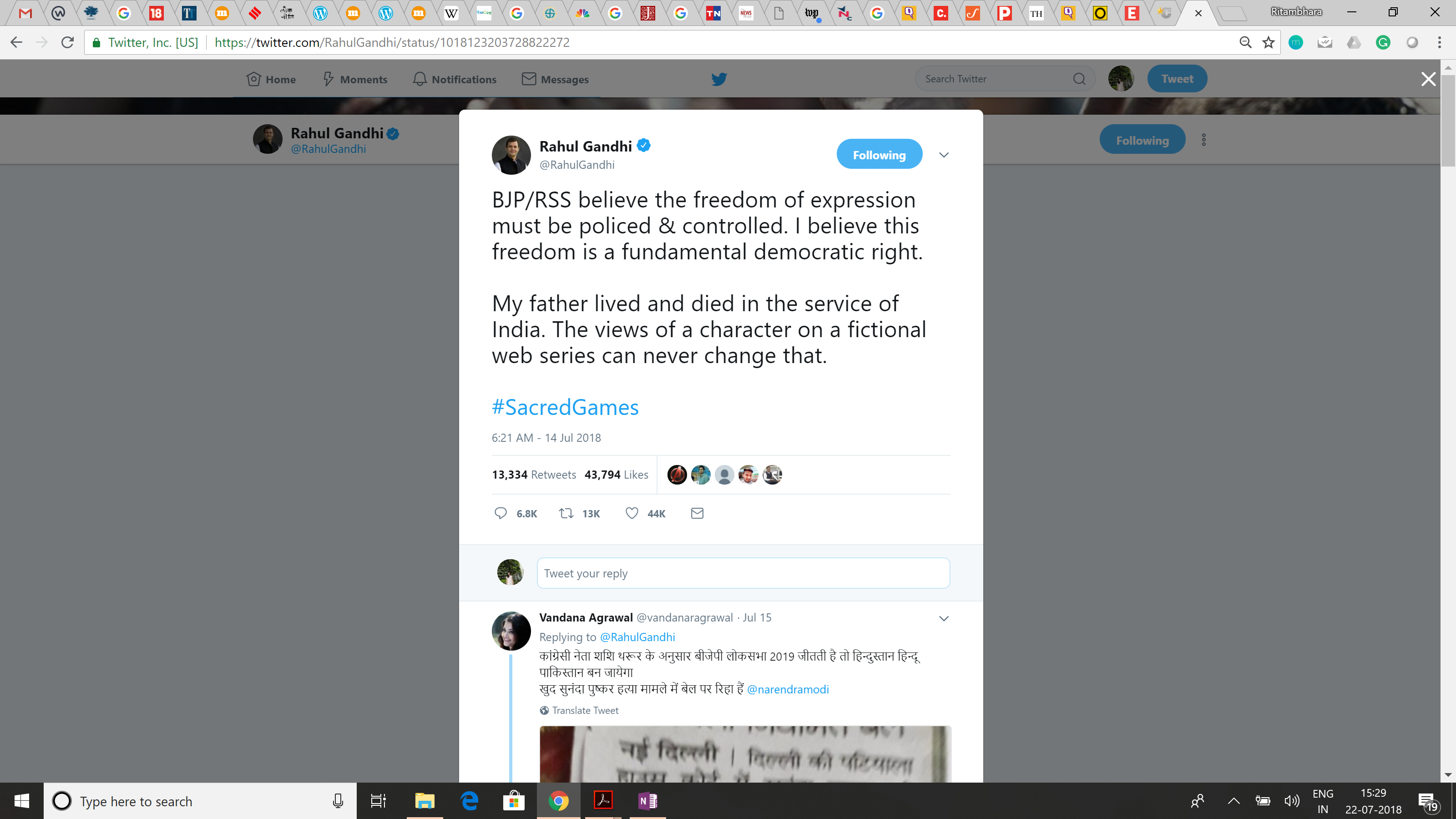
I became a lot more interested in the series when I saw Rahul Gandhi’s tweet about it. It was in the news when one Congres member from West Bengal filed a petition in the court against the series for disrespecting the then Prime Minister because the protagonist used cuss words to criticize the decision on Shah Bano Case and Bofors scam.
Not only this many articles and reviews came in the national newspapers like The Hindu about this TV series saying that this series reflects ‘the coming of age for Indian Television’. Then I decided that I will certainly watch this series. One weekend, when I started watching this series, I didn’t even realize when I finished four episodes and the impact(as I get so much involved in whatever I watch) was so intense that I couldn’t sleep for a few hours. I was constantly thinking about it and what will happen in the next episodes. The next day came, and I again got glued to my cell phone and finished all the next four episodes as if the world is going to end before I need to know what will happen in the next episodes.
This whole series also reminded me of the Gangs of Wasseypur 1 and 2 which was also directed by Anurag Kashyap. These movies are also very intense and show you the real picture of our society. It makes you see things from a very objective perspective as we all know that human beings are flawed and no one can be perfect. Along similar lines, “Sacred Games” is mind-blowing, intense, gripping and shows the reality and pinches you at every scene to think about the issues present in our society and polity and how these issues shape our thinking, decisions and are the basis of our politics. It is an adaptation of a book of the same name by Vikram Chandra.
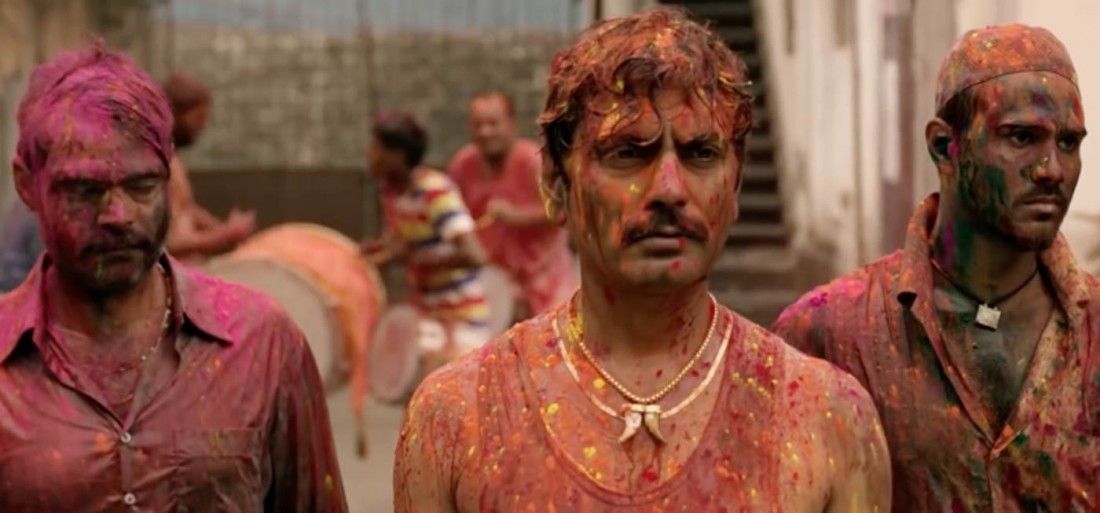
There are two main characters- Sartaj Singh(Played by Saif Ali Khan) and Ganesh Gaitonde(Nawazzudin Sidique). Sartaj Singh is an honest police officer who chases the underworld don Ganesh Gaitonde. Sartaj Singh’s part was directed by Vikramaditya Motwane. Their stories are going on parallel in the series. I am not here to tell anyone the story of the series. The most interesting thing about this series was to link the scenes with the then political situation of India. This interconnection with politics, I also noticed, was present in Gangs of Wasseypur. The description of major political events provides you the linkage and compels you to relate political events with the social happenings and it also compels you to think that how much a decision taken by the political leaders can impact the society in various unpredictable ways. That is why I say that “SACRED GAMES” is all about Indian politics” You take out the politics from the series, it has nothing to narrate.
Religion is one of the important themes of this series. The name of the series- “sacred” means related to God. The first episode starts with dialogue by Nawazuddin-“Do you believe in God?, “God does not give….F………” In fact, every prominent scene is somehow linked to religion, and the life of the protagonist Gaitonde also moves around religion. He questions everything related to religion and provokes you at every moment. It teaches you how “religion” is used as a manipulative tool to control people and ultimately mobilize and polarize people to exercise their franchise in elections. How ‘caste’ and ‘concept of pollution and purity’ are two important tools that are so inherent in our mindsets and in our daily lives that we don’t even realize that we are biased towards them. Here I remember the quote by Swami Vivekananda- “There is a danger of our religion getting into the kitchen” and unfortunately this is what has happened. The menace of “untouchability” has divided our society till today even after the abolition of it, under Article 17 of the Indian Constitution.
The series also tells about the “god-men” present in our society and how these worthless people brainwash young people towards inactivity, self-doubt, and destruction. I get irritated whenever these people come into the limelight. They are the most hypocritical people in our society. Here I remember a story –An Astrologers Day of R K Narayan, where a person is unemployed and has nothing to do then, he becomes a baba who has only one work, to manipulate people for his own benefit.
It was really ironic when the directors try to unfurl the whole “Kamandalisation of Indian politics” starting with the then Prime Minister Rajiv Gandhi’s decision of the Shah Bano Case and he denied the benefits of this decision to Muslim Women by passing the Muslim Women Benefit Bill in 1986. It is also written in various books that he was the one who ordered the opening of the lock of the controversial Ram temple. However, the most interesting observation was the decision to allow the show “Ramayana” by Ramanand Sagar which started in 1987 exactly at the same time that created the image of “Rama” in the psyche of every citizen of the country.
In fact, in one of the hilarious scenes where ‘Gaitonde’ is talking to ‘Trivedi’, he cuts him short by telling that he has come from the generation where Ramayana was created by Ramananda Sagar and not Valmiki. Here I would like to share an incident- Every Dasherra, we witness “Ramleela” at Ramleela Maidan in Delhi. It’s not the people who play Raam, Lakshman, and Sita who are important but the people in power. Basically, the people who are in power kill Ravan in the Ramleela. It also shows that how the then Prime Minister used “appeasement politics” towards both communities which finally led to the catastrophe of the Babri-Masjid Demolition and subsequent riots in various cities.
Hindu-Muslim riots happen in our country consistently and it destroys innocent lives. The series also showed that how innocents are like “collateral damage” in the war between two communities. When Gaitonde’s wife “Subhadra” is killed and he goes on a spree killing thousands of people from other communities just to take revenge is a grim reminder of the philosophy of ‘an eye for an eye will make the whole world blind’. Through the role of Katekar(Police Constable), the series also shows the inherent bias in the system towards minority communities. But it also shows honesty and commitment to service by the same constable and how he is feeling guilty when he didn’t work for one particular case.
There is so much to write about this series that in every scene it is forcing you to think and relate to the pressing issues of society and politics. In fact, the role of the Cuckoo( Kubbra Sai) was very bold and it tells you that it is high time that Section 377 must be decriminalized because those people are also human beings and we must give them space to live as we all agree that this is an era where “human rights” are the most important. You need to accept those people as they are.
However, on a critical side, the series is loaded with pessimism with a “ray of hope” here and there. It also reminds me of the book Homo Sapiens by Harari where he convinces us that we have created religion and it is one of the most successful myths which binds the people in one or the other community and if we want to get out of this myth, we have to create another ‘myth’ to survive. Here, I also remember the conversation between Gaitonde and his wife Subhadra where they talk about religion and Subhadra tells that ” religion gives hope to the poor”.
This series is a powerful depiction of the reality of society and it forces you to think about various issues prevailing in our society. It successfully portrays the nexus among politicians, businessmen, crime, and religion through godmen and I was flabbergasted when Sartaj Singh’s mother watches the same godmen who is the main villain in coming episodes played by Pankaj Tripathi. Things are so connected and are part of our daily routines that it is very difficult for us to unlearn them. It’s up to us to create awareness among others and understand the issues in an objective manner and make others aware of their biases. As Sartaj Singh’s father Dilbag Singh practiced goodness without discriminating between people as criminal or innocent, we should also practice the same. The scene where he gives ‘roti’ to Gaitonde when he is locked up in ‘anda cell’, tells me to be hopeful and positive even if there is so much manipulation, cheating, lies, etc in this world.
Transparency and accountability are one of the most important pillars of any democracy to function in an effective manner. When India adopted the Right to Information(RTI) Act in 2005, it ushered into the era of ‘good governance”. However, achieving good governance is not a goal but it is a continuum and it needs to be supplemented by the other steps in terms of giving statutory backing to the concept of citizen charters, enacting the Rights of Citizens for Timely Delivery of Goods and Services Act and the Transparency of Rules Act. In fact, the government already introduced the bill related to the time-bound delivery of goods and services including the concept of citizen charters. However, the bill got lapsed. It needs to be reintroduced.
However, I want to talk about another issue which the Economic Survey 2017 proposed in its Volume II. I want to congratulate the former Chief Economic Adviser Arvind Subramaniam who has made the Economic Survey an intensive document by introducing many innovative ideas and principles. It’s up to the government of the day to take forward these ideas and make it a reality. The Volume II of Economic Survey 2017 introduced the idea of Transparency of Rules Act(TORA).
TORA is aimed at putting an end to the asymmetry of information, rules, and regulations imposed upon the average citizen. The act requires all government departments to display all rules affecting the citizens directly on their website. If the rule is not displayed on the website, the rule cannot be imposed upon the citizens. All rules have to be updated regularly and the history of all rules will also have to be displayed. Every department after displaying all the information related to laws, rules and regulation will become “TORA” compliant. Once a department has been declared TORA compliant, citizens can be sure that the information provided is authentic and updated.
As per the law, a person cannot take “ignorance of the law” as a defense for not complying with the law. Once TORA is implemented, any rule which is not displayed on the website of the government that applies to a citizen cannot enforce against them. This does not act as an exception to the principle of ‘ignorance of law’ but helps strengthen by holding the government accountable for not generating awareness regarding the rules and this act can help in improving transparency and accountability in the political system. If the information related to laws, rules, and regulations will be easily available, citizens will understand their legal obligations. It will finally help in reducing the number of cases due to non-compliance of the laws which happens due to the ignorance of the law.
ADVANTAGES:
When the Government of India enacts this Act and all the websites of the government of India become TORA compliant, it will bring about a radical change in the society in various ways:
It will increase the transparency and accountability in the whole legal process and the citizen trust in the legislative structure will deepen.
It will also help in decreasing the litigations which have emerged due to the ignorance of the law which leads to non-compliance.
It will also help in organizing the legal structure which is very opaque and difficult to understand for the common people.
It will decrease the discretionary power of the government officials which will check the problem of corruption and other misgivings in the decision-making process.
As per the Economic Survey, even government officials are also not aware of the ‘latest version of complicated rules’. To make the whole governance process more efficient and effective, the government must enact this law.
Most importantly, it can turn out to be one of the pillars of transparency and accountability after the enactment of Right to Information(RTI), Citizens Charter and Right of Citizens for Time Bound Delivery of Goods and Services and Redressal of their Grievances Bill.
India has still very low score in Corruption Perception Index (81/180) in 2018, Ease of Doing Business Index 2018(Rank of India-100/190) and Democracy Perception Index 2018 etc. Indian democracy is very vibrant in terms of procedures, laws, rules, and regulations. However, when we talk about substantive democracy, there is a long way to go. That is why Ramchandra Guha in his book “India After Gandhi” calls Indian democracy “fifty-fifty democracy”.
To achieve the full potential of Indian democracy, Government of India must take a step to enact the other three laws including the Transparency of Rules Act(TORA) to make our democracy full-fledged. As one paper of World Bank- “Do more Transparent Governments Govern Better?” tells us that countries with better information flow also govern better. Only freedom to get all information is not enough but it needs to be publicised with the help of TORA and make it actionable with the help of giving legal backing to citizen charters in every government institutions. When these four pillars are adopted in a proper sense, our democracy will be one of the best in terms of ensuring transparency and accountability.
“There’s so much pollution in the air now that if it weren’t for our lungs there’d be no place to put it all”- Robert Orben (Comedy Writer)
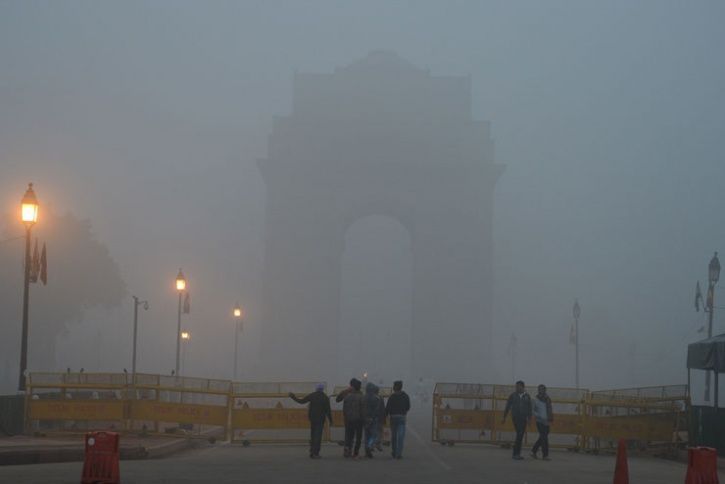
The above quote is so true for the city of Delhi. The pollution level has breached the highest mark in recent times and the Delhi has notoriously become the most polluted city in the world. As per the Supreme Court, 8 people die prematurely every day due to air pollution in Delhi. There is a high possibility that these people belong to the lower and middle class as they are more affected by pollution and do not have the wherewithal to save themselves with the help of various technological and other solutions. These residents of Delhi who generally do not own cars, bear the brunt of the toxic air. As per one study[i], levels of suspended particulate are generally higher in the low neighborhoods of Delhi. The poor people also spend more time outdoors where they come in direct contact with hazardous air.
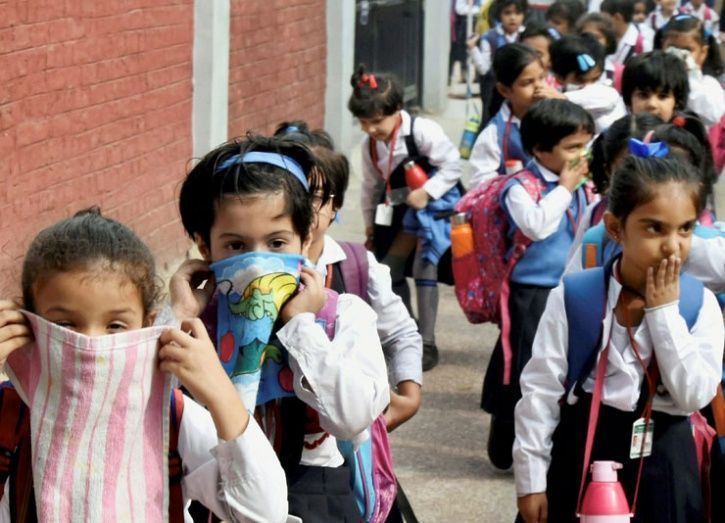
The affluent households are not that much affected by the toxic air due to the use of air-conditioning, air purifiers, better nutrition, and adequate greenery in the surroundings. Not only this, children in the region are the most vulnerable due to the harmful impact of air pollution. One in every third child has reduced lung function and a high propensity for increased pulmonary hemorrhage. On the face of it, three toddlers moved to the Supreme Court to demand the “Right to breath fresh air” under the “Right to life” under Article 21. In fact, the right to breathe fresh air is a human right. This public health emergency needs to be solved on a war footing. Otherwise, it will reach to a stage of unspeakable damage as our children are our future and so-called ‘demographic dividend’ and if they are not healthy and sound, the country will not progress in the future.
Various studies have been conducted to understand the causes of air pollution in Delhi. Almost all of the reports including the recent Economic Survey released by the Government of India have been vocal about vehicular emissions as one of the main causes of pollution. Delhi has seen the uncontrollable growth of personal cars in recent decades. As per NTPDC report, Delhi comprises 1.4% of the Indian population but accounts for more than 7% of all motor vehicles in the country. As per the recent Economic Survey, vehicular emissions are responsible for 30% of pollution in Delhi. Therefore, there is a need to promote public transportation by providing more quality buses, extending the metro lines to more areas, improve last-mile connectivity by providing eco-friendly solutions- bike sharing, e-rickshaws, rent the cycle, charging higher parking fees, congestion charges to discourage usage of cars, promoting the idea of car-pooling and most importantly encouraging the buying of electric vehicles by providing more incentives, less interest rate on loans to buy electric vehicles, involving the private sector to create charging infrastructure under CSR activities and seriously formulating a policy for the 100% electrification of the public transportation system.
The problem of stubble burning is also needed to be tackled with cooperation between the Centre and States. Farmers need to be given subsidies to buy Turbo Happy Seeder(THS) machines and there is also a need to look for innovative eco-friendly and sustainable solutions to convert the crop residue into useful manure.
Despite all these measures, there is a need to mobilize all the stakeholders and take the help of civil society to take innovative steps to deal with the problem of toxic air. The Government of the day can’t be omnipresent. Therefore, citizens of Delhi-NCR need to become vigilant to persuade each other not to burn garbage, adopt the habit of car-pooling, plant more trees, take measures in their region for protecting the environment, etc. In fact, corporate sectors and various other offices can also start some new ideas to deal with the problem of air pollution. For instance, corporates in Gurgaon have started one day of the week as a car-free day[ii] which has proved to be successful in reducing the pollution level.
Not only this, there is a need to start a sensitization campaign among the citizens of Delhi towards the value of fresh air and its harmful impact on health. The Ministry of Environment and Health and the Delhi government started the Clean Air Campaign[iii] this February to sensitize the Delhiites towards the quality of air and as per the various reports, it was found that it turned out to be successful. There is a need to take more steps like this.
The pollution in the Delhi-NCR region is not only a public health emergency but also a case of environmental injustice where and poor and our future generations especially the small children are bearing the brunt of toxic air. The most ironical that in most cases these people haven’t contributed towards the deteriorating quality of the air. On the face of it, this is high time that authorities take heed of this injustice and take strong actions to provide fresh air for all the citizens of Delhi-NCR.
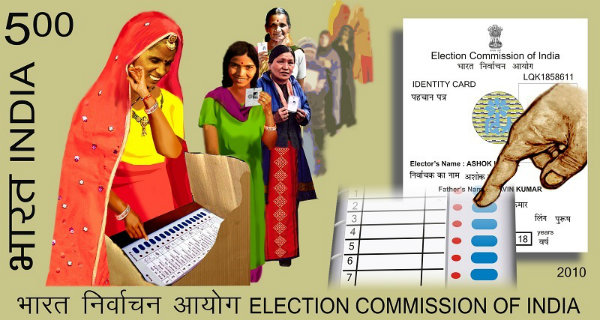
Our constitutional forefathers adopted the parliamentary form of democracy after India became an independent country in 1947. India as a nation of teeming millions has also taken a bold step of adopting universal adult suffrage when experts were debating about India’s survival as a nation. This one ‘right to vote’ given to Indians showed the faith of our constitutional forefathers in the capacity of Indian voters when India was poor third world country with low literacy and abysmal development and growth in the economy. This faith is still visible in India’s election processes, as Indian general election considered as the largest event management exercise on earth during peace times.
The Constitution of India came into force on January 26, 1950. The first general elections to Lok Sabha and State Legislative Assemblies were held simultaneously in 1951-1952. In fact, this practice of simultaneous elections continued till 1967 when due to premature dissolution of State Legislative Assemblies the cycle of the synchronized elections got disrupted. In 1970, the fourth Lok Sabha got dissolved prematurely. And fifth Lok Sabha term was extended till 1977 due to emergency provisions under Article 352 of the Constitution of India.
Since then the dissolution of the Lok Sabha and the State Legislative Assemblies is the order of the day due to the fragmented political system, the emergence of regional parties and indiscriminate use of the power under Article 356 which gives power to the President to declare President’s rule in any state on various grounds. Though after the Supreme Court Judgement in S. R. Bommai vs. Union of India case, the arbitrary use of the Article has come down. The Sixth, Seventh, Ninth, Eleventh, Twelfth and Thirteenth Lok Sabha was dissolved before the end of the term of their respective Lok Sabha. Due to this, the cycle of simultaneous elections got disrupted in the Indian polity for last 48 years.
One nation, one election also known as simultaneous elections mean a restructuring of the Indian election cycle in a manner that the General Elections for the House of people and the Assembly elections for State Legislative Assemblies are conducted simultaneously. In such condition, voters will cast their vote on a single day and at the same time for electing the members of Lok Sabha and State Legislative Assemblies.
Recently, India’s Prime Minister Narendra Modi pitched for the debate to conduct simultaneous elections at various platforms. In fact, the President of India Ram Nath Kovind in his first address to parliament this year advocated for simultaneous elections and remarked that a sustained debate is required on the subject of simultaneous elections. Election Commission, Law Commission of India, NITI Aayog and Parliamentary Standing Committee has favored the conduct of simultaneous elections of the House of the people and the State Assemblies. The analysis from the NITI Aayog report and the discussion conducted on the MyGov website provides enough evidence to conduct simultaneous to improve governance process and reduce the election fatigue in the country.
WHY DO WE NEED SIMULTANEOUS ELECTIONS?
India is a world’s largest democracy in the world due to its electoral size as well as subcontinental dimensions. It is the largest peacetime mobilization of the people in the world. Commenting on the size and scale of Indian elections, the Strategic Plan 2016-2025 published by Election commission of India mentions,
“The magnitude and complexity of the Indian election can be estimated from the fact that the Indian elections are not only the largest exercise in logistics in the world but are also considered as one of the most credible elections in the world. India, in fact, accounts for the largest share of electors in any country, exceeding the total number of electors in the entire American continent, or even that of the entire African continent or that of all the European nations put together shows the complexity of election process. However, the independent election commission along with other organizations are doing the humongous job of conducting the election process in free and fair manner. Despite that, Indian election process is fart with a number of challenges. The scope of this paper is to focus on the challenges created by the frequent elections and their overall impact on the polity, economy, and society of the country.
If we take the example of the period March 2014 to May 2016, then as per the Election Commission data, there were 15 State Assembly elections were conducted along with the elections for the 16th Lok Sabha. If we add the elections conducted in the third tier of the Government i.e. the Panchayati Raj Institutions and Municipalities, bye-elections, the number of elections conducted in one year will increase substantially. To manage this situation and reduce the burden on the exchequer, the idea of simultaneous elections was propounded by various political parties as well as the reports of various institutions. 170th Report of the Law Commission of India headed by Justice B. P. Jeevan Reddy, “theholding of a separate election to a Legislative Assembly should be an exception and not the rule. The rule ought to be one election once in five years for Lok Sabha and all the Legislative Assemblies”. In December 2015, the Parliamentary Standing Committee of Department of Personnel, Public Grievances, Law and Justice has also supported the idea and given an alternative of holding the elections in two phases. It stated that elections to some Legislative Assemblies could be held during the midterm of the Lok Sabha and elections to the remaining assemblies could be held with the end of the Lok Sabha term. It has also given recommendations for fixing the schedule of the bye-elections.
NITI Aayog report has analyzed the whole issue extensively and recommended for holding simultaneous elections for the Lok Sabha and the State Legislative Assemblies. The recent India Action Plan- Three Year Action Agenda (2017-2020) also supported the idea of synchronized two-phase elections from the 2024 election to the Lok Sabha.
In fact, Election Commission of India also supported the conduct of simultaneous elections on various platforms. President of India has also supported the idea of simultaneous elections and said, “With some election or the other throughout the year, normal activities of the government come to a standstill because of the code of conduct. This is an idea the political leadership should think of. If political parties collectively think, we can change it… The Election Commission can also put in their idea and efforts on holding the polls together and that will be highly beneficial”. After this debate, Government of India has come out with five questions on the MyGov website to ascertain the views of the public and create a debate and discussion on this idea in public forum. People have aired their views freely in support of conducting simultaneous elections. In fact, they have narrated their ordeals of suffering due to deadlock in administration at the time of elections as well as disturbances of noise pollution, traffic jams etc. on the website. It can be seen as the anecdotal evidence to prove that the substantial number of people are in favor of conducting simultaneous elections.
Therefore, there is need to understand the profound implication of the frequent elections happening in our country. It can be seen on the below points:
Impact on the Political and Administrative functioning of the government: Whenever any elections are conducted in our country, Election Commission enforces the Model Code of Conduct(MCC) to maintain a free and fair environment for the election process. It is imposed from the date of announcement of the election schedule by the Election Commission and is in force till the whole election process is completed. During this period parties in power as well as other political parties are not allowed to announce welfare schemes or development projects throughout India if it is a General Election. In fact, even during the Assembly election, the Central Government can’t take any decision related to that particular state.
The Parliamentary Standing Committee has articulated this problem stating that, “…The imposition of Model Code of Conduct (MCC) puts on hold the entire development program and activities of the Union and State Governments in the poll-bound State. It even affects the normal governance. Frequent elections lead to the imposition of MCC over prolonged periods of time. This often leads to policy paralysis and governance deficit”. If we just take the year of 2014, the governance activities were suspended around 7months. If we assume that number of the average period of operation of Model Code of Conduct as 2 months during the State Assembly elections, the analysis in the below graph shows that at least for four months every year, the government functioning, as well as development works, will be suspended due the imposition of Model Code of Conduct.
Economic and financial impact of the frequent elections: Fighting elections and conducting elections create huge expenditure not only on the government machinery but also for all the political parties and their candidates. The management and the conduct of the elections create a severe strain on the economic and fiscal budget of the Government of India as well as the various state governments. In fact, this is also the reason behind the generation of black money and corruption. Dr. S. Y. Qureshi in one conference remarked, “…. elections have become the root cause of corruption in the country”. He further mentioned that “…. after winning elections, the politician-bureaucrat nexus indulges in “recovering the investment” and that is where corruption begins”. As per the news report, the expenditure on the General elections 2014 was the highest ever around 3500 cr. Therefore, conducting simultaneous elections will help in saving the precious tax money and increase the fiscal space which can be used for the development activities.
The social impact of the frequent elections: Frequent elections disrupt the normal life of common citizens as can be ascertained from the responses on the MyGov website. Since normal functioning of the government is on standstill and officials are busy in the management of elections, normal people wait for the completion of the election process to take forward their essential activities. School teachers are deployed for the election duty which impacts the quality and quantity of the education provided to the children. Not only this, frequent elections perpetuate the feeling of casteism, communalism, and religious biases.
Therefore, there is a strong basis and need to synchronize the elections of Lok Sabha and State Legislative Assemblies.
CRITICISM AND COUNTER ARGUMENTS
The idea of simultaneous elections is also criticized by various political parties, constitutional experts as well as various other stakeholders. The key criticism can be seen in the following points:
There are various logistic and operational challenges present in conducting the simultaneous elections in India because of its sheer number of electorates and sub-continental size and diversity of Indian polity. It is very difficult to comment on the capacity and capability of institutions which manage the election process in India. If they are still successful in doing it, they will be successful in the coming future. Regarding operational challenges implementing this idea presently, there is need to create consensus among all political parties to debate and come out the feasible proposals and subsequent constitutional amendments.
Some think-tanks and experts like Indira Jaisingh are of the view that not all voters are highly educated. They do not know whether they are voting for the Assembly or Parliament. It is not as simple as it seems. Indian voter is very matured and credible which can be seen in the track record of India’s voting pattern since the First General Election. In fact, the voting behavior depends on a range of parameters like incumbency, anti-incumbency, narrative dominance, political leadership, local and regional issues and other factors of caste, religion etc.
Another strong criticism is that simultaneous elections would benefit national parties at the cost of state/regional parties in case of a “national wave in favor of large national parties”.This can’t be proved after seeing the General election of 2014 when there was a wave in favor of BJP government, despite that Odisha, Andhra Pradesh and Sikkim voters chose for regional parties in their respective states with more percentage of votes.
There is also a criticism that the simultaneous elections will weaken the federal structure in the country between Centre and States. However, it is premature to talk about this because the spirit of federalism has not come from anywhere rather the Constitution of India provides enough grounds for the principle of federalism in the Indian polity.
Successful experiments of Simultaneous Elections
South Africa held elections simultaneously for every five years for national and provincial legislatures and held municipal elections every two years. Sweden also held an election to its national legislature(Riksdag) and provincial legislature(landing) and local bodies(Kommunfullmaktige) on the fixed date on the second Sunday of September every four years. The UK also passed a Fixed Term Parliament Act, 2011 to provide a sense of stability and predictability to the British Parliament and its tenure. It will provide some stability in the electoral process. In fact, the Parliamentary Standing Committee praises this experiment as a novel experiment which needs to be looked on. In fact, the US election, though it is a presidential system, works in proper fixed term form which creates stability in the functioning of the democracy of their country. There is no doubt these countries have a good track record in their democratic process except some hiccups as well as human development parameters.
Therefore, India should also synchronize the assembly and general elections to make our democratic process more stable and vibrant.
Indian democracy celebrates the festival of elections every year with a number of elections. Elections are the symbol of a vibrant democracy. However, the frequent elections create disturbances not only in the administration and political system but also in the normal life of the people of India. In fact, in the last 30 years, there has not been a single year without an election in our country. It leads to a number of unavoidable consequences which creates problems for the long-term growth and development of the country.
In fact, India is on the cusp of change because of its huge demographic dividend[i] in the form of a window of opportunity. The governance processes also need to be transformed radically to satisfy the expectations of the youth in the country. To bring about rapid transformation[ii], India needs to bring about huge structural changes in the economy and public policy of the country. Frequent elections not only impose restrictions on the functioning of the governance process but also saps the energy and risk-taking capabilities of the government. Therefore, it is imperative to evolve a solution to stop these frequent elections cycle and move towards a stable system of simultaneous elections[iii].
Justice B. P. Jeevan Reddy, 1999, ‘170th Report on the reform of Electoral Laws by Law Commission of India’.
Sarkaria Commission Report on Centre-State Relations (1988)
Supreme Court Judgement on S. R. Bomai vs. Union of India (1994)
Justice A. P. Shah, March 2015, ‘255th Report on the Electoral Reforms by Law Commission of India’.
Dr. E. M. Sudarshan Natchippan, December 2016, ‘79th Report on Feasibility of Holding Simultaneous Elections to the House of People (Lok Sabha) and State Legislative Assemblies by the Department related Parliamentary Standing Committee on Personnel, Public Grievances, Law, and Justice.
Bibek Debroy and Kishore Desai, ‘Analysis of Simultaneous Elections: What, Why and How’ by NITI Aayog.
Standing Committee Report Summary by PRS Legislative Research.
‘India Votes- The General Elections 2014’ by the Election Commission of India.
Priyanka Chaturvedi, 2016, ‘Idea good, but is it practical?’, Observer Research Foundation.
Hemant Sarin, 2016, ‘Simultaneous Elections to the Parliament and State Assemblies’, Live law.
Gaurav Vivek Bhatnagar, 2016, ‘Constitutional Experts decry Modi’s call to Simultaneous Polls to Parliament and State Assemblies’, The Wire.
Venkaiah Naidu, 2016, ‘Breaking out of Election Mode’, The Hindu.
Jagdeep S. Chhokar and Sanjay Kumar, 2016, ‘The case against simultaneous polls’, The Hindu.
Kanishka Singh, 2017, ‘Merits and Demerits of simultaneous elections’, The Indian Express.
Dr. S. Y. Qureshi, 2016, ‘Holding Lok Sabha and Assembly polls together are desirable but not feasible’, The Quint.
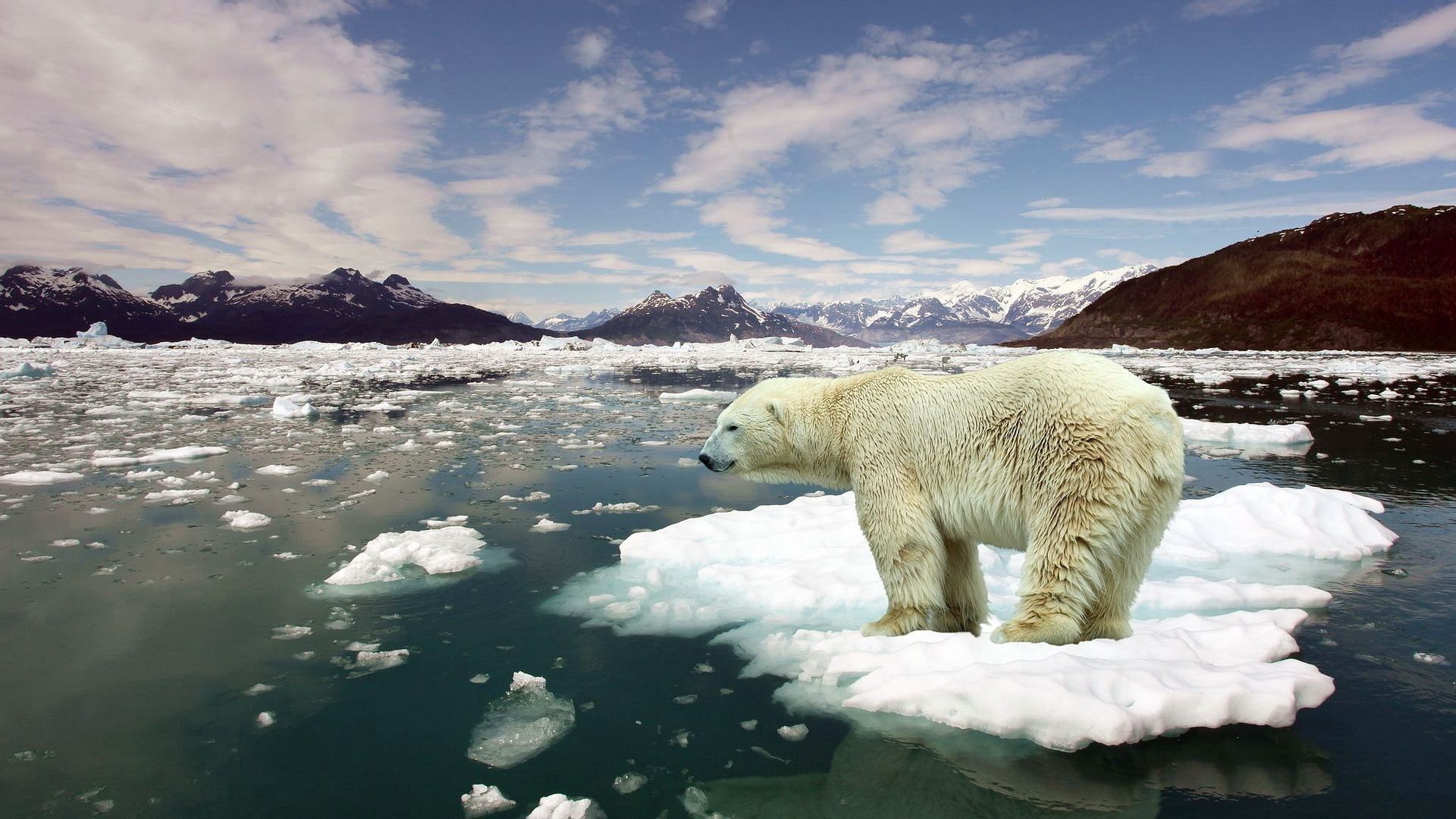
The year 2016 was the warmest year since the late 19th century and it was the hottest of three record-breaking years in a row. The year 2017 is also the hottest year on record without an El Nino boost. It is a matter of serious concern that even after taking all efforts and following commitments under the Paris Agreement, it will be very difficult to limit the warming of the climate by 2oCelsius. In fact, as per one report[i] “Turn Down the Heat” of the World Bank, without any action, we could be seeing warming by 4oC above pre-Industrial levels. As per the Climate Action Tracker, under the baseline scenario of the Intergovernmental Panel on Climate Change’s (IPCC) Fifth Assessment Report, global temperature is expected to reach 4.1oC-4.8oC above pre-industrial levels by the end of the century. Increasing global temperatures will exacerbate the melting of ices in Arctic and Antarctic ecosystems which will trigger catastrophic impact in terms of sea-level rise, intense storms, floods, etc. In fact, the adverse impact of climate change and Global warming is inevitable and we don’t have to wait for coming years to see their consequences. Low-lying delta regions and coastal areas are vulnerable to these changes. In fact, more than a tenth of humanity resides in vulnerable regions of the world that are within 10 meters of today’s sea level. It is also known as Low Elevation Coastal Zone(LECZ). Almost half of Bangladesh lies in the LECZ and it will be severely affected rising sea-level. On the face of it, it is high time to realize the importance of ‘climate change adaptation’ and work towards building resilience in the society.
Mitigation vs. Adaptation debate
Climate mitigation is any action taken to permanently eliminate or reduce the long-term risk and hazards of climate change to human life and property. Mitigation has become the dominant narrative in the world popularized by the international organizations who are slowly waking up to the issue of climate change adaptation. Mitigation strategies became the dominant narrative because of two reasons. First is the belief in human capability in the age of technology. We almost believed that we can change the environment or stop the changes happening around us. Second is the belief that development process cannot be stopped not only because of belief in the ideology of capitalism and its spreading impact and interlinkages through globalization but also the abject poverty and deprivations in other parts of the world, where these people need to be provided with basic necessities. In fact, even in the problem of climate change, countries are looking for opportunities for growth in the areas of renewables, technology, infrastructure etc. Here is the main problem where we want to focus on only the “cause” and not the “effect”.
However slowly, the idea of adaptation is gaining ground due to the severe impact of climate changes in terms of various disasters in not only developing countries but also in developed countries. As per the IPCC 2001 report[ii], Adaptation is the adjustments in ecological, social or economic systems in response to actual or expected stimuli and their effects or impacts. It refers to the changes in processes, practices, and structures to moderate potential damages or to benefit from opportunities associated with climate change. In the simple language, adaptation calls for ‘natural resource management’, ‘strengthening food security’, ‘development of social and human capital’ and ‘strengthening institutional systems’. Due to the realization of the value of adaptation, the focus is now shifting towards the bottom-up approach and understanding the vulnerability of various regions and the people to prepare them to cope with the adverse impacts of the climate change. As per the Stern Review[iii] 2006, climate change may displace 200 million people by the middle of the century. Many islands[iv] like Tuvalu, Micronesia in western Pacific Ocean and Maldives, Kiribati in the Indian Ocean are already facing the brunt of climate change. This is high time to mainstream the vulnerability approach and adaptation in the development process to address the emerging challenges.
Why Adaptation?
Adaptation is more effective in solving the problems of climate change because of various reasons. First and foremost, no matter how much we will try to mitigate the impact of climate change, a certain degree of heating is inevitable due to historical emissions. It is very much visible in every country of the world with recurrent extreme-weather events. The second reason is that adaptation measures will give results immediately and in a very short period of time in comparison to mitigation measures which will take decades to show the results. For instance, countries started taking actions to stop the enlargement of the ozone hole in the decade of 1990s. But as per the report[v], the ozone layer is expected to return to normal levels by 2050 which is really a long time when many of us will not be alive. The third reason is that these measures can be applied at regional or local level by empowering the local community and their effectiveness is not dependent on actions of others. It is based on a decentralized and bottom-up approach which gives confidence to the local people to deal with their challenges. However, there are various challenges and hurdles in accepting and mainstreaming the adaptation process.
Challenges/Hurdles
It requires changing the mindset of the people who are at the helm to accept the adaptation process and empower the local community. However, sometimes a local community will also be reluctant to leave the vulnerable areas due to their livelihood sources like fishing, as well as attachment to their land and houses.
Another challenge is finance. We need a lot of finance to relocate and provide basic necessities to the vulnerable communities. The finance is also required to protect the natural resources. The irony is that those countries and the people who are most threatened due to climate change do not have the wherewithal to finance their adaptation processes and activities. Transfer of finance and technology from the developed countries to developing countries has become difficult because of the opposition from various quarters and the election of climate skeptics as the leader of western countries.
Adaptation needs to adopted as per the requirement of the region and the people. It is a very complex process because of huge diversity and complexity of the issue and even the adaptation processes and measures need to be modified as per the changing circumstances. This whole thing makes it very challenging to implement in a diverse setting like India or all over the world.
What needs to be done?
There is no need to tell the urgency of the problem again as I discussed in the introduction part of this article. It needs to be tackled on war-footing and the whole processes of adaptation in the form of “Protect-Aware-Accommodate-Retreat-Empower” must be mainstreamed in the development process. Protect the vulnerable communities, make them aware about the looming crisis, accommodate the vulnerable people to safer areas, retreat from the disaster-prone areas and most importantly empower the local communities to make them capable enough to deal with the upcoming challenges of climate change. Not only this, the government should take into account the views of other stakeholders like Coastal Alliance to frame its policies. The work done by various organizations need to implement in other areas of the country. Since the sea has no boundary naturally and the disaster will never ask before coming to any country. Therefore, the countries should come forward to tackle the problem by creating a joint action plan, sharing of knowledge and technologies, developing the capacity of the people and learning from the successes and failures of different adaptation strategies.
Conclusion
India is a signatory to not only the Paris Agreement 2015 but also agreed to the Sustainable Development Goals(SDGs). SDGs cannot be achieved without climate change adaptation. If India does want to ‘leave anyone behind’ and committed to achieving the goal of development in harmony with nature, they must take actions to reduce the impact of the crisis and build the resilience in the society to handle the upcoming crisis.
After 70 years of independence and adoption of one of the most progressive Constitutions in the world, the status of women in Indian society is still deplorable. Violence against women occurs at every second with impunity because of failure of governance[i] as well as the patriarchal mindset of the people who still think women as their property. In fact, crimes against women[ii] are reported every two minutes in India.
If we only talk about the crime of ‘rape’, as per the statistics[iii] of National Crime Records Bureau, 92 rapes are committed every day in India in 2012. In fact, there are a number of cases who are not reported[iv] by the victim due to the fear of the perpetrator or the stigma attached to this crime or maybe lack of awareness and courage. It means that a number of rapes committed are more than the numbers reported to the law enforcement bodies.
Rape occurs when a man commits the sexual intercourse with a woman without her consent. However, the IPC (Indian Penal Code) under Section 375 provides an exception in the case when men and women are married and women are more than 15 years and less than 18 years old, the sexual intercourse will not be considered as rape. This whole exception is based on the Age of Consent Act[v] 1891 which was enacted in British India. In fact, this exception is violative of the Article 14, 15 and 21 of the Constitution. However, as per the lawmakers, this exception was given to deal with the social reality of rampant child marriage[vi] in India. But the problem is that it also creates arbitrariness if we compare it with Prohibition of Child Marriage Act[vii] as well as POSCO Act[viii].
When I started writing this piece, I didn’t think that Supreme Court will declare this section unconstitutional. Supreme Court has struck down this clause in its recent judgment[ix] in October 2017 on the grounds of violation of Article 14, 15 and 21. However, the Supreme Court didn’t say anything about criminalizing the marital rape. Now, it means that sexual intercourse with the minor wife is rape but sexual intercourse with the adult wife without her consent, is not. In India, marital rape is not a crime not because we have not recognized the rights of women but because the Government of the day has no political will to criminalize the marital rape due to fear of backlash from the conservative sections of the society. As per the UN Population Fund report[x], more than two-thirds of married women in India, aged 15 to 49, have been beaten or forced to provide sex. This statistic is a stark reminder for the government of the day to take a serious interest in resolving various issues related to this issue by enacting the appropriate law.
Opponents of this idea give numbers of justifications for not criminalizing the marital rape. The first and most vocal opposition is that criminalizing marital rape will destroy the sacred institution of marriage[xi] because the mindset is that when a woman enters into a wedlock, she has given ‘irrevocable consent’ to perform sexual intercourse with her spouse. This whole concept stems from the theory of women as a man’s property. It is totally unjustified and uncalled for. How can we sustain the sacredness of the marriage when there is no freedom and ‘sexual autonomy’ for one partner? And after India became a constitutional democracy and adopted the ‘Rule of Law’, it can’t take recourse to culture and traditions to justify sexual crimes committed within or outside the wedlock.
The second criticism is that the law will be misused by the women to fabricate false crimes as witnessed under Section 498[xii] of the IPC. In fact, almost all the laws are misused in one way or other in India which no way justifies not enacting a law to address the crimes committed against married women in India. In fact, the exception for Marital Rape is not justified on the basis of Article 14-Right to Equality when one woman gets the protection of law but another doesn’t because she is in an intimate relationship with her preparator. It is also not justified because it is arbitrary and discriminatory.
The third reason given not to criminalize marital rape is that there are enough laws and safeguards under Domestic Violence Act[xiii], 2005 and other laws which women can use to prosecute her husband for violence against her. The irony is that recognizing marital rape as a crime is very much related to the recognizing the “sexual autonomy” and bodily integrity of women. We want to say that don’t bring this matter in front of everyone because you have other laws to deal with it. It is almost treating women as the secondary citizens who have not entitled the ‘Right to life with human dignity’ under Article 21. It shows the patriarchal and patronizing mindset of Indian society.
In fact, this is high time that India must criminalize the marital rape to give autonomy and freedom to the half of the population of India. Now we are in 2017 when Supreme Court of India has given “Right to Privacy[xiv]” in its path-breaking judgment in August 2017. In this judgment, Supreme Court has given a broad perspective of privacy. It says, “Privacy safeguards individual autonomy and recognizes the ability of the individual to control vital aspects of his or her life. The pursuit of happiness is founded upon autonomy and dignity of the individual.” It also recognizes the right to be left alone.
This whole concept of privacy can be applied to the marital rape issue where as per the law, the married women has no autonomy in her sexual relationship. She cannot exercise her bodily integrity. It is absolutely unfounded and unjustified now after ‘the right to privacy’ judgment. In fact, we can be reminded of the fact that right to privacy to the people in India was not there earlier which has been evolving since the law of land came into force. Therefore, it can be said that Indian society was not ready ten-twenty years back to accept the issue of marital rape but now in the year 2017, we must accept this reality and take action to criminalize this inhuman and brutal practice to give justice to those women who are suffering in silence.
Many committees appointed by the Government of India advocated for criminalizing the marital rape[xv]. The Justice J. S. Verma committee, which was appointed after the dreaded ‘Nirbhaya’ incident has recommended “marriage or any other intimate relationship between a man and a woman is “not a valid defense against sexual crimes like rape”. The committee also added that the legal prohibition on marital rape should also be accompanied by changes in the attitude of all the stakeholders and there is need to create awareness of women’s rights to autonomy and bodily integrity regardless of marriage or other intimate relationships. Recently appointed Committee on the Status of Women (2015) headed by Pam Rajput also recommended that as a pro-women measure, marital rape should be declared as a criminal offense irrespective of the age of the wife and the relationship between the ‘perpetrator’ and ‘survivor’. However, the Central government[xvi] consistently denied taking a proper stand by saying that the people in India are not ready for it and it will create stress for the entire family system.
The claim that it is a western concept is unjustified because of South Africa[xvii] another developing country which has criminalized the marital rape. In fact, as per the UN Women’s 2011 report[xviii], 52 countries out of 179 countries have explicitly amended their legislation to make marital rape a criminal offense. It is totally against to the various Human Rights Conventions to which India is a signatory. It’s been a long time to the women of India, the government needs to recognize the spirit of “Right to life” with human dignity under Article 21 and the recent judgment of “Right to Privacy” to pave way for declaring marital rape as a crime which violates the dignity and autonomy of women.
Pradhan Mantri Narendra Modi in his first Independence speech announced the major initiative of financial inclusion in the name of the Pradhan Mantri Jan Dhan Yojana(PMJDY) to mainstream the poorest of the poor to the formal economic system of the country. The scheme was launched on August 28, 2014. The Prime Minister in his emotional speech declared, “Mahatma Gandhi worked towards removing social untouchability. If we want to get rid of poverty, we have to first get rid of financial untouchability. We have to connect every person with the financial system”.
In fact, after 68 years of Independence, 42% of households do not have bank accounts and only 35 % of Indians older than 15 years had a bank account in a formal financial institution in 2012. Financial inclusion is the process where financial services and banking facilities are easily accessible to the weakest and marginalized sections of society in the remotest corner of the country. Financial inclusion is not only important in removing poverty and deprivation but also helps in the growth and development of the economy. The PMJDY scheme was launched in two phases: Phase I (August 2014-January 2015) and Phase II (August 2015 to August 2018). Initially, the target was to open 7.5 crore bank accounts in one year. As of August 16, 2017, 29.51 crores, Jan Dhan Accounts are opened in the country.
In this article, I will do the SWOT (Strengths, Weaknesses, Opportunities, and Threats) of the Pradhan Mantri Jan Dhan Yojana (PMJDY).
Strengths:
Financial mainstreaming of the poorest of the poor in the country to create inclusive growth and development. As per the PMJDY website, 99% of households now have at least one bank account.
It will help in generating higher savings for poor people. As per one study[i], the availability of bank branches positively impacts savings. As per the recent study conducted by the State Bank of India(SBI)[ii], Jan Dhan Accounts are keeping villagers sober and it might be helping in slowing rural inflation.
Account holders will get an overdraft facility of ₹5000. It can help people to start some self-employment activities which have the potential to improve their well-being and it will strengthen their decision-making abilities.
It will provide accident insurance cover of ₹1 lakh to deal with tragedies and shocks of life for poor households.
It will provide a RuPay debit card to every account holder to access the facility of cashless transactions.
Weaknesses:
As per various reports[iii], it was found that one-fifth of these Jan Dhan accounts are dormant and 79 % of the households[iv] already had a regular bank account. Therefore, dormancy and zero balance accounts are serious challenges of this scheme.
As per the data, only 1.5% of account holders have sanctioned loans and around half of the account holders did not even avail of the loan. The loan facility is provided on the basis of the discretion of bank employees which can create some biases in disbursing the loans.
As per the RBI report[v], Jan Dhan’s accounts were misused during the demonetization process last year and a large sum was deposited to these accounts.
The absurd limit of ₹50,000 stops some poor people[vi] to receive their subsidies in the Pradhan Mantri Awas Yojana (PMAY)[vii].
Only 76% of the Jan Dhan account holders got a Rupay card[viii] and at least one in five of the issued cards remained dormant.
Opportunities:
It can help in implementing the Direct Benefit Transfer(DBT)[ix] scheme in terms of JAM trinity solution where J-Jan Dhan, A-Aadhaar, and M-Mobile. JAM[x] can usher into a radical transformation to provide social benefits directly to the bank accounts of the people, in turn, reducing hassles and massive leakages prevalent in the social-security schemes.
Digital India scheme[xi] and the government’s consistent push for Mobile banking[xii] can create a conducive climate for increasing financial inclusion. In fact, after the demonetization of high-value currencies, there is a consistent increase in digital payment.
It can be used to provide for funding facilities to vulnerable sections of the society. In fact, as per the Gates Foundation Report[xiii], it helped in financially empowering the women and marginalized sections of the society.
MUDRA yojana[xiv] and Stand-Up India[xv] scheme can create opportunities for Jan Dhan Yojana to create business opportunities by providing funding to the ‘unfunded’ as well as ‘unbanked’ sections of the society.
It can help in increasing the ‘financial literacy’ in the country which will help in increasing the penetration of various financial services like insurance, loans, investment options etc. to far-flung areas of the country.
Threats:
The first and most obvious threat can come from the next government which comes into power if it is not BJP. They might scrap the whole scheme on various grounds.
Sustainability of these accounts in serving the long-term interests of providing financial services to the poorest sections of the society when they are not provided with gainful employment opportunities or the other ways of generating income.
Recently Supreme Court of India has given its verdict in the Aadhar case and provided “the Right to Privacy”[xvi] to every individual in the country. On the face of it, linking bank accounts with Aadhar number can create hurdles for the scheme in providing direct benefit transfer.
Misuse of these Jan Dhan accounts and RuPay cards will always be a threat to this program of the government. Due to this, a number of Jan Dhan accounts were closed during demonetization because of their suspicious activities[xvii].
The overdraft facility and insurance scheme can also increase the NPA (Non-performing Assets) of the Banks who are already stressed due to stalled projects of the private and public sectors.
The Pradhan Mantri Jan Dhan Yojana is the game-changer[xviii] scheme of the NDA (National Democratic Alliance) to create a medium to mainstream the poorest of the poor of the country so that an era of social-transformation can be ushered in our country. The use of these accounts to transfer the cash benefits to the beneficiaries’ accounts can turn into a panacea to all the ills which are plaguing the social security schemes of the government. However, after three years of the scheme, the government should also focus on addressing the challenges[xix] emanating from the schemes.
The economics has become the vehicle of growth, prosperity, and development of countries in the world in the era of globalization. In fact, the question here is why we are more worried about economic growth, economic development, and prosperity? What is the need to talk about emerging nations? Why should we care about “Breakout Nations”? And why will some countries be emerging as breakout nations, some will be frontier countries[i] and some will remain insignificant with respect to economic growth and development.
Ruchir Sharma, an investment banker and keen watcher of economic happenings around the world in this book takes us on a journey where he picks the countries who will be the next economic miracles of the world. Finding reasons, causes and set formulas for economic growth and subsequent economic development of the nations was a never-ending quest by the authors of various milieus because everyone wants to step up the ladder of the success of economic growth.
The author discusses his experiences and nuances of more than twenty countries in 280 pages of this book with stimulating details incorporating the flavor of colloquial language and examples. The most important argument of the author is that we need to understand and analyze the emerging markets as ‘individual nations’ and he is wary of the ‘idea of emerging nations as a group’. In this context, he is skeptical of the sustainability of the BRICS[ii] group because the countries have competing political interests and there are stark differences between these countries in terms of commodity importers (India and China) and commodity exporters (Russia and Brazil).
The author is more interested in studying the individual countries by traveling to those places and trying to understand, “whether the political regime gets the connection between good economics and good politics” than commenting as academicians without getting the feel of the ground reality. In the whole book, the author has come out with various “Rules of the Road” to recognize the potentiality of the real breakout nations.
The author also gives his insights regarding the great debate of the impact of the political system and institutions on the economic growth and development. In fact, his latest book, The Rise, and Fall of Nations: Ten Rules of Change in the Post-crisis world is a further development of the same idea where he tries to give ten rules which need to be considered to evaluate the rise and fall of the nations. He rubbishes the idea that political system or the institutions are responsible for growth and development of the economy and their subsequent achievement of prosperity and remaining poor. “It’s’ not the type of the system that matters, it is the stability of the systemand, even more important, whether the leaders running it understand the basics of economic reform”, says Ruchir.
He compares the country of China which has surpassed all the growth expectation and emerged as the successful example of command-and-control capitalism with the economy of Vietnam, which is not growing despite being a command economy. As per the author, any particular system has an only fifty-fifty chance on its economic growth and successes. In this context, he criticizes the grand theories on the ground of their emphasis on one factor in terms of institutions, geography, or culture to explain the rise and fall of the nations. He also finds faults in their building of narratives with historical facts as well as giving long-term predictions about these countries as a foolish approach. In fact, the book “Why Nations Fail: The Origins of Power, Prosperity, and Poverty”[iii]by the authors Acemoglu and Robinson provide a comprehensive analysis of various hypothesis for the rise and fall of nations. In this book, they argue that the “institutions”- political as well as economical act as deciding factor in the growth and development of any country. However, Sharma does not agree with this hypothesis and focuses more on the role of political leadership which is responsible for steering the economy towards growth and prosperity and also towards disaster if they don’t get the basics right.
In this book, Sharma starts with China, India, Brazil, Mexico, Russia, going to Eastern Europe, talking about Czech Republic, Poland, Hungary, coming to Turkey for which he is bullish, shifting towards South-East Asian countries, Indonesia, Malaysia, and turning towards the African continent with billion opportunities and finally talking about gold-medalist countries of South Korea and Taiwan. He also gives an interesting perspective that breakout nations can also emerge in the Western world in the USA, Germany, Spain, and Ireland.
The whole narrative of the author is based on his personal travel experiences to these countries and anecdotal evidence but if we compare in general the views given by the author are very much similar to the book “Why Nations Fail”. This book says that institutions matter but Sharma says, “No, Individual leaders who are at the helm matter”. There is a question: Who came first: Institutions or Individuals? Individuals are part of the institutions or they are the one who created, sustaining and influencing the system of institutions. Both the books talk about Mexico, Russia, North Korea countries in a negative perspective because of their institutions and leaders respectively. In all the countries discussed by the author, he names the different leaders of the respective countries to emphasize their role in the economic growth and development.
In fact, if we deeply introspect, institutions as well as the leaders who are the decision makers both responsible for the growth, development, prosperity as well as bringing doom and poverty for any nations of the world. It is very complex and humanly impossible to factor all the causes and reasons behind the rise and fall of nations. In fact, many things are at play at the same time. It is a full bucket of things which will turn the nations towards prosperity as well as poverty.
Regarding his criticism of the BRICS grouping, now there is enough evidence to refute his proposition. For instance, these countries have announced “New Development Bank”[iv] in 2012 and other institutions which are going to challenge the erstwhile Bretton Woods System[v]. BRICS grouping led by China and India will emerge as a formidable force[vi] in the world in recent years. Though the countries of the group have different potentials, they can also find common grounds to collaborate with each other in the coming future.
This book was written in 2011 when there was lot of chaos in the Middle East due to ‘Arab Spring’[vii], In India, the India Against Corruption[vii] movement led by Anna Hazare was going on in the wake of spate of scams in the UPA II government, emergence of Turkey as a successful Muslim model for growth etc. Similarly, there were various other developments in other parts of the world. These things have influenced the writer in creating his perspective.
The author paints a bleak picture of China because of its heavy debt, increasing labor costs, and overcapacity in the infrastructure sector. He is also not bullish about India. In the last seven years, many things have changed in India. The new government came into power at Centre and they brought various radical and forward-looking changes to create a conducive climate for growth and development. So, we can’t judge the country just by looking the few days experiences and few years performances.
It is very complex and unimaginable to predict various economic parameters for any country and especially for a diverse country like India with a subcontinental dimension and federal structure where the states are also acting dynamically to attract investment in the spirit of cooperative and competitive federalism. However, he looks Turkey under the leadership of Recep Tayyip Erdogan[ix] as a breakout nation and a role model for the Muslim countries in the Middle East. However, in just seven years, things have changed much in Turkey after the emergence of ISIS[x] and the last year coup[xi] in Turkey. In fact, author himself agrees that it is very difficult to forecast for the future growth in these complex societies and these days things are changing very fast, which cannot be ignored in the context of providing an explanation for the future economic growth in various countries of the world.
However, the author conveys the economic concepts, nuances, and intricacies of the investment and forecasting in a very easy-going story-line to make his points that the nations need to be studied and analyzed on an individual basis and there should not be any grand narratives and club different states into same groups. The book was interesting in terms of knowing smallest details of various countries in terms of high charges of hotel rooms in Brazil as compared to the USA etc. and how they can be related to their economic fundamentals and future growth story.
Imperium (2006) is the first novel in a trilogy centered on the life of the great Roman orator Cicero. Other two books are Lustrum and Dictator. In the book, Imperium, Robert Harris takes us on a historical journey of ambitious man from a commoner to achieve the position of the consulship. Harris is a master storyteller and famous novelist who grips the reader to the unfolding of events in his story. The book is in the form of a story told by the Tiro, secretary of Cicero who has keen observation not only of the surroundings and events happening around him but also on the psyches of the people around him including Cicero.
The book is a must guide for the people who have political ambitions or want to understand the intricacies of the politics in real terms. As Cicero tells, “Politics is a profession” not a fight for justice. In fact, the book starts with a journey through which Cicero slowly develops various skills and creates a narrative to attain supreme power in Rome. And the book proves that a common man can achieve ‘the power of life and death as vested by the state in an individual’ without having any resources if he develops the skills required for achieving success in the arena of politics.
Knowing philosophy and history is very important to build a career in politics. Cicero not only reads philosophy in Athens but also tries to find out various evidence and examples from National Archive to understand the present-day politics of Rome. It can be easily related to the politics of India. How politicians use various events of history like freedom struggle, Mughal rule, Colonial legacy and names of leaders to create narratives to build their case for winning the elections.
Cicero learns the skills of oratory from the famous Apollonius Molon in Rhodes and becomes a master orator in subsequent years. This was one of the most important skills which provided him new avenues to achieve victory in the Senate. Oratory is still vital to creating a narrative in politics. Cicero often talks about the various characteristics required to become a statesman, like remembering the face of every person, importance of appearances etc.
Cicero built his whole narrative around the issue of corruption and how aristocrats are neck deep in corrupt activities. He successfully prosecuted the Verres, the former governor of Sicily. In fact, the issue of corruption in public life is still very strong and every now and then political parties and the leaders build their narratives to remove corruption and black money from the country. For instance, the emergence of the AAP( Aam Aadmi Party) and the BJP(Bhartiya Janata Party) ‘s campaigning around removing black money through various measures including the controversial demonetization move are the examples of the corruption as the concurring issue in the politics of any country since ages.
The author convincingly shows the phenomenon of creating ‘hope and fear’ among the masses around the issue of war against pirates. How do politicians create fear among the masses to gain more power? It seems that Pompey is acting as the USA and pirates as terrorists because terrorists do not have any proper unified system and there are no rules and treaties to bind them. And the Pompey similarly as the USA accumulates more power legally and illegally to increase its influence to fight against terrorists.
The election campaigning and electoral process at that time provide a mirror of the present-day political and the electoral process. How does money play a deciding role in the electoral process? How do politicians bribe voters to get the support of voters? However, the win of the Cicero in the election of consulship also gives a hope to the commoners to achieve the political power if they have all skills and attributes to achieve it. The portrayal of women as the wife, mistress, love interest etc and Cicero’s desire to have a son from his wife Terentia shows the nature of patriarchal society prevalent at that time. It is still true in the present-day society of India.
In the end, Cicero campaigns for his consulship and successfully achieves the supreme power in Rome. Through the whole journey of the book, the author portrays the complex character of Cicero and how much is he in love with the process of politics? Slowly, he starts thinking about the end rather than means to achieve the political power. In fact, here, he is in sync with the Nicole Machiavelli’s thought that success should be the yardstick to measure and judge political activities rather moral or ethical criterion. And how does the writer portray the true and real picture of the politics through all events occurring in the life of Cicero? It shows that politics is not about right and wrong or achieving justice but it is very complex bargaining process in which different groups negotiate and cooperate to achieve their goals. This realistic picture of politics can make others realize to see things in various perspectives rather criticize the leaders for their political expediencies.
Doklam stand-off is the latest crisis between the two giants in the Asian continent. However, this dispute is different from other disputes occurred on the boundary in the recent years. India has been facing long and contentious border dispute with China along its 4000 km length border. The disputed boundary area is divided between Eastern Sector( Arunachal Pradesh), Western Sector( Aksai Chin ) and the Middle Sector (Sikkim). This time, the dispute was unique in the sense that it involves a third country Bhutan and happening in the middle sector, which was generally considered as settled and peaceful. It is a matter of concern for India because of its strategic location in Chumbi valley from where the Siliguri corridor( chicken neck) is very near. In fact, there are various unknowns in the recent disputes. Why China has taken a belligerent attitude against a small country like Bhutan? What is the game plan for China? Is it the idea of the Middle Kingdom forcing China to claim territories of other countries. Is the hyper-nationalism in China after the election of Xi Xinping creating pressure to extend its territorial claims? or China is emerging as the next hegemonic power which will trample the region for its advantage.
In this blog, I will try to analyze the emergence of China as an assertive power which is using proper strategy to put forward contested sovereignty claims on various territories to extend its influence and power and trying to put pressure on other countries in the Indo-Pacific region to follow its diktats.
How this dispute started?
Doklam area is disputed between China and Bhutan. China has started building roads in the disputed area and started claiming its sovereignty on it. India has sent its troops to help Bhutan due to its special and privileged partnership as well as treaty obligations under the Indo-Bhutan Friendship Treaty 2007. Therefore, this dispute is related between three countries and it is happening at tri-junction of these three countries.
Causes
First and foremost cause, China is guided by the idea of Tianxia and consider itself as the Middle Kingdom and South Asian countries as its periphery. This is the motive behind all territorial and sea claims made by China either in South Asia or the South China Sea or the East China Sea. The South China Sea has become the flashpoint between China and South East Asian countries in the recent years. China has claimed almost whole of the South China Sea on the basis of the historical nine-dash line which was refuted by the Permanent Court of Arbitration. Similarly, China has started building a road on the disputed doklam plateau to claim territory. Bhutan claims that doklam plateau belongs to it and China has violated the agreement between the two countries by building the road on its territory. As India Army Chief said, ” China is flexing its muscle and using ” the salami slicing” tactic to take over territory in a very gradual manner”.
Second and the likely cause is the series of setbacks and irritants between India and China in the recent years. Both countries have their own list of grievances and complain to make against each other. India has consistently criticised the China’s double attitude against terrorism in the UNSC. China has blocked India’s bid to ban Jaish-e-Mohammad terrorist Masood Azhar in UNSC. China also created hurdles in India’s membership to the coveted Nuclear Supplier Group. Most importantly, Sino-Pak all-weather friendship is the most critical issue between the Sino-Indian relationship. India’s opposition of CPEC(China-Pakistan Economic Corridor) because of its violation of India’s sovereignty in Pok(Pakistan occupied Kashmir). India and Bhutan did not attend the OBOR(One Belt, One Road) summit in May 2017. OBOR is the brain-child of Chinese President Xi Xinping. It is the most ambitious infrastructure development initiative taken by any country in the world. China is also irritated because of the Dalai Lama’s visit to Tawang in April 2017 which was fiercely opposed by China. China claims Arunachal Pradesh as its territory.
Thirdly, China is flexing its muscle in the world because of its economic heft and newfound status in the world. China has emerged as the second largest economy in the world. It has trade and economic linkages with every country of the world and it is totally impossible to live isolated in this globalized world. However, as Rakesh Sood says that China has got more confidence and space to assert itself at global level after the election of Trump as the USA president where Trump wants to focus on domestic issues rather creating peace in the world.
Fourthly, China is also worried because of India’s emerging status in recent years and its relations with the other countries like Japan and the USA. China was feeling wary about the recent Malabar Exercises conducted among India, the USA, and Japan navies. Indo-Japan bonhomie in terms of Civil Nuclear Agreement signed in 2016, development of Bullet train with technology transfer and especially the ‘Special Strategic and Global Partnership’ between these two countries in Africa in terms of “Asia-Africa Growth Corridor” and focus on security cooperation is also creating irritation in the eyes of China’s diplomatic circle. USA’s recognition of India as ‘major defense partner’ and agreeing to India’s accession to various technology regimes has added fire to the “security dilemma” of China.
Why this dispute is called a “new normal” between China and India?
This time India did not buzz despite repeated threats by Chinese officials, abuses by Chinese Media and consistently took a stand against China’s belligerent attitude in the region. India and Bhutan consistently questioned the new normal of China. In fact, various think-tanks warned India that this kind of dispute will be the new normal because of China’s larger pattern in claiming contested territories. China is trying to bully its small neighbors and claim the disputed territories inch by inch.
What needs to be done?
The Doklam crisis was finally defused after 73 days and forces from both sides withdrew from the tri-junction just a few weeks before when Prime Minister Modi had to travel to Xiamen for BRICS summit. It was found that China has agreed to various proposals of India in the recent summit by not mentioning anything about Belt and Road Initiative and putting a ban of Laskar-e-Toiba and Jaish-e-Mohammad. It was a welcome development. However, Indo-China relationship is very complex and India needs to take multi-prong strategy to deal with China. India should never forget that China is its neighbor and it is emerging as the next superpower of the world. BRICS platform has emerged as the best platform where India and China not only resolve their bilateral disturbances but also move shoulder to shoulder to solve the pressing challenges of the world. India recently became the member of the Shanghai Cooperation Organization(SCO). This group can also help in dealing with various extremist challenges in the region. In fact, China and India need to cooperate to solve the crisis in Afghanistan. I will end with the thought of the writer of the book ” Does the Elephant Dance?” David Malone that these countries will have to rise along with respecting each other ‘s sensitivities and they need to understand domestic compulsions and cultures to create new paths for cooperation in the future.