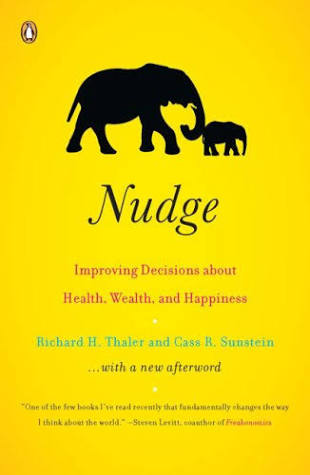
This book was difficult for me because I never read this kind of book before. The title of the book conveys the main idea of the book. Nudge can create a sustained push for not only changing the human behavior towards everything but also help in various policy matters.
Richard Thaler, the writer has provided various examples to prove his theory. In fact, after reading these ideas, we can also realize those things after a keen observation in our personal life.
The most recent and important example can be remembered in the context of India is the issue of prohibition. Supreme Court of India has banned the shops from serving liquor if they are located within a 500m distance of national highway. Various state governments have also banned liquor in their state. Bihar is the recent example. Here, the question is: Will banning any substance solve the real issue? Will it really solve the issue of drunken driving? It was always found that banning/ restrictions have failed miserably to solve any problem. Here we need an innovative form of pushes in the form of nudges as described in the book. Why not the government should start an innovative campaign of information dissemination regarding prohibition. For instance, popularize the information that spending on alcohol can be used for other productive purposes like buying a house or a vehicle. There is need to create a feedback mechanism to make the people realize about their choices. For example, banning junk food will not solve the problem of obesity but providing the fresh fruits, vegetables at a reasonable rate to the public will create a powerful nudge. Make eating fresh fruits as a fashion statement. It is really happening nowadays for organic foods.
This book has provided various concepts: Libertarian Paternalism, Choice Architect, Default options etc. These concepts decide the choices we make in our life. Our parents, governments act as a choice architecture which provides us various options to choose in our life. Why not provide good choices to the people so that there is no need to ban anything.
In fact, I found something very interesting in this book regarding how we think and why we choose bad options despite knowing that they are not good for our well being:
- Because we use our automatic system to think which is effortless and uncontrolled.
- We generally do not use our reflective system which is rational and controlled.
- The most prominent example is of Voters who seem to rely primarily on the automatic system. They just go by the pictures or possibilities that who is going to win.
- We follow guesses, rules of thumb, behave in overconfidence, work in the spirit of unrealistic optimism and more worried about losses than gains. Not only this, the status quo bias also hurts our choices.
- We are not able to resist temptation and sometimes act mindlessly. For example, eating is one of the most mindless activities we do in our life despite knowing that it affects our health, well being and overall life. But we don’t care whatever garbage comes in front of our eyes, we just grab on that because of lack of self-control.
- Sometimes, we also behave in that manner due to social influences.
So, the issue is how to solve these issues: There is need to NUDGE people towards good choices. And the writer has provided six principles:
- Incentives
- Understand Mappings
- Defaults
- Give Feedback
- Expect Error
- Structure Complex Choices
The policymakers, as well as people at the helm, should provide incentives to the people to follow rules. The recent example, I can remember about providing various prizes under DIGI DHAN MELA programme of Government of India to make India digital.
The default options are very powerful and ubiquitous. People generally do not change the default options. So why not make good choices as default so that number of people can follow it. The writer discusses this option so many times. For instance, if we want to save money, why not deduct the amount from the salary automatically. In fact, the saving and insurance ideas of today are mostly based on this concept. In fact, he has highlighted the concept of SAVE MORE TOMORROW.
Providing feedback is also a good option. If we provide feedback to the people in comparison to others, they tend to improve their situation. This also works in cases of comparison.
The writer has written this book analyzing the policies prevailing in the USA. However, the basic idea of nudge can be used in India’s various public policies. In fact, the campaign of Texas-DON’T MESS WITH TEXAS was very successful in reducing littering in the city. It can be adopted in India in various manners. For instance- DON’T MESS WITH DELHI.
The writer also discusses various objections to the idea of LIBERTARIAN PATERNALISM.
In fact, the book is a good read for future as well as present policymakers who really want to provide good choices to the people to make their life better.
Just now, I found a very interesting implementation of this idea by the UK government. The UK government has a “NUDGE UNIT” in the name of BEHAVIORAL INSIGHTS TEAM. This organization was set up to popularize “nudge theory”, which is a combination of behavioral economics and psychology. It is helping the government to improve policy options and bring about change in the behavior of the people.

 Policy Wise