Public Policy matters!

The core objective of public policy should be the welfare of the citizens” – Excerpt from Anticipating the Unintended Newsletter

Before I review this important book on public policy, let me tell you an interesting story of my childhood and how the Indian state was all around me, similar to the childhood of Jaitley, one of the authors of this book. My childhood was spent in this government quarter located in a block of Deoria district in Uttar Pradesh. My Amma (grandmother) was a government officer there for more than 20 years. The block is demarcated as an administrative unit under the government of India for the purpose of governance. I still have this fading memory of the event occurring twice in a year during my stay with my grandmother: once on Republic day and another on Independence day. 

So whenever Independence Day or Republic Day came, every employee prepared for it for many days before. They cleaned the whole place. Grasses were trimmed. Gutka stains were removed. Whitewashing was also done sometimes. All government officials wore their best clothes and reached the office on time (only these two days ) to participate in the function. I had no choice but to accompany Amma to these functions. She never said anything, but there was this unspoken rule for all kids to attend and participate in these functions and be present when officers were talking about the freedom struggle, contributions of leaders like Gandhi, Nehru, Ambedkar, Patel, Sarojini Naidu, etc. Interestingly, my mind was focused on the laddu and samosa, which were distributed at the end of the functions. That was the only incentive I used to attend these functions. Now that I look back, it feels like those speeches really made an impact on my life, so much so that I had one and only dream of being part of the Indian Civil Services. However, later in my life, I could understand the limitations of the State machinery and how it is also a creature of its circumstances and the people who are at the helm.

Public Policy seems like a subject for intellectuals and out of reach for people of other disciplines. Also, it can be a little boring for some, but the thing is that public policies are everywhere. What do you eat? Where did you study? Where are you working? Whom you are getting married to? Every decision and action are somehow interlinked with public policies, as the book adds: ‘context is king in public policy’.

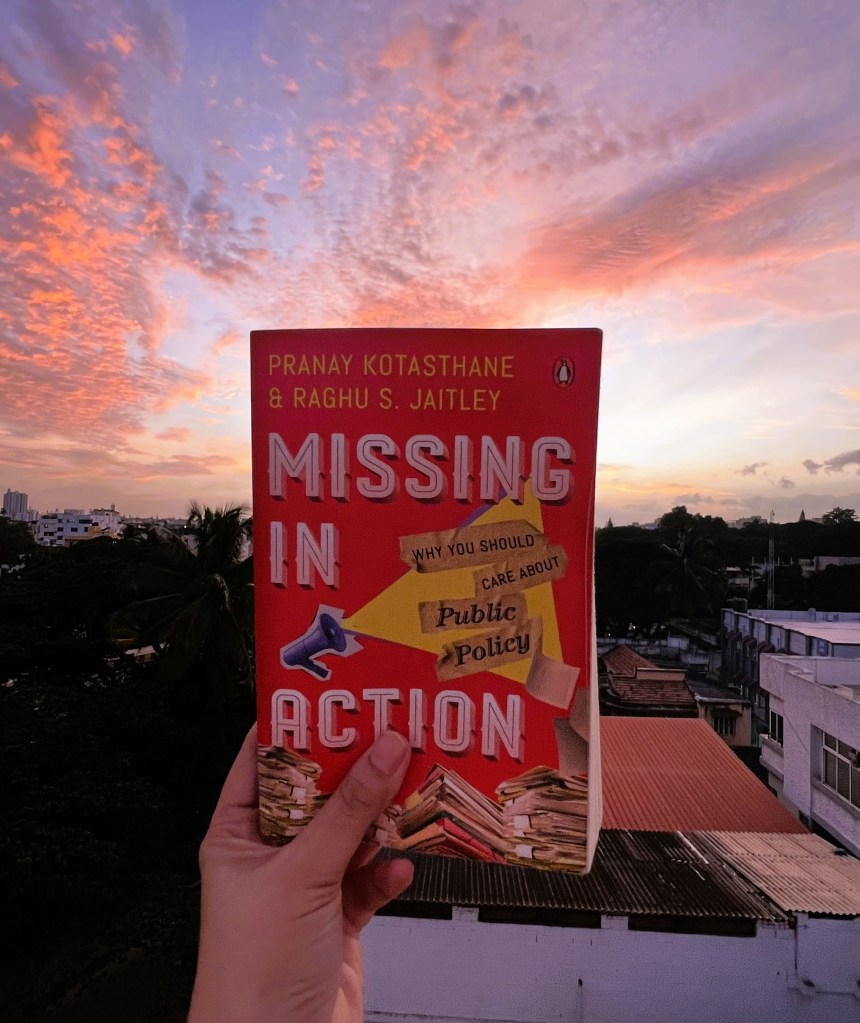
The book, “Missing in Action: Why You Should Care About Public Policy” by Pranay Kotasthane and Raghu Sanjay Jaitley tries to make Public Policy interesting by using relevant examples. Its clever interlinking of the policies of the Indian state with Bollywood’s songs and movies of various times makes it relatable for common people to understand the complicated concepts about the Indian state, market, and society. The idea of the book is to answer the question of why, what, and how the Indian state works. This book, along with another profound book, In Service of the Republic by Vijay Kelkar and Ajay Shah, should be included in the curriculum of every college running public policy courses in India. The best thing about the book written by Kotasthane and Jaitley is its reliability, simple language, and examples given from the Indian context to explain the concepts. The authors’ use of first-principle thinking and providing the context and historical reasons behind every concept have made it an easy read for a subject that is inter-disciplinary in nature.

The book is divided into three parts: Sarkaar (State), Bazaar (Market), and Samaj (Society). These three important forces play a crucial role in policy making, implementation, and execution. Each part has different chapters that deep dive on the roles of state, market, and society and their interplay among them. Kotasthane and Jaitley bust some myths about politics and public policy before diving into three parts of the book.

Indian State: Mai Baap Sarkar

Sadak, tum ab aayi ho gaon, Jab sara gaon shahar ja chuka hai”- Mahesh Punetha

This part focuses on educating the reader on why the Indian State is the way it is and what it does. The authors discuss the origins of the idea of the state in general and the ‘Indian State’ in particular. They both feel that thrusting the responsibility of social revolution on the state by the Constitution of India was a revolutionary step. However, it overburdened the state with responsibility for reforming society, which later turned the State into ‘mai baap sarkar’. 

The Indian state became a nanny state because of the huge expectations and responsibilities thrust upon it by the constitution and the citizens. As the authors rightly put it, “it miserably failed at the task it was supposed to be doing : upholding law and order, policing, and providing basic public services due to its thrust on social reform”.

According to Kotasthane and Jaitley, the Indian State is a Republic of No, instinctive, still socialist, and focuses more on symbolism than substance. Rightly so, we are good at banning things, getting outraged because of flying kisses, movie scenes, or songs, and still thinking that the private sector is exploitative when there is hard evidence showing that 1991 economic reforms and privatisation pulled many people out of poverty. The government of the day will tell you to change your DP to support the ‘Har Ghar Tiranga Movement’ , when many other important things could have been done on this occasion. Some examples can be: don’t practice casteism, racism, sexism, etc., and some more practical ones like keeping your areas clean, helping others, or not using plastic, etc.

Bazaar (The Market)

This part talks about India’s economy and its interaction with markets and businesses. The Indian state and society both looked at the market with some suspicion because of historical reasons of colonial rule as well as the socialist ideas of our freedom fighters and early leaders. The market as well as the private sector have always been demonized until it reached a state of ‘hand to mouth’. At the brink of economic collapse, India went for economic reforms in 1991. Kotasthane and Jaitley argue for more economic growth to increase the economic pie since evidence suggests that every 1% GDP growth in India can take millions out of poverty. Economic growth is required to provide a dignified life for the people of this country.

It has many other useful concepts, such as the property rights system, opportunity cost neglect, cost-benefit analysis, marginal cost of public funds (MCPF), bans, and price controls by the state. The authors have thoroughly explained these concepts through examples from India. One such example is the problem of Delhi smog. You will be surprised to know that the government’s price signaling in terms of the minimum support price (MSP) for grains is one of the reasons why the capital city turns into a smog chamber every winter. If you are a student of policy or economics and find it difficult to understand economic jargon, you must read this section to get a better understanding of these concepts.

Samaj: Mere Angane Me Tumhara Kya Kaam Hai

This part delves into the challenges between the Indian state and society. Indian society was and has always been conservative and illiberal, considering all kinds of biases and discrimination practiced until today. Just read matrimonial ads published in any newspaper, and you will see how our society is still obsessed with caste, class, race, color, religion, and other factors that make them feel exclusive and superior. However, the Indian Constitution is a liberal document that talks about rights, freedom, and social justice. The friction was bound to happen and is still happening. The Indian state is ruled by the people who come from society, and they try their best to bend these rules, laws, and orders to practice societal norms and practices. They have always lived a double life: liberal while doing their job but conservative at home. This dichotomy changed after liberalisation because people were no longer dependent on the state for everything.

In this part, Kotasthane and Jaitley also discuss the so-called ‘population problem’. They are not hungry stomachs but enterprising brains. Poor governance rather than overpopulation is India’s biggest problem, according to the book. In the end, authors discuss narratives, development models, and finally the idea of India and how the discourse has shifted from finding the right solution for the overall development of the country to proving the other side wrong. However, the solution also lies in the people of India, its Constitution, and state, because India’s quest for destiny is still going strong. You, the reader, and the conscious citizens of this country are still determined to make this country a better place to live.

Happy Independence Day to all of you!

If you liked reading this post and gained something from it, please buy me a coffee by clicking the link below:

Buy Me A Coffee

Jails are not an equaliser

“If you steal 1,000 rupees, the hawaldar will beat the shit out of you and lock you up in a dungeon with no bulb or ventilation. If you steal 55,000 crore rupees then you get to stay in a 40-foot cell which has four split units, internet, fax, mobile phones and a staff of ten to clean your shoes and cook your food ( in case it is not being delivered from Hyatt that particular day)-Incredible India! – Anca Verma (a high profile prisoner)

Prisons reflect the social realities of Indian society and it has been shown in one of the most insightful books on life behind prison walls, “Behind Bars: Prison Tales of India’s Most Famous” by Sunetra Choudhary. The book narrates the story of famous prisoners who were sent to jail for their misdeeds. Their influence allowed them to tell their stories without fear of consequences. It also tells the story of some innocent people who got entangled in this maze. The book humanizes the story of these prisoners and shows how even powerful people feel ashamed because they have to go to jail because they committed some crimes. The author not only tells the story of these prisoners but also the realities of living in these jails. What a challenge it is for poor people to survive in jails. How powerful and rich people misuse their wealth and power to live an entitled life even while serving a jail term. In this book, she writes about the following people: 

  1. Amar Singh: Everyone who follows Indian politics knows him. He was a power broker in Indian politics. He landed in jail because of his special quality of networking. He was sentenced under the ‘cash for vote scam’ which rocked the UPA government during the signing of the 123 agreement between India and the USA. 
  2. JP: He was the American Mallu whose life was turned upside down when he was arrested and sent to Tihar jail.
  3. Sushil Sharma: He is the famous tandoor murderer who not only shot his wife point blank but also disposed of her body in a tandoor. He was with the National Students’ Union of India (NSUI) at the time when this horrific incident happened. 
  4. Anca Verma: She was a high-profile prisoner with major political connections. She was arrested along with her husband Abhishek Verma. 
  5. Rehmana: She was sent to jail on her wedding day because she married Arif, a Pakistani from Abbottabad who is currently on death row for firing at Delhi’s Red Fort. 
  6. A Raja: He was the Telecom Minister and the face of the 2G scam which rocked the UPA II government and finally led to its defeat in the next General Elections. 
  7. YB: YB is a juvenile who was sent to jail for committing rape. He was later acquitted. 
  8. Peter Mukherjea: The former CEO of Star News was arrested for murdering his daughter Sheena Bora along with his wife and business partner Indrani Mukherjea. 
  9. Wahid Sheikh: He was an English teacher at the Maulana Anjuman-i-Islam Abdul Sattar Shoaib School. He was arrested by ATS for being a suspected SIMI (Students Islamic Movement of India) activist. He was tortured by decorated police officers. 
  10. Somnath Bharti: The infamous political leader from AAP who was sent to jail for domestic violence. According to his wife’s allegations, he used his pet dog Don to attack her when she was pregnant. 
  11. Khushi: She is a trans bar dancer who was gang-raped in police custody. What more to say when protectors themselves become the perpetrators.
  12. Rajesh Ranjan (Pappu Yadav): His life in jail was full of surprises. He fought the election from jail, became a notorious gangster, and also fell in love and got married. 
  13. Kobad Ghandy: A 69-year-old man who is accused of being a member of the banned organisation, CPI(Maoist). He is the only person who spent substantial time with Afzal Guru before his hanging. He wrote a detailed letter to the author of this book describing the events leading to Afzal’s execution. 

Anyone who is interested in the concept of state and violence must read this book. It shows how the rule of law is there to control poor and vulnerable people. Rich and powerful people can always get away with doing whatever they want to do in their lives.

If you liked reading this post or gained something from it, please buy me a coffee.

Buy Me A Coffee

P. V. Narasimha Rao: Lion, Fox and Mouse

A prince….must imitate the fox and the lion. For the lion cannot protect himself from traps and the fox can not defend himself from wolves. One must therefore be a fox to recognise traps, and a lion to frighten wolves.”Niccolo Machiavelli, The Prince, circa 1513 AD

“If Jawaharlal Nehru discovered India, it can reasonably be said that P. V. Narasimha Rao reinvented it”. 

Kapil Komireddi

It’s early morning in this sleepy village of UP. My hometown. Animals and human beings both are awake. Handpumps are surrounded by children and adults. Women of the house are hustling in the rasoi. Meals are being prepared. The smell of boiling rice has taken the whole house in her custody. Buffaloes and cows are waiting for their breakfast meal. The house is being cleaned and smeared with cow dung. One corner of the house is filled with this stoic silence. It is called ‘Dalan‘ where this old person is sitting on a cot wearing this bedag white kurta and dhoti. Black Ainak sitting on his nose like his old friend. Nothing can disturb him at this time. “Even pralaya can’t move you at this time”, a voice looms from the aangan. One kid fills the lota with water and runs towards the Dalan. She sees an old person holding Akhbar in his hand. A school headmaster whose day starts with reading newspapers.

And this old person was my Dadaji who influenced me to have a long-lasting relationship with newspapers. Newspaper reading and political discussion have always been part of Indian culture. Memorising the names of our political leaders and Bollywood actors mentioned in various newspapers was my favorite pastime. It is for this reason that I remember the name of P. V. Narasimha Rao. He was the first South Indian Prime Minister of India. We had a competition among our childhood friends to memorize the complete spelling of his name. I used to say his name out loud to my classmates and colony friends proudly. In those days, I had no idea he would change the course of Indian history.

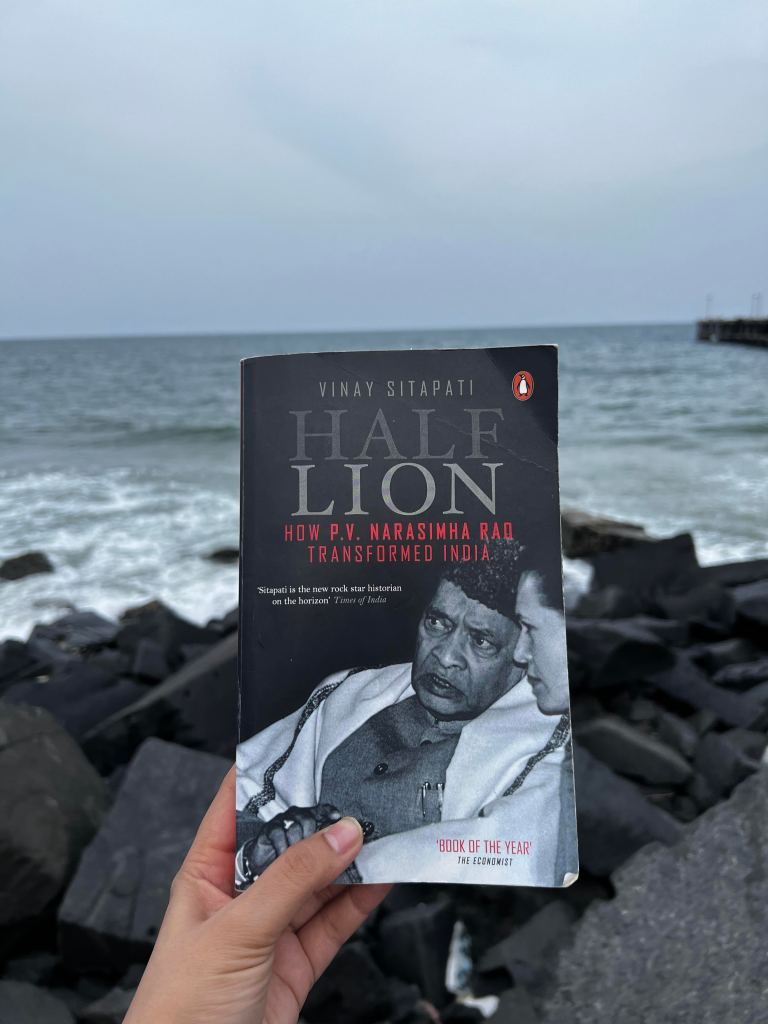
Half Lion: How P.V. Narasimha Rao Transformed India 

Vinay Sitapath’s well-researched book, “Half Lion: How P.V. Narasimha Rao Transformed India,” tells the story of P.V. Narasimha Rao from a small village to New Delhi-the ultimate power center of India. The author narrates a balanced account of P. V. Narasimha Rao who was a tragic figure and one of the most misunderstood leaders of India despite his various achievements. The author humanises the story of Rao to showcase that he was after all a human being who was a creature of his circumstances. 

The author Vinay Sitapati is a political scientist who has worked as a journalist with the Indian Express. He is a lawyer by education. Interestingly, the subject of this book was also a lawyer by education. The book traces the journey of P. V. Narasimha Rao from his humble background starting from Vangara village located in Karimnagar district of then the State of Andhra Pradesh to become one of the most decisive Prime Ministers of India. The book dealt with the background happenings of the politics of that time. It gives a glimpse into the lives of politicians. What kind of stress and tension do they have to endure? How difficult is it to take everyone along? How difficult is it to bring everyone on the same page with respect to any policy issues? How did the political constraints shape the political reforms? How do interest groups create hurdles in implementing big bang reforms in the country? How does political management play such an active role in implementing policies?   

Reading this book was not only a pleasant experience but also an eye-opener. People generally don’t know about him because he was not a popular leader either among his party cadres or among the public. This is one Prime Minister of India, many people don’t even remember who had the political will and conviction to usher into the 1991 Economic Reforms that brought millions of Indians out of poverty.

The book answers many fundamental questions relevant to Indian politics with respect to the role of P. V. Narasimha Rao. What was Rao’s role in the liberalisation reforms? Have they transformed India for the better, or have they made the poor worse off? Why was he selected as prime minister? Did he secretly want the Babri mosque demolished? Why did Sonia Gandhi and Narasimha Rao fall out? How did he survive a hostile Parliament and party to last a full term in office? Are the corruption charges against him true? And is Narasimha Rao India’s most transformational leader since Jawaharlal Nehru? According to the author of this book, the central idea of this book is to understand how prime minister Narasimha Rao achieved so much despite having so little power. 

This book made me not only respect and admire P. V. Narsimha Rao but also like him as a person. Even after being a politician, he was not at all pretentious. 

Architect of Modern India

P. V. Narasimha Rao was a grassroots leader who rose to become the Prime Minister of India. He was instrumental in implementing the idea of economic liberalisation, reforming the Indian economy, opening India’s foreign policy, achieving nuclear deterrence, and most importantly running a minority government when he didn’t have the support of his party, lacked charisma and popular support as well.

When Rao became the Prime Minister, India as a country was standing at a crossroads. The Soviet Union collapsed. The country is reeling under a severe Balance of Payment crisis. Separatist violence against the States of Punjab, Kashmir, and Assam was threatening the integrity of India. He took it as a challenge and transformed India. Despite running a minority government, he not only completed a full five-year term but also successfully took India on a path of success. He was a true problem solver. Even during his stint as a Chief Minister of Andhra Pradesh, he proactively implemented a land reform policy. 

His push for economic reforms leading to the opening of the Indian economy has borne fruit for the country. His legacy is seen in terms of increasing per capita income, mobile phones in every hand, and also India’s success in terms of pulling millions out of poverty by implementing welfare schemes. Today, if we are able to use mobile phones, we should thank Rao. He addressed the separatist movement in Punjab, Kashmir, and North East. Due to the successful implementation of economic reforms, he could push for policies that led to the realization of the ‘welfare state’ in the country. 

This book not only shows the highs and the lows of his life and how he was like one of us. A normal human being who was affected by harsh criticism. The best thing about him was that he used to maintain a diary where he used to write everything whatever he felt. Fortunately, the writer of the book has had access to these writings which show what he was thinking? How things were affecting him? What was going through his mind when he was faced with difficult situations? 

Transformation in his ideologies from being a staunch socialist to a leader who not only wholeheartedly accepted the idea of liberalisation but also implemented it at a national level itself shows his openness and forward-looking nature.

Sidelining of P V Narasimha Rao by the Indian National Congress

His own party i.e. Indian National Congress (INC) disowned him due to various reasons. He was blamed and victimised for many things that he publicly said he has not done. His achievements as a Congress leader and Prime Minister were erased. He was blamed for allowing Sikhs to be killed in Delhi during the Anti-Sikh Riots in 1984. He was criticized for letting Union Carbide chairman Warren Anderson escape India after the Bhopal Gas leak. Finally, everyone thought that he played a secret role in the demolition of Babri Masjid.  Left-wing parties, intellectuals, and Marxists blame him for pro-rich policies and bringing untold miseries to the people of India. 

His actions or inactions during the 1984 Sikh riots and 1992 Babri-Masjid demolition were questionable. His personal notes and letters provide justifications for his inactions for both the tragic events of India’s history. He surrendered his authority to the Prime Minister’s Office during the Anti-Sikh riots which are unforgivable. He had too much confidence in his ability to negotiate with Hindutva leaders including the organisations like VHP and BJP. According to the author, it was his indecisiveness and poor judgment of Rao that paralysed him not dismissing the Kalyan Singh government and imposing the President’s rule in the State of UP. In fact, he was more focused on saving his own minority government rather than imposing President’s rule on UP. 

He was a contested figure who displayed huge contradictions in his actions. However, his contributions as a leader who stood behind a team who implemented economic reforms is a commendable feat when he didn’t have any support from his party and the people. He was a Philosopher king, a lion, and a fox depending on the circumstances and demands of the time. In fact, “Rao was a tragic figure, remembered for so much that went wrong, but not for so much that went right”, adds Salman Khurshid, a veteran Congress leader. 

P. V. Narasimha Rao: the best Congress Prime Minister of India? 

Which is more important: institutions or individuals in deciding the trajectory of any India. Some theories give importance to institutions and some give it to individuals. Institutions play an important role in shaping the destiny of any country, argues Daron Acemoglu and James A Robinson in his book, “Why Nations Fail: The Origins of Power, Prosperity, and Poverty”. According to them, political and economic institutions are interlinked in a country and that leads to poverty and prosperity based on the nature of these institutions. But then the question comes: who set up and ran these institutions? Individuals right. And Ruchir Sharma, the author of “Breakout Nations: In Pursuit of the Next Economic Miracles” believes in that. According to him, ‘it’s not the type of the system that matters, it is the stability of the system and, even more important, whether the leaders running it understand the basics of economic reform’. And this theory fits really well with the role of P. V. Narasimha Rao who not only understood the idea of economic liberalisation but also stood like a rock behind his team who implemented the 1991 economic reforms. So Rao indeed was the architect of modern India. 

However, ultimately he was a human being and had his fair share of shortcomings. The best thing about him is that he had the ability to introspect and think. It led him to become a better administrator when he took the role of Prime Minister. He learned from his mistakes during his chief ministership. 

According to the author, he had the acumen to assess the situations and contradictions of India. He also could understand and assess his opponents and enemies. Accordingly, he knew when to act like a lion, fox, or mouse. That was his most important political skill. His brilliant ability to assess the political context not only in terms of role but also in terms of timing. And this quality helped him implement difficult policy decisions. 

Arun Jaitley called him India’s best Congress Prime Minister and rightly so. He added that Rao showed it is possible to be a Congressman without being from the Family. Jairam Ramesh, a veteran Congress leader who worked as OSD to Rao added that he was a master tactician who knew which cards to play when.

‘How do you make a U-turn without making a U-turn? That’s a special Narasimha Rao art, Shekhar Gupta said while taking his interview.  It’s not like that, Rao replied. ‘If you understand that where you are standing is itself in motion, the turning becomes easier.’ (‘Walk the Talk: P.V. Narasimha Rao Interview: November 1st, 2013)

Hindi and Urdu words used in the write-up:

  • Dalan- Verandah
  • Angan-Courtyard
  • Bedag-Unblemished
  • Ainak-Glasses
  • Rasoi-Kitchen
  • Lota-A small container for water generally made up of brass or steel
  • Dada-Grandfather
  • Pralaya-Destruction
  • Akhbar-Newspaper

If you liked reading this post or gained something from it, please buy me a coffee.

Buy Me A Coffee

Public policy work is a test match, not an IPL.

The pursuit of happiness by each person is best achieved when the State creates conditions of stability and vanishes into the background”

Excerpt from the book

It was a cold winter evening in Gurgaon. I was lying on my bed wrapped in a blanket, leisurely watching some YouTube videos. The video was interrupted by some Twitter notifications concerning Prime Minister’s address to the nation. I started watching Prime Minister’s All India televised address where he declared 1000 and 500 notes as demonetised. My first reaction was to check how much cash I had at home. Seeing only 1500 rupees cash at home, I felt relieved. Like other people on WhatsApp groups and Twitter, I also believed for a few days that this was a master stroke by the then government headed by Narendra Modi. This step is going to eliminate the black money available in the country. However, later on, like most other people, I had seen suffering, common people had to go through standing in the queue for long hours just to exchange their old currencies. My domestic help came the next day crying that she has no bank account here and she doesn’t know how she can replace her old notes. I also remember following the everyday newspaper headlines on this issue and how the government shifted the goalposts of this policy decision, saying that it will increase digitisation in the country.

Was demonetisation a good policy decision? Why did the BJP government take such a drastic decision without having a broad base consultation? Why there was no deliberation with the public before taking this decision? Did it make any impact on curbing black money in the country? What were the consequences of this decision? How it has impacted the common people in the country? This book will help you to make sense of these questions if not find the right answers.  

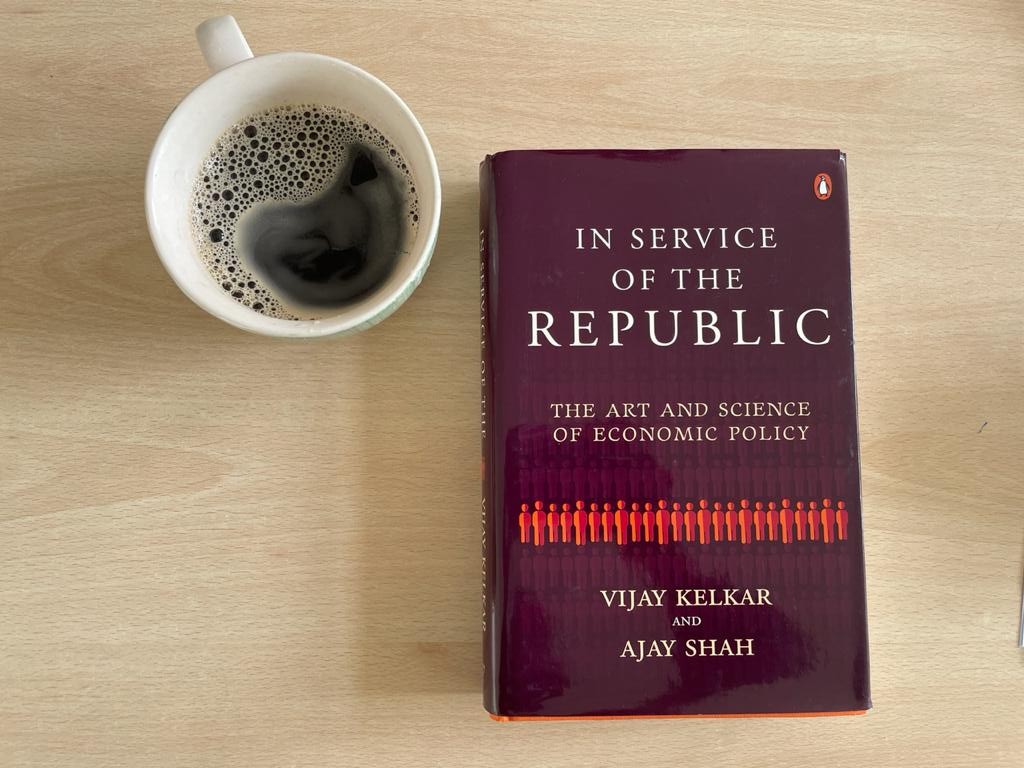
I purchased this book-In Service of the Republic: The Art and Science of Economic Policy last year after many episodes on The Seen and Unseen podcast recommending it a must-read for all those who are interested in policymaking. Vijay Kelkar and Ajay Shah, former bureaucrats are the authors of this book. This book not only makes one understand why demonetisation was a disastrous public policy decision but also shows the nuts and bolts of policymaking, execution, and implementation. Insights mentioned in the book make it a manual for all public policy practitioners. Although the book has 40 chapters, it’s short, so it’s easy to read. What goals should the State pursue? What is the government’s mission? Every line in this book made me want to write it down.  

India i.e. Bharat: A Union of States

“A State as a human community that claims the monopoly of the legitimate use of physical force within a given territory” – Max Weber, The Vocation Lectures, 1919

Why State is needed? What is the main responsibility of the State? What are things State is supposed to do or not do? How State’s different actions have far reaching consequences not only for the present generations but also for the future generations. The authors list various conditions when the State’s actions are legitimate and justified. The state should not do anything except address market failure. Market failure happens when the free market fails to deliver efficient economic outcomes. Market failures happen in four ways:

  1. Externalities occur when some of the costs or benefits of a transaction fall on someone other than the producer or the consumer. Pollution is an example of negative externalities. IT companies in Bangalore led to more parents providing computer education to their kids so that they can get jobs, which is an example of positive externalities.
  2. Asymmetric Information refers to a situation where one party has more or better information. For instance, when a customer is buying medicines at a shop, she has no way of knowing if the medicines are adulterated.
  3. Market Power is established when a few firms achieve a dominant position in a market.
  4. Public goods are goods that are available to anyone. They have two characteristics: non-excludable and non-rivalrous. Roads and clean air are public goods.

India a low capacity State

Indian State works through panic, package, and neglect“- Harsh Vardhan (Financial Economist)

Many authors Indian and Western have shown that the Indian State lacks capacity. It can organise a humungous Kumbh Mela where crores of devotees come to take a dip in the holy Ganga. It can also successfully conduct elections for such a huge electorate spread across and length and breadth of this country. However, the Indian state has continuously failed to deliver basic health, education, and sanitation services even after seven decades of independence. Why do Indian Institutions lack capacity? Because building a high capacity State takes time and consistent effort by policymakers, politicians, and bureaucrats.

Building a high capacity State takes time

“Where we do not have high intellectualism, we get raw power play”

Building the republic takes time. It will take many decades of hard work by the policy community for India to rise to the ranks of the advanced nations of the world. Policy reform is slow, hard work, and not amenable to quick wins on social media. There will be no sharp impact, no human interest angle. There will be small changes spread all across the economy, which can add up to substantial impacts.

Independent judiciary is an essential foundation of the market economy because it helps in the contract enforcement between the government and private firms. Poor contract enforcement leads to market failure. Different types of private solutions (contracts, torts, class action lawsuits, and private enforcement) can flourish when and only when the courts are swift and competent.

The need of the hour is to have an institutionalised application of mind. It is a way of ensuring that the right questions are asked, and alternatives evaluated before a decision is made. This helps avoid impressionistic and casual approaches to policy formulation and reduces the extent to which sectarian considerations dominate. In India, we have some irrational decisions because one section/caste group/pressure group is lobbying for it. Sound policy decisions require a lot of background research work, consistent probing, and also a feedback loop.

The Rhine river was not cleaned in a day. Rhine Action Plan was drafted in the year 1987 and it took many years of implementation and actions which led to the cleaning of the river. The hardest problems in state capacity are the criminal justice system, the judiciary, the tax system, and financial regulation. The best way to make progress is to take small steps and listen to the statistical evidence.

Policymaking is a process of trial and error

When getting hold of a larger object, don’t discard the smaller object. Don’t use a sword when a needle will suffice”.

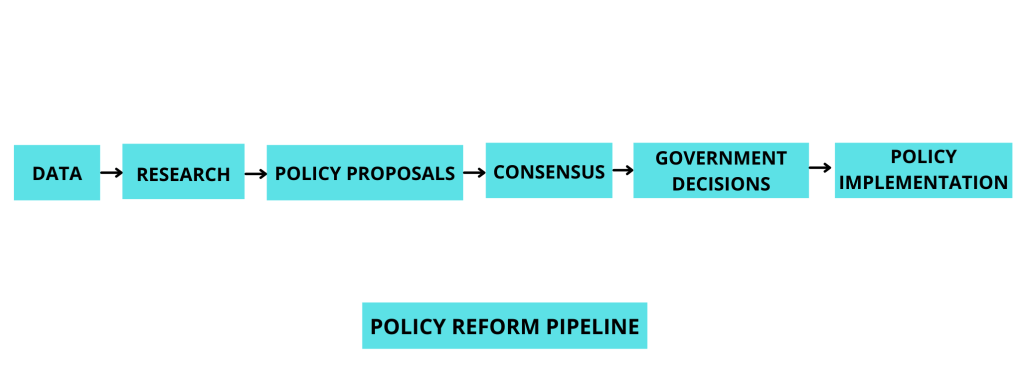
Public Policy is a process of hypothesis testing, of forming a theory about the world and experimenting with interventions that are thought to help. This testing should go through a policy pipeline where the first data is gathered. Research is conducted which led to policy proposals, creating consensus among the public and policymakers. Finally, the government takes the decisions and implement the policies.

Created on Canva

Why do public policies fail? There are various reasons behind it:

  1. The information constraint: We don’t have enough data because the government itself does not collect the data with transparency and fairness. There are various other issues with data collection in the country. Policymakers just do not know what is going on. For instance-The data about people dying from COVID has so many discrepancies.
  2. The knowledge constraint: We don’t understand the real problem because of a serious lack of social science research in India.
  3. The resource constraint: The government spends more than we think and know. The marginal cost of public funds (MCPF) is much larger than Rs 1 in India.
  4. The administrative constraint : Public administration is harder than human resource management in the private sector.
  5. The voter rationality constraint: Voters have no incentive to know about issues of public policy.

Public Choice Theory: A Guide to Public Policy Making

……No matter how famous or well-reputed a person is, when she is hired as an official in the government agency, we are aware of the gap between her personal interest and the public interest. Public Choice Theory encourages us to engage in “politics without romance”. The objective is not to hire saints but to achieve a state which yields good outcomes when each actor is self-interested. Public Choice Theory predicts that public organizations will favor multiple objectives as this gives reduced accountability. Clarity of purpose is efficient for the principal and not the agent. A publicly stated and clear objective, on each policy initiative, improves the policy process. Public choice theory encourages us to think that all officials and all politicians are cut from the same cloth. We have to construct systems of checks and balances that will work through rational incentives of all parties and without assumptions that any one person is a saint. The puzzle of policy design is that of finding checks and balances.….

However, this theory also has its limitations. In reality, every individual in public life has a mixture of personal and altruistic elements. The State is not a benevolent actor, it is formed of self-centered persons. To create checks and balances, citizens, policymakers, and politicians can use these five pillars: data, media, intellectuals, legislature, and judiciary.

Strong Institutions are need of the hour

The policymakers should prioritise institution-building over just GDP growth. In the book named “Why Nations Fail”, the authors have given a ‘theory of institutions’ where they argue that institutions decide the destiny of the country. Institutions can be of two types: Political and Economic Institutions. The authors also add that poverty and prosperity of nations are the interplay of economic and political institutions. A complex modern economy only works when it is a self-organising system. It has to have the creative efforts of a larger number of individuals, all working in their own self-interest. There is no one measure of institutional quality but the authors have listed a few measures that can be used as a benchmark to understand the quality of Indian institutions:

  • Extent of perceived safety of women and functioning of the criminal justice system
  • Flight of millionaires
  • Flight of India-centric firms
  • Flight of India-centric trading
  • Flight of India-centric contract enforcement
  • Freedom of speech to comedians

Appreciation of ‘self-organising system’

The authors reiterate that State machinery should appreciate and facilitate the self-organising system. For instance- local problems should be solved by local people who are on the ground since they understand the problem better. The authors talk about Coasean Approach(Transaction Costs Perspective) to deal with market failures. The key concept of this perspective is that when property rights are clear, both sides are brought to the table to negotiate. However, this approach also requires the State to play a role in clearly defining property rights and judicial infrastructure that can help in enforcing contracts.

One of the best solutions mentioned in the book is an approach by political scientist Elinor Ostrom. She was the first woman to get a Nobel prize in economics. She discovered that many practical arrangements established by traditional communities over very long periods of time achieve good results. An example of this is declaring a moratorium on eating fish during the month of Shravan. Though this step seems religious, it leads to saving fish counts in the river.

Social engineering is inappropriate

Social systems are very complex and outcomes are generally greatly different from those that the planners may have desired. The values and imagination of the people should drive the changes in the world, rather than the values and objectives of a few central planners. Society can and should evolve gradually through the thoughts and actions of the people. The best framework of public policy is one in which the State impinges upon the lives of individuals as little as possible.

Policymakers need to be aware of the knowledge constraint, biases and implementation constraints. Most importantly they need to realise that every individual, official, and politician responds to incentives. We all remember how the sterilisation scheme launched during emergency miserably failed despite having a good intention of population control. Rather than State giving surprises, implementing stringent policy measures, policymakers should nudge the people through signaling or incentives towards social change. As the authors of the book added, “we should pursue revolutionary change for government structures but evolutionary change for the people”. The best thing I got from this book is that I should never see even policymakers as someone who knows everything. They are also working in unknown territories. Better policy making requires a lot of effort and commitment from all stakeholders including civil society organisations, NGOs, politicians, and the common people.

If you liked reading this post or gained something from it, please buy me a coffee:

Buy Me A Coffee

India Tomorrow!

“Being in politics is like being a football coach. You have to be smart enough to understand the game, and dumb enough to think it’s important”

Eugene Mc Carthy (1916-2005), American Democratic Politician

Recently, when Rahul Gandhi travelled abroad just before the foundation day of the Indian National Congress(INC), there was a hue and cry in the media and other social media platforms criticizing him for not being serious about Indian politics. But seriously, he also needs a holiday break. In fact, in this book he tells the authors that he goes abroad to have some personal space as he is constantly surrounded by security and the people in India. Reading the interviews of these young political leaders makes you feel that they are also common people just that they are in the business of politics which is one of the most demanding jobs in the country.

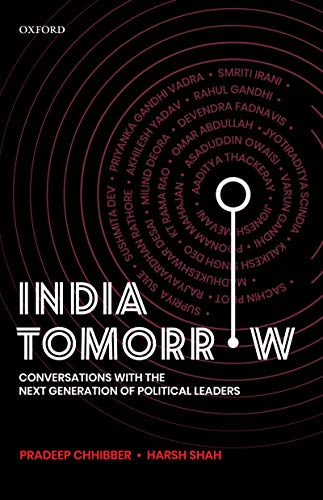
The book is about the prominent young political leaders who will shape the destiny of India in the coming years. The authors interviewed 20 young political leaders below the age of 50 from across the country and compiled those interviews as it is in their original voices. The interviews include those from Rahul Gandhi, Priyanka Gandhi, Sachin Pilot, Akhilesh Yadav, Poonam Mahajan, Varun Gandhi, Omar Abdullah, Aditya Thakeray, Smriti Irani, Jignesh Mevani, Sushmita Dev, Kalikesh Singh Deo, etc. All these interviews were conducted in person. These young political leaders come from different political parties and with a completely different background. Conversations here show their perspectives on important issues of the country. What is their thinking, inspiration, and passion that motivates them to be part of the Indian political system. As Chhibber and Shah added in the introduction that the idea behind this book is to give readers a ‘snapshot of contemporary Indian politics and its future; through the stories of 20 of the country’s most prominent next-generation politicians’.

The interesting thing about this book is that these conversations are free-flowing, and authors have posed the questions as they seemed okay without any hesitation. The book attempts to unravel the personalities, aspirations, ideologies, interests, passions, and motivations of these young political leaders. The idea is that we know the names of these leaders and frequently read or see them in the newspapers or televisions, but we have no idea what happens in their life. Reading this book makes me realize that these young politicians have done a lot of hard work to achieve whatever they have achieved in their political careers despite coming from political families. For most of them, political career had come with a big personal cost. Not only this, as authors of the book add, ‘Politics in India is a full-time job’ and the political leaders can’t maintain a healthy work-life balance.

However, the authors have missed many other important young political leaders who are already contributing in a significant way in shaping the destiny of Indian republic. For instance- Arvind Kejriwal, the current chief minister of Delhi and also the founder of the Aam Aadmi Party is a major miss in this book. However, the authors also added that the list of leaders interviewed in this book is not exhaustive and many other prominent young leaders have not been added in this book.

The interesting thing is that we get to know the personal sides of these young leaders. How there is also dissonance in their political posturing and their personal views on issues related to the Indian political system. For instance- Varun Gandhi has a liberal outlook towards society & economy despite being part of the right-wing Bhartiya Janta Party (BJP). Aaditya Thakeray belongs to Shiv Sena, known for its extremist views, has a more liberal outlook than most other leaders on many different issues. Jignesh Mevani has an activist political attitude as compared to people like Sachin Pilot & Jyotiraditya Scindia who have been trained in politics from an early age.

In this book, all women political leaders, across party lines, stated the presence of gender based challenges they faced in their profession. While interviewing these young leaders, the authors have explored the issues and tensions prevailing in Indian politics. The authors discussed the issues of caste and religion, institutional decline, federalism & center-state relations, integration of J& K, dynastic politics, and women empowerment.

Though authors covered all issues related to length and breath of the country, they did not mention young regional political leaders to know their personalities, aspirations, ideologies and interests. Currently, the book has leaders who are more prominent and popular than those who are grassroots workers and who are making a difference at ground level.

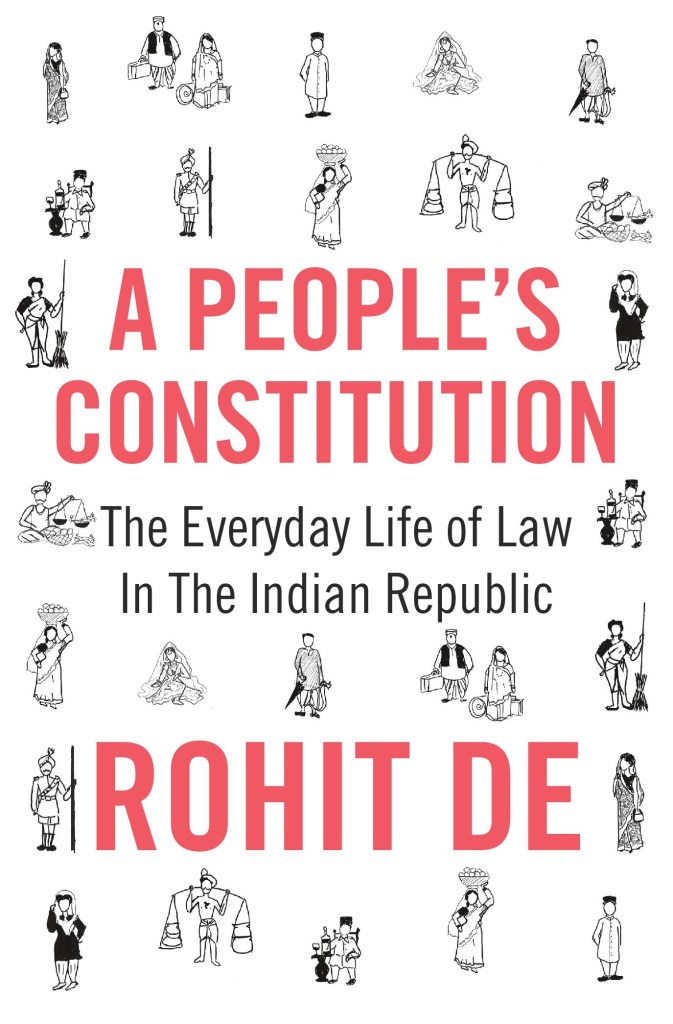
Is it a People’s Constitution?

“The constitution is not for the exclusive benefit of governments and states; it is not only for lawyers and politicians and officials and those highly placed. It also exists for the common man, for the poor and the humble, for those who have businesses at stake, ‘for the butcher, the baker, and the candlestick maker'”

Justice Vivian Bose, 1956

While I was reading the book that celebrates the contribution of ordinary people in shaping the constitution of India, a heinous and brutal crime was being committed in the largest State of India. A Dalit girl was brutally raped by upper caste men in the Hatharas district of UP and she subsequently succumbed to her injury in a Delhi hospital. But the Orwellian thing about the incident is that the girl was denied dignity even in her death. Her body was cremated in mid-night without informing her family. Her family couldn’t even see her one last time. The police barricaded the area restricting the access to the family. It shows that even after the seven decades of the enactment of the Constitution of India, justice seems distant for the marginalized sections of the society. However this book paints a different picture adding that common people played an important role in transforming the Indian constitution to people’s constitution.

People’s Constitution turns out to be a unique book for me. Because I used to think fighting for constitutional rights and going to Supreme Court has always been the prerogative of the educated and the elites of our country. Rohit De changed my perspective about this fact. The book gives the subaltern perspective on Indian Constitutional Law and constitutional rights and how the Constitution of India was shaped and transformed by the marginalized sections of the society. As De puts it, ” the Constitution didn’t descend upon the people; it was produced and reproduced in everyday encounters.”

The book narrates the cases of constitutional significance led by ordinary people during the first two decades of the enactment of the Indian Constitution. It shows how the honest prostitutes, invisible butchers, Marwari merchants, vegetable vendors, and other ordinary citizens showed exceptional courage and also ‘constitutional consciousness’ in those days itself. They took the legal route to fight for their fundamental rights. The idea is that constitution was interpreted in different ways by the ordinary people of the country and it was not the only prerogative of the elites.

And the most fascinating thing about this book is that the author has taken special effort to sit in the Supreme Court archive room and go through the important government orders, notifications, documents and the arguments exchanged between both the parties and showed in his book that various things happen around a case when it is being heard in the Supreme Court.

As shown in the book, the litigation/case in the court should never be seen in terms of winning and losing. The arguments exchanged in the courtroom and the discussion outside in media and in the public have a huge significance because it brings out all the nuances of that particular issue and what was the public sentiment about it and how it was played around in the public memory.

Also, I noticed one more interesting pattern, how the Indian Constitution was being used by both the parties who were asking for their rights and other who were trying to prohibit or ban the particular activity. For instance: if Husna Bai was asking from the Court to protect her freedom of trade and profession of prostitution, at the same time, her critics and also Durga Bhai Deshmukh & Rameshwari Nehru had been instrumental in enactment of prohibitions laws on human trafficking and forced labor based on Article 23 of the Constitution. And also in the case of banning cow-slaughter on the basis of Article 28 leading to The Hanif Querishi Case displayed that proponents and opponents of the ‘cow slaughter ban’ chose the constitutional methods to fulfill their goals.

The author claims that the Indian constitutionalism is still unexplored and understudied because it defies easy explanations. The constitutionalism as a concept is based on the desirability of the rule of law rather than the arbitrary rule of men, but the irony is that both simultaneously exist in India as we can see the ordinary people going to court to fight for their fundamental rights and at the same time there is no rule of law in many parts of the country.

The important argument of the author is that these cases filed by ordinary people were mostly related to their daily lives. And they belonged to minority communities or subaltern groups. And the final argument is that these people went to court to secure their economic rights which were getting hampered as the new Indian State was trying to regulate the market.

In 228 pages the author has shown the remarkable stories of marginalized and deprived sections of the society that have already been started striving for their constitutional rights after the enactment of the Constitution of India. The book is quite comprehensive, and most of the time feels like an academic research paper 😉 However, the book is one of the unique attempts to recognize the study of constitutionalism from below and how the constitution created a platform through which the citizens and the State can communicate with each other.

However, the reach of the Indian Constitution for the marginalized sections of the society has not been substantive enough till now. Though the author celebrates the contribution and participation of the marginalized sections as well as minority communities of the Indian society in using the newly enacted Constitution to empower themselves. However, I still believe what has shown in the short story of “Naya Kanoon” (The New-Constitution), also mentioned in the book, by one of the greatest Urdu writers Sadaat Hasan Manto written in the context of the Government of Indian Act 1935. This story is still relevant because the ordinary poor people, (remember the migrant crisis during the lockdown), still treated in the same way by the State as the Ustaad Mangu, the tonga driver in this story was treated by the policeman. So the Kanoon is still the “old one”.

If you like reading this post, click the link below to buy me a coffee.

Buy Me A Coffee

Why Political Science & IR is the best optional for UPSC?

The pursuit of knowing was freedom to me, the right to declare your own curiosities and follow them through all manner of books. I was made for the library, not the classroom. The classroom was a jail of other people’s interests. The library was open, unending, free. Slowly, I was discovering myself.

Ta-Nehisi Coates, Between the World and Me

Many civil services aspirants reached out to me to share my experience about taking Political Science and International Relations as the optional subject for my civil services preparation. I gave the main examination thrice with Political Science and International Relations optional and qualified twice for the interview. I feel that Political Science and International Relations is one of the best optional subjects for anyone appearing for the Civil Services Examination. However, I am not coercing anyone to take this optional. It absolutely depends on the person’s own interest. In this blog post, I will be talking about the pros and cons of taking Political Science and International Relations:

PROS:

  • It helps you to prepare for the General Studies paper as the syllabus of this optional overlaps with General Studies Paper I, II, and IV
  • Taking this optional means that you have to read not only Modern history, World history, and Indian Politics but also International Relations
  • The Political Theory section of this optional prepares you on ethical and philosophical issues which are helpful in Ethics, Integrity & Aptitude paper. It also helps you in answer writing
  • Reading Political Science & IR also helps you to understand the context of things happening in and around the world. It also helps you interlink concepts and understand things in a better manner
  • The best advantage of taking Political Science & IR is that it also helps you during interview preparation

CONS:

  • This optional is quite vast and you need to read a lot to have a solid grip on this paper
  • If you are not a regular reader of the newspapers, you will find it difficult to prepare for this optional paper
  • Some people find the political theory part to be boring because it is very theoretical. Too much theory makes it hard to pass the first paper.

Please also read the posts below where I list the important books on Modern India, Indian Government & Politics, and Comparative Politics & International Relations:

If you gained something from this post, click the link below to buy me a coffee.

Buy Me A Coffee

Indian Government and Politics

If I were asked under what sky the human mind has most fully developed some of its choicest gifts, has most deeply pondered on the greatest problems of life, and has found solutions, I should Point to India.

Max Mueller (German Scholar)

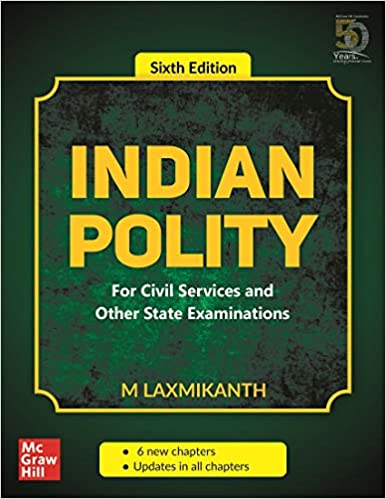
Indian Polity: M Laxmikant: Indian Polity by Laxmikant is the bible for UPSC aspirants. It is not only helpful for prelims but also helpful for mains examination. Indian Government and Politics section of the Political Science & International Relations (PSIR) requires you to be aware of all constitutional provisions. Most importantly, you have to be aware of the current happenings of Indian politics and constantly try to see the bigger picture and what happened in the history of Indian politics with respect to that particular issue. For instance: If President’s rule is declared in some states, you should know under what article of the Constitution of India, it is declared and what is the Supreme Court judgment on President’s rule and what is something about this particular president’s rule.

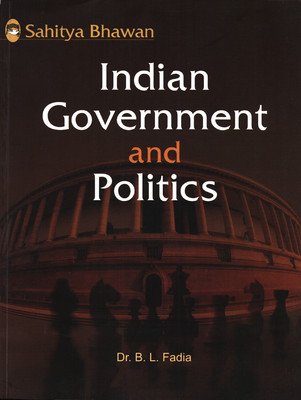
Indian Government and Politics: B L Fadia: This book by B L Fadia is a kind of guide book for the section on Indian Government and Politics. It almost covers the whole syllabus. It is a quite methodical and full of text, so it can help you to summarize or to have many view points on a particular issue. However, the book is quite boring.

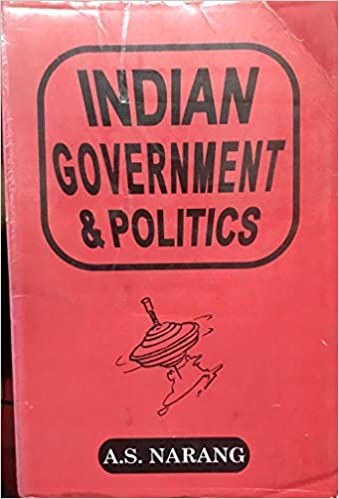
Indian Government and Politics: A S Narang: This book is very similar to B L Fadia’s book. However, two things are different: one is that the book is quite old, so it is not updated as per current happenings and the second thing is that the writing style is totally different as compared to the B L Fadia’s book. Just have this book to understand how the author has written on a particular issue. It’s not compulsory to buy.

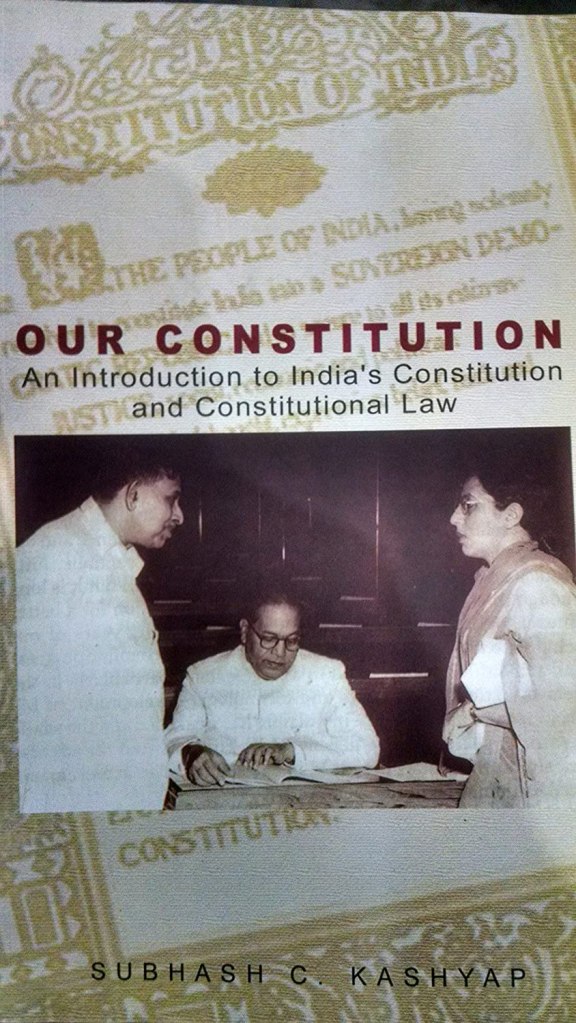
Series of Books by Subhash Kashyap: Subhash Kashyap is a well-known political scientist, Indian Constitution expert, distinguished scholar, and writer. He has written extensively on parliament, the constitution of India, and the Indian political system. His books on Indian Constitution and Parliament give you a lucid perspective on legal and political issues which helps in writing answers for the main examination. I would highly recommend reading these books if anyone has taken PSIR as an optional for the Civil Services Examination.

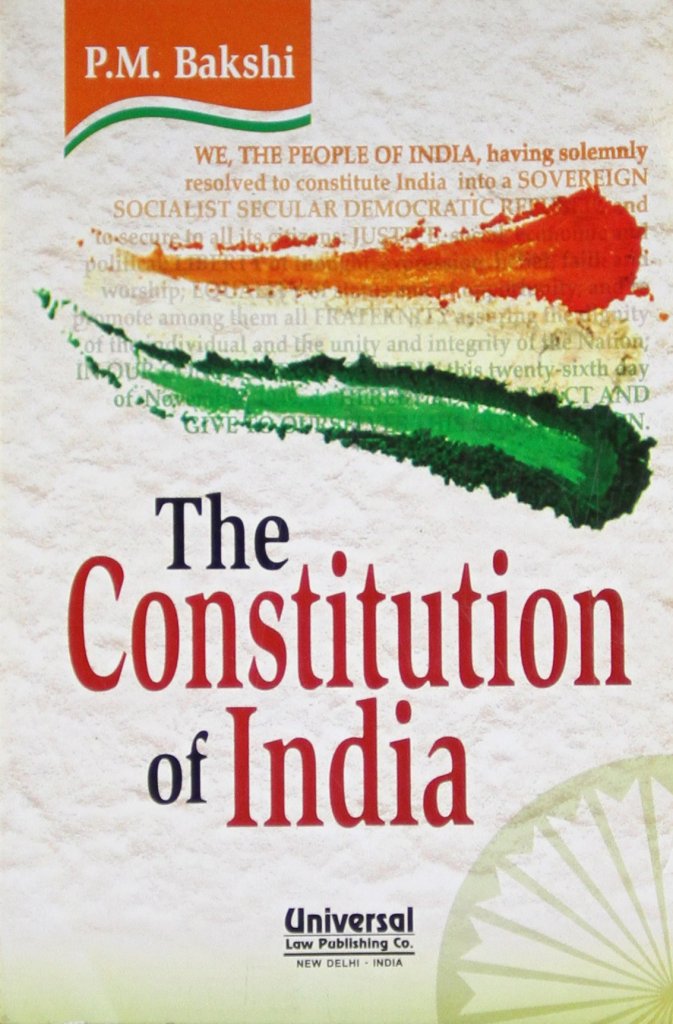
The Constitution of India: P M Bakshi: This book has all the acts of the Constitution along with the important cases. Keep this book with you whenever you want to refer to some important case related to any specific article of the Constitution of India.

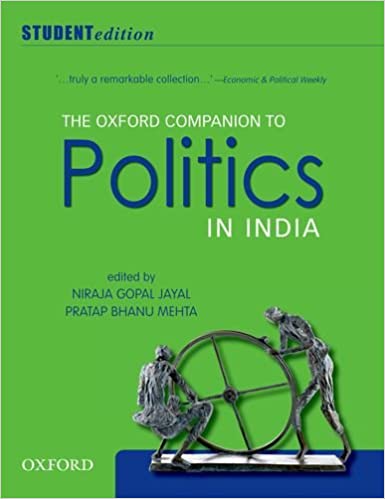
The Oxford Companion to Politics in India: Niraja Gopal Jayal & Pratap Bhanu Mehta This book is very important and highly recommended. It can help you to analyze the critical issues of Indian politics. This book is divided into eight parts comprehensively covering all essential issues starting from the institutions, the society, political processes, ideological contestations, social movements, political economy, and different ways of looking at Indian Politics. I would recommend this book reading as many times as you can and if possible also make notes from this book that will be useful for revision just before the main examination.

Miscellaneous: (Highly Recommended): The Indian Government and Politics section of the PSIR optional is quite dynamic and also needs a lot of analysis and interlinking of many concepts for better understanding. So, I will also recommend reading unconventional books on Indian politics, history, and memoirs or autobiographies of politicians to understand the political dynamics and nuances of Indian politics.

  • NCERT Books on Indian Politics, Democracy, and Constitution of India
  • IGNOU Notes on Indian Government and Politics
  • Read 2-3 newspapers daily. The Hindu, The Indian Express, Times of India
  • Watch Rajya Sabha Debates. Big Picture and also the Samvidhhan series
  • Watch out for important Supreme Court judgments
  • Check out the PRS website for all new bills, Standing committee reports, and their summaries

Please find my other blogs on Political Science and International Relations below if you want to know more:

If you enjoyed reading this post, click the link below to buy me a coffee.

Buy Me A Coffee

Health Challenges for the Modi 2.0

“Will the ‘New Government’ be able to achieve the goal of “Health for All”?

The incumbent government led by Narendra Modi got a huge mandate for his second consecutive term in the recent Lok Sabha elections 2019. The government does not have any coalition compulsions and can take any complex decisions. The compositions of the Council of Ministers (COM) and the allocations of the portfolio also reflect the focus of the government on talent and good governance. The huge mandate given to the incumbents also creates tremendous expectations.  “Health will be a topmost priority of the government”, said Dr. Harsh Vardhan, Union Health Minister in his first official statement. Even Prime Minister Narendra Modi mentioned in his speech that this victory is for those poor people who wait for years to save money and also to seek treatment. Now the poor people are covered under Ayushman Bharat. In fact, now health is going to dominate the discourse of public policy in the country as it is one of the most important components in Human Capital approach. If India has to take advantage of its huge ‘demographic dividend’, it has to bring about structural transformation in the health sector to achieve the goal of Health for All”.

During the elections, two narratives were going on with respect to achieving the goal of universal healthcare. One narrative was to make the ‘right to healthcare’ as a legal and justiciable right proposed by Indian National Congress (INC) in its manifesto and supported by various civil society organisations. Another narrative was created by the incumbent government to achieve the goal of universal health coverage via the route of insurance schemes like Ayushman Bharat. The winning of the incumbent government led by the Narendra Modi shows that the goal of achieving universal healthcare will be led through the insurance-based model.  However, many health experts have criticized the insurance-based model. The argument here is that when the proper infrastructure related to healthcare facilities and personnel will not be available, how can the Auyushman Bharat scheme be able to provide quality services? The role of the private sector in the scheme is also criticized. Providing basic services like health which is indispensable for the survival of poor people should not be left to the private sector.

In the last five years, the Narendra Modi government has launched two important schemes namely Swachh Bharat Mission and National Health Protection Scheme (NHPS) also known as Ayushman Bharat to bring about substantive changes in the health sector.  Swachh Bharat Mission (SBM) aims to make India ‘open defecation free’ by 2nd October 2019 which in turn will help in preventive healthcare of the country. The government also launched Ayushman Bharat on Sept 23, 2018, as the world’s largest publicly-funded health insurance scheme as a tool to achieve universal health coverage in the country. It aims to provide a Rs 5-lakh medical insurance cover to 50-crore low-income citizens. Annually, Rs 10,000 crore is the budget estimate of the scheme being touted as the biggest universal medical care program in the world. The scheme also aims to establish 1.5 lakh Health and Wellness centers to upgrade the primary healthcare infrastructure of the country. This scheme is going to solve the problem of out-of-pocket expenditure of the people. In fact, as per one report, 65 % of health expenditure is out of pocket and some 57 million people are sent to poverty every year due to this expenditure   This government launched National Health Policy 2017 (NHP 2017) in its tenure. This health policy was launched after 15 years since the last policy launched. NHP 2017 aims at increasing the public health expenditure as 2.5% of the GDP gradually.


Challenges for the New government in achieving Universal Health Coverage:

As health is one of the most important priorities, the government of India has to face many challenges in the coming five years to achieve the goals set in the National Health Policy 2017. Some of the challenges are mentioned below:

  • The most important challenge is to change the perception of the health sector. The investment in health sector needs to be seen in a positive manner as it will play an important role in building a healthy population. This healthy population will be contributing to the overall development of the country as a working population in the future. The health expenditure as a percentage of GDP is less than 2%.
  • As per the National Family Health Survey-4 2015-16, less than 10% of children receive adequate nutrition in the country. The lack of proper micro and macro nutrients to children is reflected in the high incidences of malnutrition and under nutrition in the country. As per the Global Nutrition Report (GNR) of 2018, India accounts for 23.8% of the global burden of malnourished and 30% of stunted children under 5.  
  • India has a severe shortage of medical professionals, especially in rural areas. India has only 0.62 doctors per 1000 population as opposed to the World Health Organization (WHO) standard of 1 doctor per 1000 population. 74% of all sanctioned specialist doctor positions are lying vacant in community health centers across the country, including surgeons, gynecologists, physicians and pediatricians as per the Rural Health Statistics 2018.
  • There is also a need for institutional and regulatory reforms in the pharmaceutical and medical devices sectors as there is no exclusive ministry governing both the sectors. The pharma sector is partly governed by the Ministry of Chemicals and Fertilisers as well as Ministry of Health and Family Welfare. The Medical Devices are still governed under the Drugs and Cosmetics Act. Though the government has implemented Medical Device Rules 2017, there is still a need to enact a separate law for effective governance of medical devices industries.
  • There is also a lot of policy anomalies in terms of promotion of generic drugs, price control policies on drugs and medical devices, issues related to fixed drugs combinations (FDC), shortage of medical professionals and treatment of Ayush doctors with respect to the medical fraternity, etc.
  • The second component of Ayushman Bharat (Pradhan Mantri Jan Arogya Yojana) in terms of opening 1.5 lakh Health and Wellness Centres needs to be implemented in letter and spirit. It will give the real boost to primary healthcare infrastructure which needs to be strengthened to make the goal of “Health for All” a reality.
  • The government has also kept its momentum in making the country open defecation free to emphasize the role of preventive healthcare in the overall improvement of health indicators.

The challenges mentioned above should guide the policy actions of the government in the health sector. The government got a huge mandate to bring about change in the lives of the people. This term of the government will be very significant as India is at the cusp of change due to the high youth population, technological advancements, and most importantly, the country will be celebrating its 75 year of its existence in the year 2022. Not only this, the Government of India is obligated to achieve Goal 3(Good Health and wellbeing for all at all ages) of the Sustainable Development Goals(SDGs). On the face of it, the government of India has a great window of opportunity to bring about policy changes with respect to the health sector to achieve the goal of “Health for All”.

Lets’s come together to achieve the goal of “Health for All”

Government’s work is God’s work?

milan
milan

It is ironic to see that “Government’s work is God’s work” is written on the Vidhan Soudha, the seat of the State Government of Karnataka but the 24% of newly elected MLAs of the Karnataka Legislative Assembly face serious criminal charges. Even  India’s temple of democracy i.e. parliament is filled with lawmakers who have criminal backgrounds and more disturbing thing is that the percent of legislators facing criminal charges have increased in the subsequent General Elections. For instance, 34% of MPs elected in 2014 faced criminal cases as compared to 24% of MPs elected in 2004. 

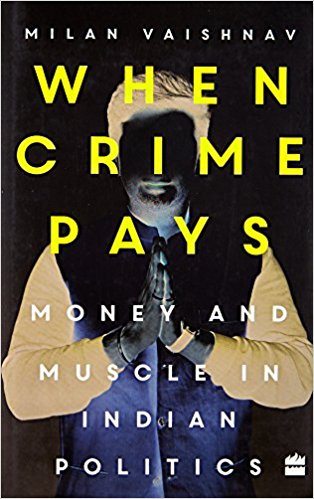
On the face of increasing criminalization of politics, Milan Vaishnav, senior associate at the Carnegie Endowment for International Peace in Washington, DC, book “When Crime Pays: Money and Muscle in Indian Politics” is an eye-opener in terms of understanding the puzzling co-existence of criminality in politics along with the democratic accountability. The author has tried to address the questions of their co-existence since the beginning when they acted as “anti-social elements” to mobilize the voters for their masters(politicians) to becoming the lawmakers themselves.The author has beautifully applied the concept of a market in terms of ‘supply’ and ‘demand’ to understand the “electoral marketplace” where voters play a ‘role of buyers’ and political parties play a ‘role of sellers’. And the most interesting thing is that all these players are guided by their self-interest. Voters want the governance vacuum to be filled, political parties want self-financed candidates and criminal candidates want self-preservation and self-protection.  

The origin of this whole criminality in Indian politics which has deep historical linkages in the post-independence era when these anti-social elements acted as a facilitator to the politicians. However, these elements entered into the political fray due to the breakdown of the Congress party’s patronage networks, vacuum created in the governance process due to the emergency declared by Indira Gandhi in 1975, increasing social demands in terms of ‘identity politics’, the huge ‘crisis of governability’ when Indian state fails to deliver basic services to the citizens. However, the author has provided an important insight into the book,

“Electoral support for the politicians with criminal records is not necessarily symptomatic of a breakdown in democratic accountability. Instead, malfeasant politicians and popular accountability can in fact be compatible to each other”. 

-Excerpt from the book

In fact, this whole idea refuted the concept of “ignorant voter scenario hypothesis”. In fact, the voters are not ignorant or uninformed, they are simply looking for candidates who can best fill a perceived vacuum of representation and protect the status of the community. The author through his various field surveys, as well as interviews of the candidates, provided interesting details of the criminalization of politics in India and what are the causes as well as how it is sustained in the strong society like India. 

The supply of criminal politicians and money power is intertwined to each other as money plays an important role in the election expenditure. This also has historical underpinnings when the corporate donation was banned by the then Prime Minister Indira Gandhi to appear harsh on ‘crony capitalism’ which in turn created the pathway for black money and hard cash to enter into the election financial regime. Not only this, India’s grand corruption in terms of ‘regulatory rents’, ‘extractive rents’ and ‘political rents’ created a linkage and interaction among them created more ground for criminal politicians to emerge. The author has quoted the example of ‘Reddy Brothers‘ in Karnataka, Madhu Koda of Jharkhand, YSR & Jagan Reddy from Andhra Pradesh showing that how they have extracted rents from natural resources taking advantage of severe gaps in India’s governance system. This whole corruption and hard cash create a lot of money power which helps in winning the elections. In fact, as per the analysis provided by the author, candidate’s wealth and electoral success are highly linked, richer is the candidate, more chances of winning. It answers the questions of why political parties select the candidates from the criminal backgrounds.

There is also calculated reasoning on the political parties to select ‘self-financing candidates’ who do not drain the party coffers but can provide rents to the party in the wake of costly elections, increasing competition etc. Criminal Politicians are like “Robinhood- one who robs the rich and gives to the poor” who act as a credible representative in a multi-ethnic society like India. The idea of Robinhood has been a recurring theme of Bollywood movies sometimes inspired by the real characters of Indian politics.  That is why the author has named one of his chapters- doing good by doing bad to address the demand side of criminality. In fact, this shows that these bad politicians use various tools like ‘redistribution’, ‘coercion’, ‘social insurance’ and ‘dispute resolution’ to signal their credibility to protect the interest of their community. This whole politics of dignity rhetoric creates an extensive ground for “defensive criminality” to flourish.

The failure of the state to maintain rule of law, deeper social cleavages and ethnic differences create demand for criminal politicians to protect the interests of their community. The author has also provided an interesting insight in terms of the role of ethnicity in creating push of criminality as it was found that less number of criminal candidates contest from reserved constituencies as compared to general constituencies. The less criminality in reserved constituencies is due to the need of appealing to all section of voters for winning the election.

Ultimately, the conclusion of the author in the book is that the real factor of the emergence of criminality in politics is ‘institutional erosion’ of the Indian state. In fact, the capacity of the Indian state was questioned many times by various authors. Gunnar Myrdal in his book “Asian Drama” called India as a “soft state” because of its failure to implement basic economic and social policies efficiently and effectively. There is also a paradox of “weak strong state” as called by Lloyd and Susanne Rudolph where the Indian State is able to send Mars Mission in its maiden attempt but it is not able to fulfill the basic necessities of its citizens. 

In fact, most of the book related to Indian politics reach this conclusion that we have achieved so much but our ‘institutions’ need radical reform to strengthen the capacity of the state. That is why the author also says, “Downsizing the state” or “enlarging the state” are imperfect catchphrases; what is needed, in a nutshell, is for the Indian state to be “right-sized”. It means that we need a radical restructuring of the institutions like the police, courts, political parties, the election system in terms of funding etc to make it more strongly to perform the role of a strong state who is not mocked when it can do more difficult things but not able to provide basic necessities of the people. 

The author in 311 pages has provided a comprehensive study of the nexus between crime and politics which also has implications for other countries of the world. As the author also wrote about the other countries like Brazil, Mexico and many African countries where similar scenario exists. This book was quoted by the recent Supreme Court Judgement on the criminalization of politics where the Supreme Court has ordered the Parliament to legislate to bar the criminals entering the mainstream politics. It is also the winner of Kamaladevi Chattopadhyaya NIF Book Prize for Best Non-Fiction Book of 2017. 

However, as per my understanding, the book has fallen short in providing concrete solutions to deal with the problem of criminalization of politics. It has provided broad solutions which are already there in the public domain regarding the strengthening the institutions, reforming the whole governance process which is, in fact, an ongoing process. The criminalization of politics is a deep malaise also agreed by author reflects the overall attitude of society in terms of voting behavior guided by narrow interests of self-preservation, development and quick success. We obviously need the restructuring of the institutions along with that there is a need to inculcate good values, ethics, and morality in the society since childhood to make India a better nation because of it’s the people who constitute nation and state. 


One Nation, One Election

election_system

Our constitutional forefathers adopted the parliamentary form of democracy after India became an independent country in 1947. India as a nation of teeming millions has also taken a bold step of adopting universal adult suffrage when experts were debating about India’s survival as a nation. This one ‘right to vote’ given to Indians showed the faith of our constitutional forefathers in the capacity of Indian voters when India was poor third world country with low literacy and abysmal development and growth in the economy. This faith is still visible in India’s election processes, as Indian general election considered as the largest event management exercise on earth during peace times.

The Constitution of India came into force on January 26, 1950. The first general elections to Lok Sabha and State Legislative Assemblies were held simultaneously in 1951-1952. In fact, this practice of simultaneous elections continued till 1967 when due to premature dissolution of State Legislative Assemblies the cycle of the synchronized elections got disrupted. In 1970, the fourth Lok Sabha got dissolved prematurely. And fifth Lok Sabha term was extended till 1977 due to emergency provisions under Article 352 of the Constitution of India.

Since then the dissolution of the Lok Sabha and the State Legislative Assemblies is the order of the day due to the fragmented political system, the emergence of regional parties and indiscriminate use of the power under Article 356 which gives power to the President to declare President’s rule in any state on various grounds. Though after the Supreme Court Judgement in S. R. Bommai vs. Union of India case, the arbitrary use of the Article has come down. The Sixth, Seventh, Ninth, Eleventh, Twelfth and Thirteenth Lok Sabha was dissolved before the end of the term of their respective Lok Sabha. Due to this, the cycle of simultaneous elections got disrupted in the Indian polity for last 48 years.

One nation, one election also known as simultaneous elections mean a restructuring of the Indian election cycle in a manner that the General Elections for the House of people and the Assembly elections for State Legislative Assemblies are conducted simultaneously. In such condition, voters will cast their vote on a single day and at the same time for electing the members of Lok Sabha and State Legislative Assemblies.

Recently, India’s Prime Minister Narendra Modi pitched for the debate to conduct simultaneous elections at various platforms. In fact, the President of India Ram Nath Kovind in his first address to parliament this year advocated for simultaneous elections and remarked that a sustained debate is required on the subject of simultaneous elections. Election Commission, Law Commission of India, NITI Aayog and Parliamentary Standing Committee has favored the conduct of simultaneous elections of the House of the people and the State Assemblies. The analysis from the NITI Aayog report and the discussion conducted on the MyGov website provides enough evidence to conduct simultaneous to improve governance process and reduce the election fatigue in the country.

WHY DO WE NEED SIMULTANEOUS ELECTIONS? 

India is a world’s largest democracy in the world due to its electoral size as well as subcontinental dimensions.  It is the largest peacetime mobilization of the people in the world. Commenting on the size and scale of Indian elections, the Strategic Plan 2016-2025 published by Election commission of India mentions,

“The magnitude and complexity of the Indian election can be estimated from the fact that the Indian elections are not only the largest exercise in logistics in the world but are also considered as one of the most credible elections in the world. India, in fact, accounts for the largest share of electors in any country, exceeding the total number of electors in the entire American continent, or even that of the entire African continent or that of all the European nations put together shows the complexity of election process. However, the independent election commission along with other organizations are doing the humongous job of conducting the election process in free and fair manner. Despite that, Indian election process is fart with a number of challenges. The scope of this paper is to focus on the challenges created by the frequent elections and their overall impact on the polity, economy, and society of the country.

If we take the example of the period March 2014 to May 2016, then as per the Election Commission data, there were 15 State Assembly elections were conducted along with the elections for the 16th Lok Sabha. If we add the elections conducted in the third tier of the Government i.e. the Panchayati Raj Institutions and Municipalities, bye-elections, the number of elections conducted in one year will increase substantially. To manage this situation and reduce the burden on the exchequer, the idea of simultaneous elections was propounded by various political parties as well as the reports of various institutions. 170th Report of the Law Commission of India headed by Justice B. P. Jeevan Reddy, “the holding of a separate election to a Legislative Assembly should be an exception and not the rule. The rule ought to be one election once in five years for Lok Sabha and all the Legislative Assemblies”. In December 2015, the Parliamentary Standing Committee of Department of Personnel, Public Grievances, Law and Justice has also supported the idea and given an alternative of holding the elections in two phases. It stated that elections to some Legislative Assemblies could be held during the midterm of the Lok Sabha and elections to the remaining assemblies could be held with the end of the Lok Sabha term. It has also given recommendations for fixing the schedule of the bye-elections.

NITI Aayog report has analyzed the whole issue extensively and recommended for holding simultaneous elections for the Lok Sabha and the State Legislative Assemblies. The recent India Action Plan- Three Year Action Agenda (2017-2020) also supported the idea of synchronized two-phase elections from the 2024 election to the Lok Sabha.

In fact, Election Commission of India also supported the conduct of simultaneous elections on various platforms. President of India has also supported the idea of simultaneous elections and said, “With some election or the other throughout the year, normal activities of the government come to a standstill because of the code of conduct. This is an idea the political leadership should think of. If political parties collectively think, we can change it… The Election Commission can also put in their idea and efforts on holding the polls together and that will be highly beneficial”. After this debate, Government of India has come out with five questions on the MyGov website to ascertain the views of the public and create a debate and discussion on this idea in public forum. People have aired their views freely in support of conducting simultaneous elections. In fact, they have narrated their ordeals of suffering due to deadlock in administration at the time of elections as well as disturbances of noise pollution, traffic jams etc. on the website. It can be seen as the anecdotal evidence to prove that the substantial number of people are in favor of conducting simultaneous elections.

Therefore, there is need to understand the profound implication of the frequent elections happening in our country. It can be seen on the below points:

  1. Impact on the Political and Administrative functioning of the government: Whenever any elections are conducted in our country, Election Commission enforces the Model Code of Conduct(MCC) to maintain a free and fair environment for the election process. It is imposed from the date of announcement of the election schedule by the Election Commission and is in force till the whole election process is completed. During this period parties in power as well as other political parties are not allowed to announce welfare schemes or development projects throughout India if it is a General Election. In fact, even during the Assembly election, the Central Government can’t take any decision related to that particular state.

The Parliamentary Standing Committee has articulated this problem stating that, “…The imposition of Model Code of Conduct (MCC) puts on hold the entire development program and activities of the Union and State Governments in the poll-bound State. It even affects the normal governance. Frequent elections lead to the imposition of MCC over prolonged periods of time. This often leads to policy paralysis and governance deficit”. If we just take the year of 2014, the governance activities were suspended around 7months. If we assume that number of the average period of operation of Model Code of Conduct as 2 months during the State Assembly elections, the analysis in the below graph shows that at least for four months every year, the government functioning, as well as development works, will be suspended due the imposition of Model Code of Conduct.  

  1. Economic and financial impact of the frequent elections: Fighting elections and conducting elections create huge expenditure not only on the government machinery but also for all the political parties and their candidates. The management and the conduct of the elections create a severe strain on the economic and fiscal budget of the Government of India as well as the various state governments. In fact, this is also the reason behind the generation of black money and corruption. Dr. S. Y. Qureshi in one conference remarked, “…. elections have become the root cause of corruption in the country”. He further mentioned that “…. after winning elections, the politician-bureaucrat nexus indulges in “recovering the investmentand that is where corruption begins”. As per the news report, the expenditure on the General elections 2014 was the highest ever around 3500 cr.  Therefore, conducting simultaneous elections will help in saving the precious tax money and increase the fiscal space which can be used for the development activities.
  2. The social impact of the frequent elections: Frequent elections disrupt the normal life of common citizens as can be ascertained from the responses on the MyGov website. Since normal functioning of the government is on standstill and officials are busy in the management of elections, normal people wait for the completion of the election process to take forward their essential activities. School teachers are deployed for the election duty which impacts the quality and quantity of the education provided to the children. Not only this, frequent elections perpetuate the feeling of casteism, communalism, and religious biases.

Therefore, there is a strong basis and need to synchronize the elections of Lok Sabha and State Legislative Assemblies.

CRITICISM AND COUNTER ARGUMENTS

The idea of simultaneous elections is also criticized by various political parties, constitutional experts as well as various other stakeholders. The key criticism can be seen in the following points:

  • There are various logistic and operational challenges present in conducting the simultaneous elections in India because of its sheer number of electorates and sub-continental size and diversity of Indian polity. It is very difficult to comment on the capacity and capability of institutions which manage the election process in India. If they are still successful in doing it, they will be successful in the coming future. Regarding operational challenges implementing this idea presently, there is need to create consensus among all political parties to debate and come out the feasible proposals and subsequent constitutional amendments.
  • Some think-tanks and experts like Indira Jaisingh are of the view that not all voters are highly educated. They do not know whether they are voting for the Assembly or Parliament. It is not as simple as it seems. Indian voter is very matured and credible which can be seen in the track record of India’s voting pattern since the First General Election. In fact, the voting behavior depends on a range of parameters like incumbency, anti-incumbency, narrative dominance, political leadership, local and regional issues and other factors of caste, religion etc.
  • Another strong criticism is that simultaneous elections would benefit national parties at the cost of state/regional parties in case of a “national wave in favor of large national parties”.This can’t be proved after seeing the General election of 2014 when there was a wave in favor of BJP government, despite that Odisha, Andhra Pradesh and Sikkim voters chose for regional parties in their respective states with more percentage of votes.
  • There is also a criticism that the simultaneous elections will weaken the federal structure in the country between Centre and States. However, it is premature to talk about this because the spirit of federalism has not come from anywhere rather the Constitution of India provides enough grounds for the principle of federalism in the Indian polity.

Successful experiments of Simultaneous Elections

South Africa held elections simultaneously for every five years for national and provincial legislatures and held municipal elections every two years. Sweden also held an election to its national legislature(Riksdag) and provincial legislature(landing) and local bodies(Kommunfullmaktige) on the fixed date on the second Sunday of September every four years. The UK also passed a Fixed Term Parliament Act, 2011 to provide a sense of stability and predictability to the British Parliament and its tenure. It will provide some stability in the electoral process. In fact, the Parliamentary Standing Committee praises this experiment as a novel experiment which needs to be looked on.  In fact, the US election, though it is a presidential system, works in proper fixed term form which creates stability in the functioning of the democracy of their country. There is no doubt these countries have a good track record in their democratic process except some hiccups as well as human development parameters.

Therefore, India should also synchronize the assembly and general elections to make our democratic process more stable and vibrant.

Indian democracy celebrates the festival of elections every year with a number of elections. Elections are the symbol of a vibrant democracy. However, the frequent elections create disturbances not only in the administration and political system but also in the normal life of the people of India.  In fact, in the last 30 years, there has not been a single year without an election in our country. It leads to a number of unavoidable consequences which creates problems for the long-term growth and development of the country. 

In fact, India is on the cusp of change because of its huge demographic dividend[i] in the form of a window of opportunity. The governance processes also need to be transformed radically to satisfy the expectations of the youth in the country. To bring about rapid transformation[ii], India needs to bring about huge structural changes in the economy and public policy of the country. Frequent elections not only impose restrictions on the functioning of the governance process but also saps the energy and risk-taking capabilities of the government. Therefore, it is imperative to evolve a solution to stop these frequent elections cycle and move towards a stable system of simultaneous elections[iii].

[i]https://ritambharachaitanya.wordpress.com/2017/05/31/demographic-dividend-or-demographic-disaster/

[ii] http://www.narendramodi.in/pm-s-speech-on-the-occasion-of-transforming-india-lecture-513478

[iii] https://swarajyamag.com/politics/holding-elections-simultaneously-the-what-why-and-how

References:

Justice B. P. Jeevan Reddy, 1999, ‘170th Report on the reform of Electoral Laws by Law Commission of India’.

Sarkaria Commission Report on Centre-State Relations (1988)

Supreme Court Judgement on S. R. Bomai vs. Union of India (1994)

Justice A. P. Shah, March 2015, ‘255th Report on the Electoral Reforms by Law Commission of India’.

Dr. E. M. Sudarshan Natchippan, December 2016, ‘79th Report on Feasibility of Holding Simultaneous Elections to the House of People (Lok Sabha) and State Legislative Assemblies by the Department related Parliamentary Standing Committee on Personnel, Public Grievances, Law, and Justice.

Bibek Debroy and Kishore Desai, ‘Analysis of Simultaneous Elections: What, Why and How’ by NITI Aayog.

Standing Committee Report Summary by PRS Legislative Research.

‘India Votes- The General Elections 2014’ by the Election Commission of India.

Priyanka Chaturvedi, 2016, ‘Idea good, but is it practical?’, Observer Research Foundation.

Hemant Sarin, 2016, ‘Simultaneous Elections to the Parliament and State Assemblies’, Live law.

Gaurav Vivek Bhatnagar, 2016, ‘Constitutional Experts decry Modi’s call to Simultaneous Polls to Parliament and State Assemblies’, The Wire.

Venkaiah Naidu, 2016, ‘Breaking out of Election Mode’, The Hindu.

Jagdeep S. Chhokar and Sanjay Kumar, 2016, ‘The case against simultaneous polls’, The Hindu.

Kanishka Singh, 2017, ‘Merits and Demerits of simultaneous elections’, The Indian Express.

Dr. S. Y. Qureshi, 2016, ‘Holding Lok Sabha and Assembly polls together are desirable but not feasible’, The Quint.